
Aeneas, Anchises and Ascanius
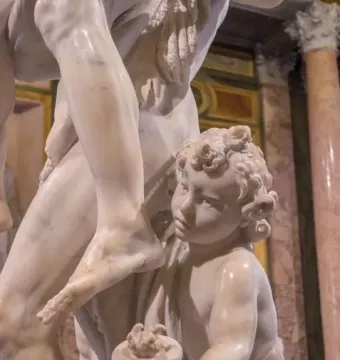
Aeneas, Anchises and Ascanius is a sculpture by Gian Lorenzo Bernini, made when he was twenty years old and now housed in the Galleria Borghese in Rome. The life-sized group depicts a scene from the Aeneid in which Aeneas leads his family from burning Troy. It shows three generations together: Aeneas carries his father Anchises on his shoulder, while his young son Ascanius follows behind. Aeneas is shown with a lion skin draped around his body, emphasizing his divine lineage through Venus. The work is influenced by earlier art, including Michelangelo, Pietro Bernini, Raphael, and Federico Barocci, and it reflects the sculptural style that brought Bernini early recognition in Rome.
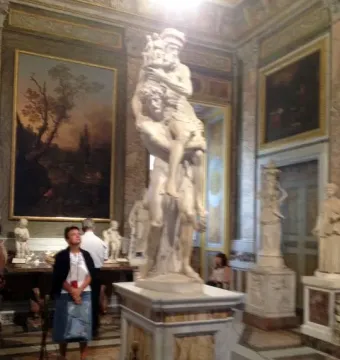
June 2014 © daryl_mitchell · CC BY-SA 2.0
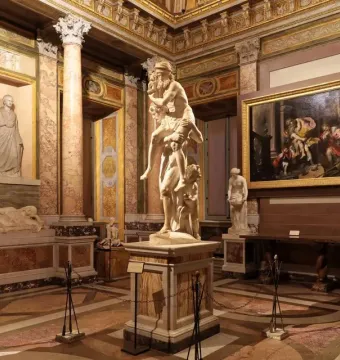
October 2017 © Burkhard Mücke (User:Pimpinellus) · CC BY-SA 4.0
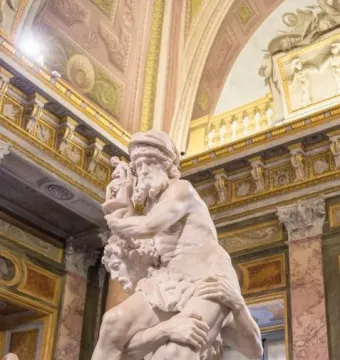
June 2014 © Antoine Taveneaux · CC BY-SA 3.0
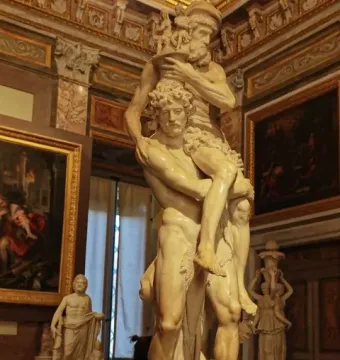
October 2017 © Burkhard Mücke · CC BY-SA 4.0
June 2014 © Antoine Taveneaux · CC BY-SA 3.0
Identification | |
| Title | Aeneas, Anchises and Ascanius |
| Original title in French | Enée, Anchise et Ascagne |
| Original title in Spanish | Eneas, Anquises y Ascanio |
| Type | Sculptural group |
| Style | Italian Baroque |
| Original title in source language | Eneias, Anquise e Ascânio |
Creator | |
| Artist | Gian Lorenzo Bernini |
| Artist nationality | Italian |
Historical context | |
| Date | circa 1618–1619 |
| Artist's age at creation | About 20–22 years old |
| Commissioner | Cardinal Scipione Borghese |
| Commission status | First of four sculptural groups commissioned by Cardinal Scipione Borghese from Bernini |
| Other works in the commission series | The Rape of Proserpina, Apollo and Daphne, and David |
| Historical significance | Bernini's first major work and one of his earliest sculptural groups; it helped establish him as a highly promising sculptor |
Discovery and provenance | |
| Later history | The sculpture was stolen in 1808, moved to Paris during the Napoleonic period, returned to Rome after the Napoleonic Wars, and was later moved from room to room |
| Influences | Influenced by Michelangelo's Risen Christ and Christ with the Cross, Pietro Bernini's John the Baptist and Saint Matthew with Angel, Raphael's Fire in the Borgo, Federico Barocci's Flight of Aeneas, Caravaggio's Saint Jerome, Domenichino's Last Communion of Saint Jerome, and Michelangelo's Tondo Doni |
| Artist's stated inspiration | Bernini said he was inspired by the Borghese Gladiator |
| Date at original display location | From October 1619 |
| Original display location | Villa of Scipione Borghese outside Porta Pinciana, Rome |
| Possible collaborator | Pietro Bernini, Bernini's father, is often thought to have assisted; some accounts say he handled the first stage and overall composition, though documentary evidence later confirmed Gian Lorenzo Bernini's authorship |
| Patronage context | Bernini was gaining renown in Rome through his father and minor commissions when the work attracted Scipione Borghese |
| Attribution history | Early attribution and dating were disputed; Domenico Bernini dated it to 1613 and later scholars revised it to circa 1618–1619 on the basis of a 1619 payment note for the pedestal |
Location and ownership | |
| Current location | Hall of the Gladiator, Galleria Borghese, Rome |
| Current display status | Currently exhibited |
Physical characteristics | |
| Scale | Life-sized group |
| Base | Current marble base installed in 1909 by Pietro Fortunati; the original support had festoons and architectural ornaments and was later replaced by a wooden support |
| Material | Marble |
| Number of figures | Three |
Appearance | |
| Stylistic qualities | Great realism, simplicity, dramatic emotional expression, and strong psychological dynamism |
| Technical qualities | Shows Bernini's growing mastery of marble, including distinct textures for the soft skin of Ascanius, the taut skin of Aeneas, and the wrinkled skin of Anchises |
| Composition | Ascending, spiral-shaped composition |
Iconography and meaning | |
| Subject | Aeneas leads Anchises and Ascanius out of burning Troy, taken from Book II of Virgil's Aeneid |
| Alternative names | Roman Piety; Dear Burden |
| Depicted roles | Aeneas carries his elderly father Anchises on his shoulders while Ascanius follows with the sacred fire from the Temple of Vesta |
| Attributes | Anchises carries a vessel containing the ashes of the ancestors; the vessel is topped with two small statuettes of the Di Penates, Roman household gods |
| Iconography | Aeneas' divine lineage is emphasized by the lion skin draped around his body; the lion skin traditionally signifies power and is often associated with Hercules |
| Meaning | The sculpture presents the three ages of man—childhood, maturity, and old age—and the transition of responsibility from father to son |
| Meaning | It also evokes the tragedy of human life, inevitable decay, and the founding of a new Roman civilization after Troy's destruction |
| Depicted figures | Aeneas, Anchises, and Ascanius |
Significance | |
| Art-historical significance | Seen as part of the transition from Mannerist sculpture toward Baroque style and as a manifesto of bodily movement and technical mastery |
| Critical reception | Contemporaries and later scholars were astonished by the work; opinions remain divided, ranging from restrained praise to enthusiastic acclaim |