
Pietà
Pietà, also known as Sexta Angustia, is a Baroque sculpture by Gregorio Fernández created between 1616 and 1619. It is housed in the National Museum of Sculpture in Valladolid, Spain. The work was commissioned by the Illustrious Penitential Brotherhood of Our Lady of Anguish and is one of the best known of the artist’s five sculptures on the same theme. The sculpture depicts the Virgin Mary holding up one hand as Christ’s lifeless body slumps to the floor by her feet. It was originally part of a paso carried in religious processions during Holy Week, along with figures of the good thief, the impenitent thief, Saint John, and the Virgin Mary.
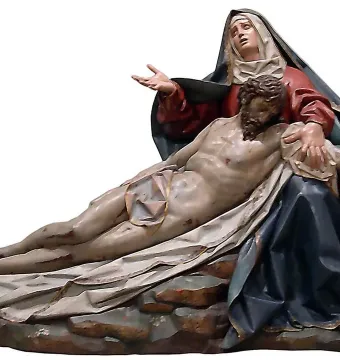
December 2006 © Locutus Borg · Public domain
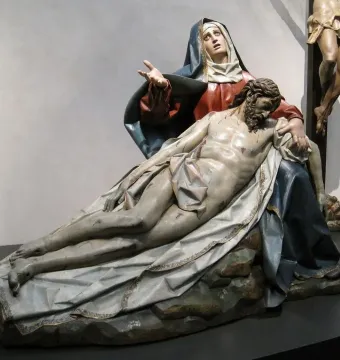
May 2010 © Rodelar · CC BY-SA 3.0
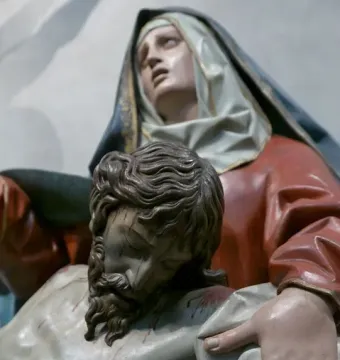
January 2018 © José Luis Filpo Cabana · CC BY-SA 4.0
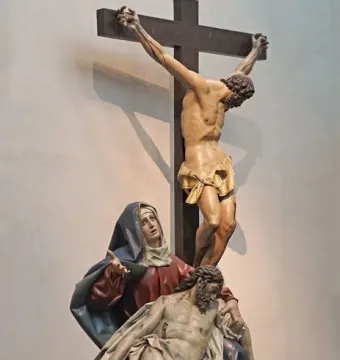
July 2014 © Luis Fernández García · CC BY-SA 4.0
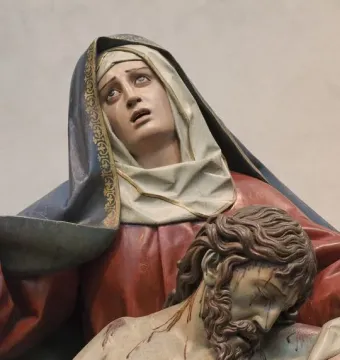
July 2014 © Luis Fernández García · CC BY-SA 4.0
Identification | |
| Title | Pietà or Sexta Angustia |
| Alternative title | La Sexta Angustia de pinchopollo |
| Alternative title | La Piedad |
| Alternative title | Pieda |
| Alternative title | The Sixth Anguish |
| Type | Baroque sculpture |
| Type | sculptural ensemble |
| Type | Processional sculpture group / paso procesional |
| Alternative title | Sexta Angustia |
Historical context | |
| Date created | 1616 |
| Date | circa 1616 |
| Delivery date | 22 March 1617 |
Creator | |
| Artist | Gregorio Fernández |
| Commissioned by | Illustrious Penitential Brotherhood of Our Lady of Anguish |
| Destination cofradía | Ilustre Cofradía Penitencial de Nuestra Señora de las Angustias de Valladolid |
Discovery and provenance | |
| Polychromy payment | 60 reales were paid to Marcelo Martínez for polychromy |
| Historical source on attribution/analysis | Ricardo de Orueta is cited in the text regarding the work's characteristics |
| First recorded description | Manuel Canesi Acevedo described the work in reference to the procession of the Angustias on Holy Thursday in 1750 |
| Eyes payment | Hervás García was paid to make the glass eyes of the images |
| Gilding payment | A payment was made for gold acquired to gild the hair of Christ, Saint John, and Mary Magdalene |
| Assembly materials payment | A payment was made for nerves or cords used to glue the wooden joints |
| Transport payment | 28 reales were paid for the men who transported the sculptural group in 1617 from Fernández's home to the church for which it was intended |
| Documentation source | Payment records are preserved in the cofradía's account books, published by historian Esteban García Chico in 1941 |
| Documentation status of commission | No documents relating to the commission are preserved |
Physical characteristics | |
| Composition | A sculptural group representing Christ in the lap of Mary, accompanied by the two thieves, Saint John, and Mary Magdalene |
| Original composition | The Virgin and Christ were with the two thieves Dismas and Gestas, plus Saint John and Mary Magdalene |
| Current composition status | Saint John and Mary Magdalene are preserved in the cofradía and no longer appear with the rest of the group |
| Support material / filling technique | Defects in the carvings are covered with embolado, a mixture of plaster and cloth |
Materials | |
| Material | Polychromed wood |
| Eyes | Glass |
| Fingernails | Horn |
| Teeth | Bone |
Technique | |
| Polychromy | Painted by Marcelo Martínez in 1617 |
Appearance | |
| Bad Thief description | Marked tension, tousled hair, furrowed brow, open mouth, tongue out, face turned away, and two cuts on the left leg |
| Mary Magdalene attire and attributes | Brown tunic tied with a ribbon, green mantle, sash across the chest, holding a chalice in her right hand and a handkerchief in her left |
| Saint John attire and attributes | Red tunic, dark green mantle, holding the crown of thorns in his right hand |
| Christ's colors | Muted tones, with red blood standing out |
| Good Thief description | Short, orderly hair; head and body slightly inclined toward Christ; white loincloth with red stripes |
| Virgin's colors | Red tunic, blue mantle, and a white cloth covering her head |
| Christ's wounds | Blood on the forehead, hands, feet, knees, and legs |
Iconography and meaning | |
| Subject | Pietà / the sorrowful Virgin Mary holding Christ after the Descent from the Cross |
| Iconographic interpretation | Mary looks up to the sky with a slight expression of disapproval or reproach, emphasized by her raised right hand |
| Iconographic interpretation | Christ seems to be slipping from Mary's lap, with his lower body resting on the rock base while Mary grips him firmly with her left hand |
| Deviation from traditional Pietà composition | The work breaks the typical pyramidal structure associated with Michelangelo's Pietà |
| Stylistic feature | Deep angular folds in the drapery and marked naturalism, especially in Christ's body, where bones and muscles are visible |
| Mary's drapery treatment | Her robes have deep modeling that creates a strong chiaroscuro effect |
| Flamish influence | The rigid, slightly stiff drapery folds show clear Flemish influence |
| Hypothesized arrangement of figures | The two thieves were at the same height; Saint John was on the right and Mary Magdalene on the left; Saint John looked toward the cross and Mary Magdalene contemplated the Virgin holding her son's body |
Location and ownership | |
| Viewing location in Antonio Ponz's time | The Chapel of La Piedad, beside the head of the church, on the Gospel side |
| Later placement of two figures | Saint John and Mary Magdalene were in two side niches in the Chapel of the Virgin of Angustias, inaugurated in 1710 |
| Since when in current location | Since the mid-19th century |
| Current location | National Sculpture Museum of Valladolid |
| Current location | National Sculpture Museum, Valladolid, Spain |
History and restoration | |
| Hypothesis by Luis Luna Moreno | In 1986, museum conservator Luis Luna Moreno proposed that originally the Virgin and Christ were placed between the two thieves in the processional step |
| Mary Magdalene attribution | Attributed to Fernández by architect Juan Agapito y Revilla |
| Saint John attribution | Attributed to Fernández by architect Juan Agapito y Revilla |
| Reattribution of the thieves | Historian Isidoro Bosarte assigned them to Fernández in 1804 |
| Traditional attribution of the thieves | The thieves were traditionally attributed to Pompeo Leoni |
| New processional elements from 2007 | Since 2007, the figures of the two thieves have processed together with the bare cross of Christ |
| Reason the rest of the images did not process | The Cofradía de la Piedad already possessed a sculpture representing the same scene |
| Post-restoration procession use | After the 1991 restoration, Saint John and Mary Magdalene returned to procession, but the rest of the images did not, by order of the Archdiocese |
| Restoration date | 1991 |
| Processional use ended | The group ceased going out in procession in 1924 because it had deteriorated |
| Procession mention | The new chapter book of the cofradía records processions in 1620, 1623, and 1625, where the work is called the paso of the Descent (El Descendimiento) |
| Liturgical/processional use | Part of a paso that paraded in religious processions during Holy Week |
Significance | |
| Number of sculptures of the same theme by the artist | One of five |
| Significance | One of Fernández's best-known Pietàs |
Other | |
| Associated figures in the procession | The good thief, the impenitent thief, Saint John, and the Virgin Mary |