
Truth Unveiled by Time
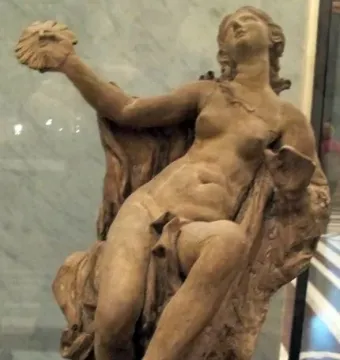
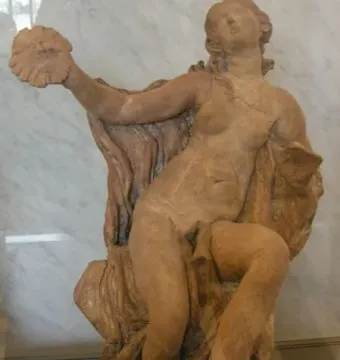
Truth Unveiled by Time is a marble sculpture by the Italian artist Gian Lorenzo Bernini, created between 1646 and 1652. It presents truth as a naked woman being stripped by a figure above her meant to represent Time, though that figure was never completed. Bernini began designing the work in 1645 during the difficult period after the death of his patron Pope Urban VIII. According to his son Domenico, the sculpture may have been intended as a response to criticism over Bernini’s role in the failed construction of two towers near St. Peter’s Basilica. The work was later left to Bernini’s eldest son, remained in the family until 1924, and is now in Room VIII of the Galleria Borghese.
© Sailko · CC BY 3.0
· CC BY 2.5
© Bernini, Gian Lorenzo, 1598-1680 · Public domain
Identification | |
| Title | Truth Unveiled by Time |
| Alternative title | La Verità |
| Type | Marble sculpture |
| Original title | La Verità svelata dal Tempo |
Historical context | |
| Possible motivation | According to Bernini's son Domenico, it was made in response to criticism of Bernini over the failed project to build two towers on the front of St. Peter's Basilica; historians are uncertain whether this is true |
| Related event | Bernini saw the bell tower he had built for St. Peter's Basilica torn down because of stability problems |
| Attribution of blame in controversy | The blame was said to fall mainly on Carlo Maderno and Pope Urban VIII, though the historical account is disputed |
| Related controversy | The failed project to add two towers to the front of St. Peter's Basilica caused cracks in the facade because the foundations could not support them |
| Context of creation | Created after the death of Pope Urban VIII, when Bernini had fallen from favor and the papal court turned against his legacy |
| Date of creation | 1645–1652 |
| Style | Italian Baroque |
Creator | |
| Artist significance | one of the foremost sculptors of the Italian Baroque |
| Artist nationality | Italian |
| Artist | Gian Lorenzo Bernini |
Physical characteristics | |
| Scale | Larger than life-size |
Materials | |
| Material | Marble |
Iconography and meaning | |
| Subject | Truth allegorically represented as a nude young woman being unveiled by Time |
| Additional motif | Truth holds a sun as a symbol of discovered truth |
| Status of Time figure | Intended but never executed |
| Iconographic source | Cesare Ripa's Iconologia |
Creation process | |
| Intended completion of Time figure | By 1665 |
| Commission status | Created without commission |
| Status | Incomplete |
| Design began | 1645 |
| Time figure | Never begun |
| Truth figure completed | 1652 |
| Sculpting began | 1647 |
Discovery and provenance | |
| Acquisition by the Italian government | 1958 |
| Location until 1924 | Palazzo Bernini on Via del Corso, Rome |
| Later storage | Stored in a warehouse of the Galleria Borghese after 1924 |
| Acquisition by the Italian government | 1924 |
| Original location after completion | Bernini's house on Via della Mercede, Rome |
| Relocation in 1852 | Transferred to Palazzo Bernini on Via del Corso, Rome |
| Bequest | Bernini left the sculpture in perpetuity to the first-born of his family |
| Attempted sale | Bernini tried to sell the work to Cardinal Mazarin |
| First display | Left at the door of Bernini's house |
| Family ownership period | Kept by the Bernini family until 1924 |
Location and ownership | |
| Current location | Room VI, Galleria Borghese, Rome |
History and restoration | |
| Original display | Displayed in a more vertical position on a tilted stucco block or plinth |
| Restoration | Recently restored |
| Current mounting | Now on a flat plinth |
| Display effect after restoration | More upright, as originally displayed |
| Condition during family ownership | Its base or plinth was tilted while it remained with the Bernini family |
Appearance | |
| Expression | Gazing upward with an expression of peace, comfort, and perhaps joy |
| Surface appearance | The marble is worked to resemble supple flesh |
| Effect | Dramatic movement, emotion, and vigor |
| Pose | Seated on a boulder or rock |
| Drapery | Flowing drapery and veils partly cover her, with her groin covered and her chest and stomach visible |
| Attributes | Right hand holds the sun; left foot rests on the earth or a globe |
| Depicted figure | Truth as a young woman |
Technique | |
| Technical praise | According to Baldinucci, the chisel seems to have worked the marble as if it were wax |
Other | |
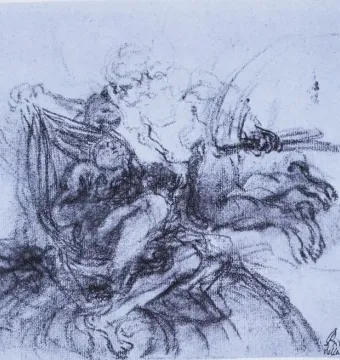
| Related drawings | Numerous autograph drawings are known |
| Stylistic connection | The figure of Truth shows links with Correggio's unfinished Allegory of Virtue |
| Correggio identification | Antonio Allegri |
| Correggio work location | Galleria Doria Pamphilj, Rome |
| Correggio work status | Unfinished |
| Bernini's interpretation in will | He wrote that his descendants should remember that truth is the most beautiful virtue in the world insofar as it is ultimately revealed by Time |