
Saint Peter: History of Its Creation
Saint Peter is one of four marble statues created by Michelangelo Buonarroti around 1501–1504 for the Piccolomini altar in Siena Cathedral. It was part of a contract for fifteen figures commissioned by Cardinal Francesco Piccolomini to decorate the Piccolomini Chapel in the cathedral. By 1504, four altar statues had been completed: Saint Paul, Saint Pius I, Saint Gregory I, and Saint Peter. The sculpture, like Saint Paul, is shown in motion, a feature that would later become characteristic of Michelangelo’s work. The source text also notes that scholars have questioned how much interest Michelangelo took in these works and how much of the larger project he may have completed himself.
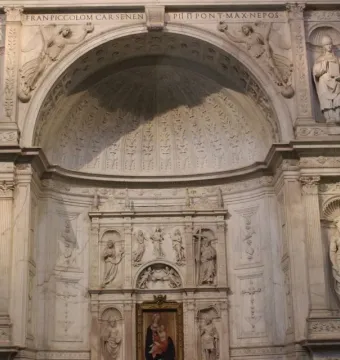
July 2015 © Miguel Hermoso Cuesta · CC BY-SA 4.0
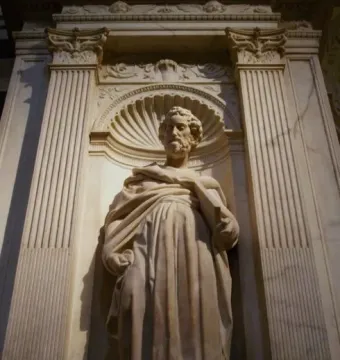
February 2011 © Joanbanjo · CC BY-SA 3.0
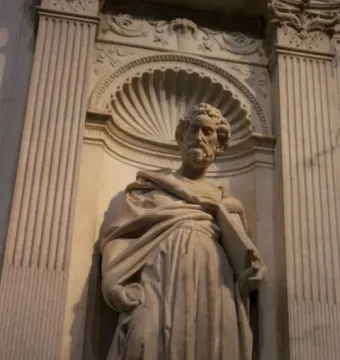
July 2015 © Miguel Hermoso Cuesta · CC BY-SA 4.0
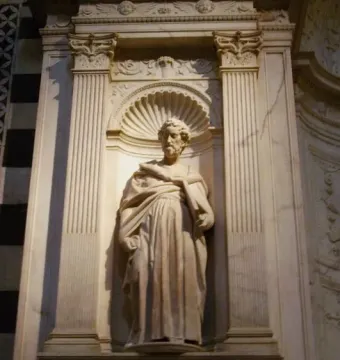
February 2011 © Joanbanjo · CC BY-SA 3.0
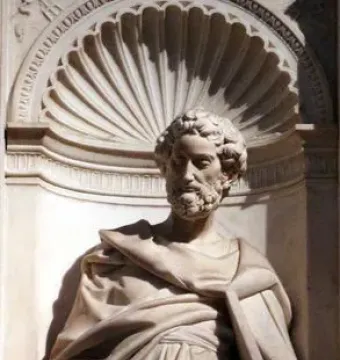
© Sailko · CC BY 3.0
Identification | |
| Title | Saint Peter |
| Number in group | One of four marble statues for the Piccolomini altar |
| Original title | San Pietro |
| Type | Marble statue |
Creator | |
| Artist nationality | Italian |
| Artist period | Renaissance |
| Artist | Michelangelo Buonarroti |
Historical context | |
| Work period | 1501–1504 |
| Historical context | Michelangelo was already on the path to fame and moving toward larger projects, including the David, while working on this commission |
| Previous artist's contribution | He left after carving only one statue |
| Previous assigned artist | Pietro Torrigiani |
| Use of assistants | A massive use of assistants |
| Production pace | About one statue per year |
| Completion deadline | Three years |
| Payment | 500 ducats |
| Commission purpose | To decorate the Piccolomini Chapel altar in Siena Cathedral |
| Commissioned by | Cardinal Francesco Piccolomini |
| Commission year | 1501 |
| Creation date | c. 1501–1504 |
| Commission size | 15 statues |
Discovery and provenance | |
| Current placement | Within the Piccolomini altar complex, on the lower tier at the left, in one of the altar niches |
| Related planned burial | Pope Pius III originally planned to be buried in front of it, but later chose Saint Peter's Basilica in Rome |
| Delivery | Michelangelo sent the statues from Florence |
| Current location | Cathedral of Santa Maria Assunta, Siena, Italy |
| Intended location | The Piccolomini altar in the Piccolomini Chapel in Siena Cathedral |
| Place of work | Florence |
Physical characteristics | |
| Height | 124 cm |
Materials | |
| Material | Marble |
Appearance | |
| Relative scale | More modest than the artist's earlier works |
| Spatial constraint | Designed for a rather narrow niche |
| Physical features | Short curly hair and a beard |
| Attributes | A book in the left hand; the right hand supports the folds of the cloak |
| Clothing | A wide mantle with broad, heavy drapery in a wet style |
| Gaze | Looking downward to the left, as if seeking the viewer's gaze and checking where to step |
| Pose | Contrapposto, shown in motion as if about to step forward |
| Depicted figure | Saint Peter, the Apostle |
Iconography and meaning | |
| Related sculpture | Saint Paul |
| Artistic sources | The drapery is derived from Andrea del Verrocchio; the pose is derived from Donatello, including his studies on adjusting figures according to their position |
Significance | |
| Artistic significance | This dynamic pose became characteristic of Michelangelo's work |
| Scholarly reception | Howard Hibbard considered Michelangelo uninterested in the commission; Lawrence Jenkens described it as a fairly large commission for its time but underexamined by art historians |
| Early sources | Neither Vasari nor Condivi mention these works by Michelangelo |
Other | |
| Authorship note | According to Symonds, Michelangelo may have completed Saint Francis after Pietro Torrigiano, but the extent of his contribution to the other fourteen sculptures is difficult to determine; Symonds did not consider the question important |