
Aztec Sun Stone
Aztec Sun Stone, also called the Aztec Calendar or Sun of the Aztecs, is a monumental monolithic disc of olivine basalt carved with inscriptions referring to Mexica cosmology, solar cults, and calendrical systems. It measures 3.65 m in diameter, 122 cm thick, and weighs more than 24 tonnes. The stone describes the movement of the stars and cycles in which months last twenty days, years eighteen months, and centuries fifty-two years. Although its original color has faded over time and the central face is damaged by multiple bullet impacts, its condition is considered stable. Historical accounts attribute its creation to 1479 under Axayácatl, when the block was extracted and carved by large numbers of people under the direction of an artist named Técpal.
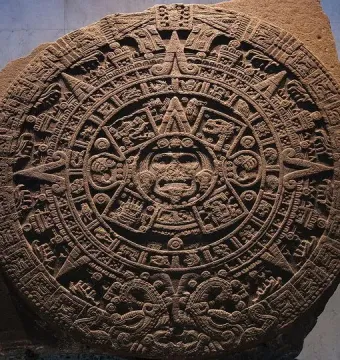
February 2012 © Sasha Isachenko · CC BY-SA 3.0
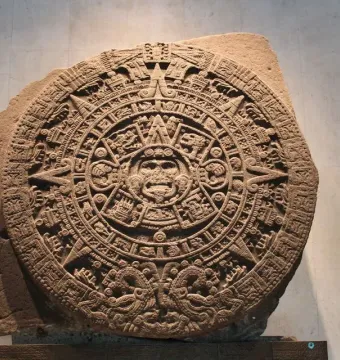
April 2015 © Arian Zwegers · CC BY 2.0
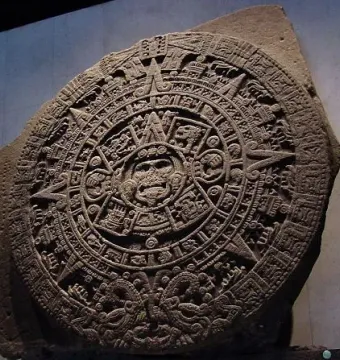
© SeRgioo · Public domain
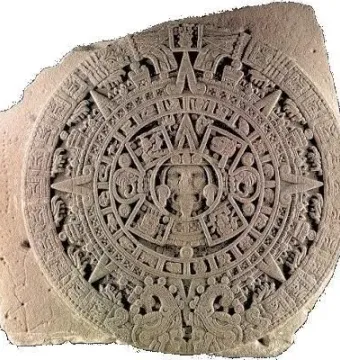
© Ceridwen · Public domain
December 2014 © ProtoplasmaKid · CC BY-SA 4.0
Identification | |
| Title | Aztec Sun Stone |
| Type | Monolithic carved disk |
| Culture | Mexica (Aztec) |
| Original Spanish name | Piedra del Sol |
| Misnomer | Often incorrectly called the Aztec calendar stone, or simply the Aztec calendar |
| Also known as | Stone of the Sun; Sun Stone; Ollin Tonatiuh; Piedra del Sol; Pierre du Soleil; Reloj de Montezuma |
Historical context | |
| Period | Late Postclassic period; late imperial Aztec period |
| Date of creation | Unknown; possibly carved between 1479 and 1521, with some sources suggesting 1479 or 1512 |
Creator | |
| Authorship | Unknown |
| Suggested commissioner | Axayácatl or Moctezuma II (Motecuhzoma Xocoyotzin) |
| Supervising artist | Técpal (apparently) |
Discovery and provenance | |
| Historical reference source | Hernando Alvarado Tezozomoc in Crónica Mexicáyotl; Diego Durán; Juan de Torquemada |
| Finder/reporting official | José Damián Ortiz de Castro |
| Discovery context | Found during land-leveling, paving, repairs, or other urban construction work |
| Discovery location | Mexico City, in the Plaza Mayor / Zócalo area, near the Metropolitan Cathedral and viceregal palace |
| Discovery date | 17 December 1790 |
| Transport method | Dragged by large groups of people using ropes and carts, according to post-colonial accounts |
| Stone source | Olivine basalt from the Xitle volcano, possibly obtained from San Ángel or Xochimilco |
| Original location | Mexico-Tenochtitlan, probably the sacred precinct near the Temple Mayor; exact original placement is unknown |
| Transport distance | About 12–22 kilometers to the center of Mexico-Tenochtitlan |
Physical characteristics | |
| Shape | Large monolithic disk / monolith |
| Diameter | About 3.6 m |
| Thickness | 1.22 m |
| Weight | About 24–24.6 tonnes |
Materials | |
| Material | Olivine basalt |
Technique | |
| Carving tools | Hard flint tools |
Appearance | |
| Completion status | Possibly unfinished because of a deep crack |
| Coloration | Formerly colored, but the color was gradually lost through weather exposure |
| Damage | Multiple bullet impacts in the central area have deformed the central face |
Iconography and meaning | |
| Inscriptions and imagery | References to days, weeks, months, years, eras, and calendrical cycles; pictographic ideas about time; movements of the stars |
| Calendrical cycles described | Twenty-day months, eighteen-month years, and 52-year cycles |
| Central imagery | Tonatiuh, the Sun god, with the name glyph of Moctezuma II in the central disc |
| Side symbols | Symbols of the four previous eras |
| Meaning of name | "Movement of Tonatiuh" or "Revolution of the Sun" |
| Interpretation of name | Some scholars say it suggests geocentric views |
| Alternative function interpretation | Possibly a cuauhxicalli or temalácatl, perhaps used in connection with the Tlacaxipehualiztli festival; this interpretation is speculative |
| Primary function according to inscriptions | The count of days, eras, and calendrical aspects |
| Cultural significance | Summarizes cosmological and chronological conceptions of the ancient Mexica; often regarded as one of the most famous works of Aztec art |
| Depicted subject | Aztec cosmology and solar cult |
Location and ownership | |
| Current location | National Museum of Anthropology, Mexico City |
| Current display area | Mexica Hall |
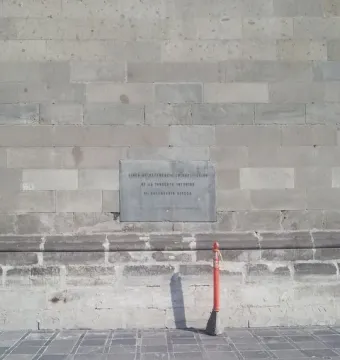
| Post-rediscovery display | Placed beside the west tower of the Metropolitan Cathedral on 2 July 1791, where it remained on the cathedral exterior until 1885 |
| Museum transfers | Transferred in August 1885 to the National Museum of Mexico on Moneda Street; later moved in 1964 to the National Museum of Anthropology, Mexico City |
| Post-conquest location | Moved outside the Templo Mayor / west of the viceregal palace and Acequia Real, then buried nearby by order of Archbishop Alonso de Montúfar |
History and restoration | |
| Rediscovery context | Rediscovered by chance during public works in 1790 |
| Rediscovery and first study | Antonio de León y Gama observed and studied it after rediscovery; he argued for preserving it for its artistic and antiquarian value |
| Public name after rediscovery | León y Gama is said to have given it the name Aztec Calendar; Alfredo Chavero later used the names Sun Stone and Piedra del Sol |
| Exposure and damage after rediscovery | It suffered weathering, depredations, profanations, and later target practice by U.S. soldiers during the Mexican–American War; Mexican sources alleged this, but no evidence of the bullet damage claim is known |
| Museum history | Moved to the National Museum of Mexico in 1885, displayed in the monolith gallery, and later transferred to the National Museum of Anthropology in 1964 |
| Public reaction to museum transfer | Its removal from public urban display caused popular animosity |
| Documentation and study | Observed by Alexander von Humboldt; later studied by Humboldt and others; photographed and artistically reproduced by various visitors and artists |
Significance | |
| Notability | Perhaps the most famous and emblematic work of Aztec sculpture |
| Comparative status | Once thought to be the largest known Mexica monolith until the discovery of the Tlaltecuhtli monolith |