
Grave Stele of Hegeso
The Grave Stele of Hegeso is an ancient Greek High Classical relief from Athens, carved from Pentelic marble in the late 5th century BC, probably between 410 and 400 BC. Found in situ in the Koroibos grave precinct on the Kerameikos during excavations in 1870, it is one of the best-known works of its kind. The stele is designed as a naiskos with two pilasters and a pediment, and shows Hegeso seated on a klismos while a servant presents her with a jewelry box. The original is now in the National Archaeological Museum in Athens, while a modern copy stands at the Kerameikos site.
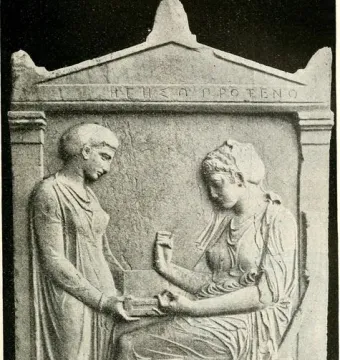
1897 © Internet Archive Book Images · No restrictions
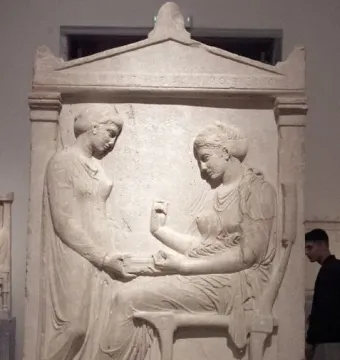
February 2020 © Paolo Villa · CC BY-SA 4.0
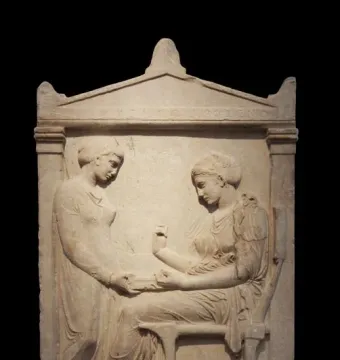
July 2011 © Vicenç Valcárcel Pérez · CC BY-SA 4.0
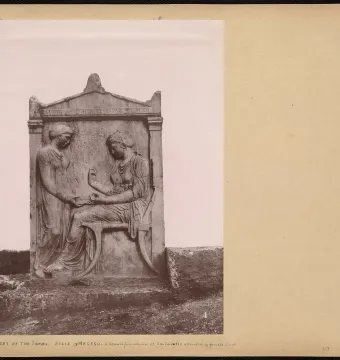
© Boston Public Library · Public domain
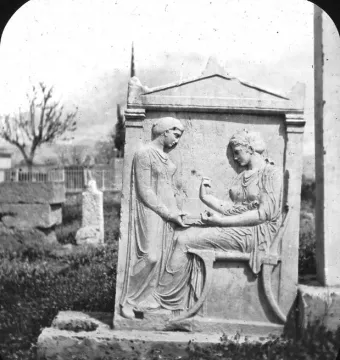
© Brooklyn Museum · No restrictions
Identification | |
| Title | Grave Stele of Hegeso |
| Type | Attic grave stele; ancient Greek relief funerary sculpture |
| Original-language name | Stela Hegeso; La stèle funéraire d'Hègèsô (ou Hégéso) |
Historical context | |
| Date | c. 410–400 BC |
| Art historical period | High Classical period |
| Historical period | Classical Athenian funerary monument; early Classical to late 5th-century BC context |
| Date basis | Pre-Euclidean genitive of the inscription, letter forms, and stylistic dating |
Creator | |
| Attribution | Attributed to Callimachus, or possibly one of his pupils |
Discovery and provenance | |
| Origin | Athens, Greece |
| Discovery location | Kerameikos cemetery, Athens; grave precinct of Koroibos on the Kerameikos |
| Discovery date | 1870 |
| Find circumstances | Found in situ during excavations by the Archaeological Society under Athanasios S. Rhousopoulos |
| Associated grave monument group | One of three grave monuments in the Koroibos grave precinct |
| Position within group | Found to the left of the palmette stele / stele of Koroibos of Melite |
Location and ownership | |
| On-site copy | A modern copy stands at the Kerameikos in Athens in the original limestone base |
| Current display at findspot | A copy is displayed at the Kerameikos cemetery in Athens |
| Current location | National Archaeological Museum, Athens |
| Museum gallery | Room 18 |
| Museum inventory number | NAMA 3624 |
Physical characteristics | |
| Dimensions | Height 1.56 m; width 0.97 m |
| Form | Naiskos-shaped stele with two side pilasters and a pediment |
| Architectural framing | Pilasters and a pediment with palmette acroteria and additional floral acroteria |
| Base | Original limestone base; heavily broken in the original stele |
Materials | |
| Material | Pentelic marble |
Technique | |
| Polychromy | Originally painted; traces of blue paint survive in the background |
Appearance | |
| Preserved paint traces | Blue paint survives in the background |
| Condition | Almost intact; only slight edge chips and slight damage to Hegeso's head, with the plinth/base mostly broken |
| Servant clothing | Long-sleeved garment or tunic, described as 'barbarian' dress; closed shoes; hair covered by a cap, headband, or sakkos/snood |
| Servant action | She extends or presents an angular jewelry box / pyxis to Hegeso |
| Hegeso's hairstyle and headgear | Hair gathered back and covered by a sakkos or snood; described elsewhere as a transparent head ornament or hairnet arrangement |
| Servant figure | A smaller maidservant or slave standing before Hegeso |
| Hegeso's footwear | Sandals with painted straps |
| Hegeso's clothing | Chiton and himation |
| Hegeso | A mature Athenian woman seated with her feet on a footstool, looking at jewelry in her right hand |
| Main scene | Hegeso seated on a klismos chair, with a maidservant presenting a pyxis |
| Object held by Hegeso | A pyxis with the lid open in her left hand; a piece of jewelry in her right hand, now missing |
Iconography and meaning | |
| Funerary meaning | The monument probably also represents the other deceased women of the family buried there |
| Interpretation of footstool | The elaborate footstool may signal rank |
| Symbolic meaning | The composition has been read as expressing domestic ideals, female status, ancestor worship, household virtues, and the values of the oikos and polis |
| Interpretation of clothing and hairstyle | Hegeso's attire and hairstyle emphasize youthful beauty and sexuality, while the maidservant's simpler dress and hairstyle signal status and freedom |
| Alternative interpretation | The scene may also metaphorically represent a visit to the grave or gifts brought to the deceased |
| Subject interpretation | A domestic scene of a woman adorning herself, showing the interaction between mistress and servant |
| Subject | Hegeso and her maidservant |
| Inscription meaning | Identifies the deceased as Hegeso, daughter of Proxenos/Proxenios; the reading may also be taken as Hegeso, wife or daughter of Proxenos |
| Inscription | ΗΓΗΣΩ ΠΡΟΞΕΝΟ |
History and restoration | |
| Condition and restoration | Restored around the edges |
Significance | |
| Reputation | One of the finest surviving Attic grave stelae; one of the most beautiful examples of Greek funerary art |
| Notable reception | Became highly famous in the 19th century for Hegeso's expression, grace, and preservation |
| Literary reception | Mentioned by Marcel Proust and interpreted by Kostis Palamas, Vera Lachmann, and Babits Mihály |
| Replicas | Many copies exist in archaeological teaching collections worldwide |
| Scholarly interest | Frequently discussed for what it suggests about gendered virtues and the social role of women on Greek gravestones |
Other | |
| Associated law and context | Related scholarship connects the monument to Pericles' citizenship law and the growing importance of women's marriage, child-bearing, and family ties from 450 BCE onward |
| Associated family | Family of Koroibos of Melite |
| Associated concepts | Oikos; polis |