
Bust of Thomas Baker
Bust of Thomas Baker is a 1638 marble portrait sculpture created by the Italian artist Gian Lorenzo Bernini, with much of the bust probably executed by one of his pupils, likely Andrea Bolgi. It depicts Thomas Baker, who lived from 1606 to 1658 and was High Sheriff of Suffolk, with connections to the court of Charles I of England. The sculpture is now in the Victoria and Albert Museum in London, United Kingdom, which purchased it in 1921 for 1,485 guineas. The source also notes a possible indirect connection between Baker and another Bernini bust through the triple portrait of Charles I by Van Dyck.
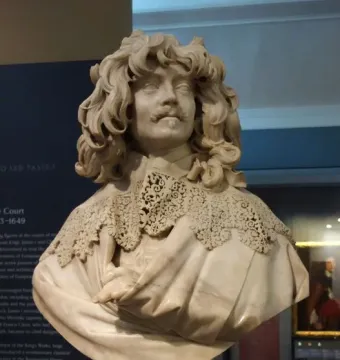
© Daderot · CC0
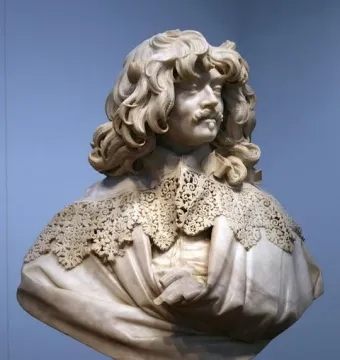
June 2013 © Jean-Pol GRANDMONT · CC BY-SA 3.0
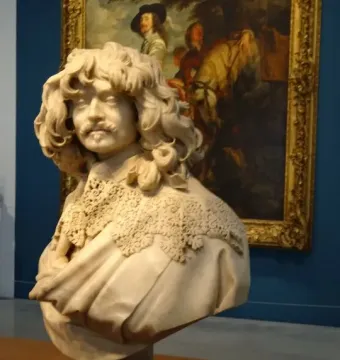
May 2013 © Jérémy-Günther-Heinz Jähnick · GFDL 1.2
Identification | |
| Title | Bust of Thomas Baker |
| Type | Portrait bust sculpture |
| Original-language title | Busto de Thomas Baker |
Historical context | |
| Decade | 1630s |
| Commission type | Private commission |
| Century | 17th century |
| Date created | 1638 |
Creator | |
| Artist | Gian Lorenzo Bernini |
| Assistant / collaborator | A pupil of Bernini, probably Andrea Bolgi |
| Extent of assistant's contribution | Most of the work was carried out by Bernini's assistant |
Discovery and provenance | |
| Commission type | Private commission |
| Acquisition by museum | Bought by the Victoria and Albert Museum in 1921 |
| Purchase price | 1,480 English guineas |
Physical characteristics | |
| Material | Marble |
| Medium | Portrait sculpture |
Iconography and meaning | |
| Subject depicted | Thomas Baker |
| Subject's role | High Sheriff of Suffolk in 1657 |
| Subject's connection to Charles I | Closely linked to the court of Charles I |
| Possible historical connection | Thomas Baker may have brought the triple portrait of Charles I to Rome, which Bernini used as the model for his bust of Charles I |
| Related work | Bust of Charles I |
| Subject's lifespan | 1606–1658 |
History and restoration | |
| Condition of related work | The bust of Charles I based on the Van Dyck triple portrait is now destroyed |
Location and ownership | |
| Current location | Victoria and Albert Museum, London, United Kingdom |
| Current owner/custodian | Victoria and Albert Museum |
Significance | |
| Notable characteristic | Represents a relatively minor figure in Bernini's oeuvre |