
Alexandre et Diogène
Alexandre et Diogène, also known as the Meeting of Alexander and Diogenes, is a large marble relief sculpted by Pierre Puget in Toulon between 1671 and 1689. Commissioned by Jean-Baptiste Colbert, it was intended for the Palace of Versailles. The work shows an episode from the life of Alexander the Great, when he meets Diogenes at Corinth and asks what he needs, only to receive the reply, "Stand out of my sunlight." It is considered the largest relief in French sculpture, and its dramatic composition is characteristic of Puget’s style. The sculpture is now preserved in the Louvre Museum in Paris.
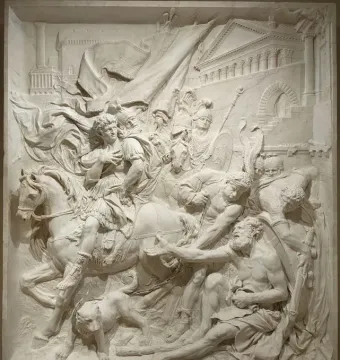
August 2022 © Shonagon · CC0
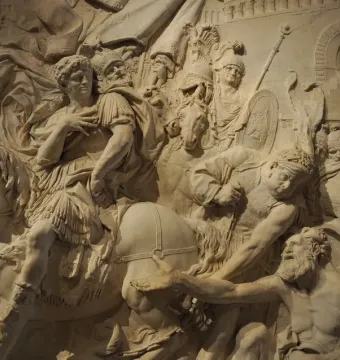
August 2011 © Amaury Laporte · CC BY 2.0
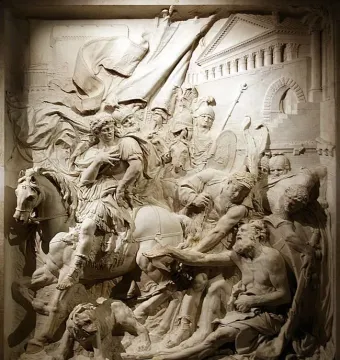
December 2011 © Jean-Pol GRANDMONT · CC BY 4.0
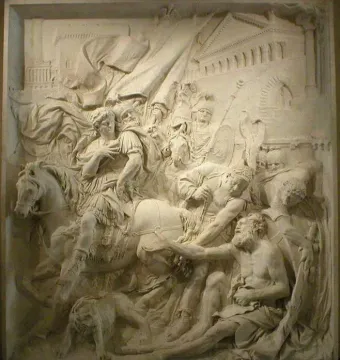
· Public domain
Identification | |
| Title | Alexandre et Diogène |
| Alternative titles | Alessandro e Diogene; Alejandro y Diógenes; Rencontre d'Alexandre et de Diogène |
| Type | Relief sculpture |
Historical context | |
| Date of creation | Between 1671 and 1689 |
| Place of creation | Toulon |
| Commission context | Made while Puget was working on sculptures for the ships of Louis XIV's fleet under construction in Toulon |
Creator | |
| Artist | Pierre Puget |
Discovery and provenance | |
| Commissioned by | Jean-Baptiste Colbert |
| Intended location | The Palace of Versailles |
| Material source | Two unused marble blocks in the arsenal where Puget was working |
| Permission to use material | Jean-Baptiste Colbert allowed Puget to use the two marble blocks for two compositions of his own choice, with no restriction on subject or dimensions |
| Related work from same material | Milon de Crotone (1671–1682, Louvre Museum) was made from the other marble block |
Physical characteristics | |
| Scale | Considered the largest relief in French sculpture, surpassed only by François Joseph Bosio's Passage du Rhin |
| Material | Marble |
Appearance | |
| Style | Highly pictorial, with depth effects, layered planes, interlocking geometric lines, and diagonals |
| Composition | Alexander is shown on Bucephalus; a dog appears between Bucephalus's hooves; the soldiers are treated in a way that moves away from portraiture toward caricature |
Iconography and meaning | |
| Subject | An episode from the life of Alexander the Great: his meeting with Diogenes in Corinth |
| Dialogue | Alexander asks Diogenes what he needs; Diogenes replies, 'Stand out of my sun' |
| Interpretation | It may be read as a critique of royal power and as an exaltation of poverty over wealth and power, though this reading is qualified |
| Historical reference | Louis XIV was often compared with Alexander in the arts before being associated with the Sun |
| Classical references | Diogenes evokes the Laocoön; Alexander's figure recalls portraits of Nero; the background evokes ancient architecture, especially the Temple of Mars |
| Possible meaning of dog detail | Possibly a reference to Diogenes' nickname 'the Cynic' |
Location and ownership | |
| Current location | Louvre Museum, Paris |
History and restoration | |
| Sent to Versailles | 1697, after Puget's death |
Significance | |
| Importance | Considered one of Pierre Puget's most important works |
Other | |
| Permission significance | Colbert's approval was exceptional in an era when artistic creation was mainly controlled by royal power, the Royal Academy of Painting and Sculpture, or the guilds |