
Tomb of Lew Sapieha
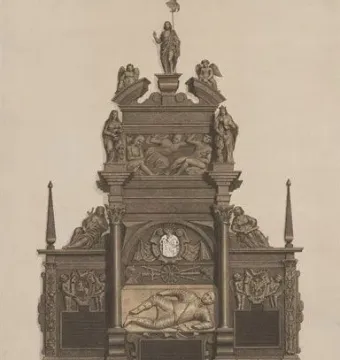
The Tomb of Lew Sapieha is the funerary monument of the Lithuanian chancellor and grand hetman Lew Sapieha and his two wives, located in St. Michael’s Church in Vilnius. It is regarded as one of the most valuable sculptural monuments of the early Baroque period in the former Grand Duchy of Lithuania. The tomb was created in several stages: separate memorial slabs were first made for Sapieha’s wives, Elżbieta Radziwiłł, who died in 1591, and Dorota Firlej, who died in 1611, followed by Sapieha’s own slab in 1633. In the 1640s, these three independent tombs were incorporated into a large monument by the North Italian sculptor Sebastian Sala.
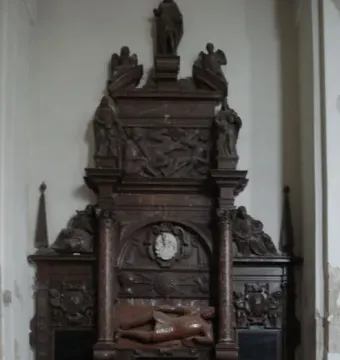
2007 © Alma Pater · Public domain
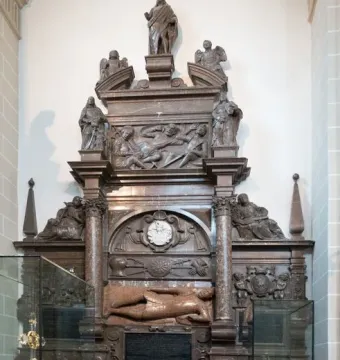
August 2014 © Jerzy Strzelecki · CC BY-SA 3.0
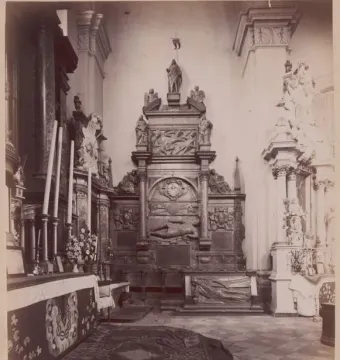
© Józef Czechowicz · Public domain
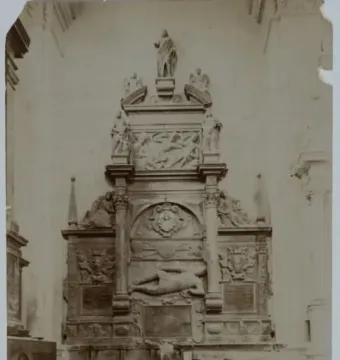
© Władysław Zahorski · Public domain
© Unknown authorUnknown author · Public domain
Identification | |
| Title | Tomb of Lew Sapieha |
| Original name | Надгробие Льва Сапеги |
| Type | Funerary monument |
Historical context | |
| Style | Early Baroque sacred sculpture with Renaissance tomb elements |
| Region | Territory of the former Grand Duchy of Lithuania |
Creator | |
| Sculptor | Sebastian Sala, a sculptor from Northern Italy |
Discovery and provenance | |
| Creation date | 1640s |
| Creation process | Created in several stages: two slabs were made first for Lew Sapieha's wives after their deaths, a third slab was created after Sapieha's death in 1633, and the three slabs were later incorporated into a single monument |
| Wives commemorated | Elżbieta Radziwiłł (died 1591) and Dorothea Firlej (died 1611) |
| Person commemorated | Lew Sapieha, Grand Chancellor and Grand Hetman of Lithuania |
Location and ownership | |
| Location | Church of St. Michael the Archangel, Vilnius |
Physical characteristics | |
| Height | About 10 m |
| Composition | Complex, heterogeneous monument with three tomb slabs, three black marble plaques, coats of arms, figures, and additional sculptural decoration |
Materials | |
| Material | Black marble |
Appearance | |
| Pediment | Broken arch pediment |
| Visual characteristics | Rich in tonal variation, with a complex, tense silhouette and disproportionate angels in the pediment |
Iconography and meaning | |
| Depicted figures | Lew Sapieha and his two wives; the resurrected Christ; angels; Saint Elizabeth the Righteous; Saint Dorothy; soldiers sleeping by the coffin |
| Symbolism | Coats of arms and attributes of military glory and valor |
History and restoration | |
| Workshop participation | Other sculptors from Sala's workshop also participated in executing the monument |
| Upper figures | Figures of the resurrected Christ and angels on the pediment arch, executed by Sebastian Sala and noted for their fine modeling |
| Central reliefs | The central reliefs are considered weaker and were probably executed by other masters |
Significance | |
| Art historical significance | Considered one of the most valuable monuments of early Baroque sacred sculpture in the region |
Other | |
| Dedicated to | Lew Sapieha and his two wives |