
Commodus as Hercules
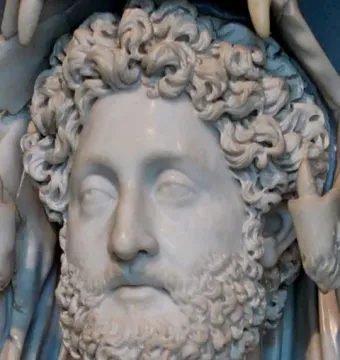
Commodus as Hercules, also known as The Bust of Commodus as Hercules, is a marble portrait sculpture created sometime in early 192 AD. It is housed in the Capitoline Museums in Rome, Italy. The work was originally discovered in 1874 in the underground chambers of Horti Lamiani. It is considered one of the most famous examples of Roman portraiture. The sculpture reflects Commodus’s association with the Greek hero Herakles, known in Rome as Hercules, near the end of his reign.
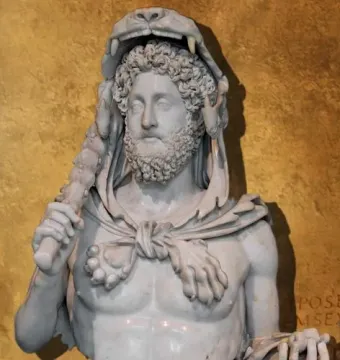
September 2006 © Jofrey Rudel · CC0
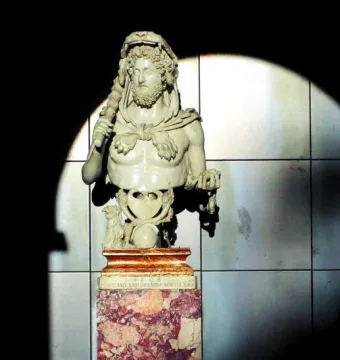
December 2010 © Rosemania · CC BY 2.0
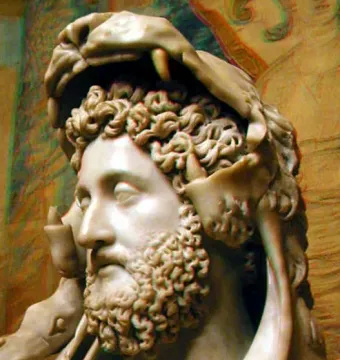
© 3dnatureguy · CC BY-SA 3.0
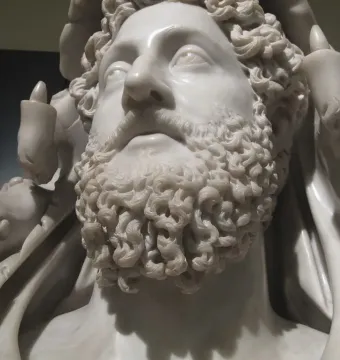
March 2012 © Institute for the Study of the Ancient World · CC BY 2.0
· Public domain
Identification | |
| Title | Commodus as Hercules |
| Alternative title | The Bust of Commodus as Hercules |
| Type | marble bust portrait sculpture |
Historical context | |
| Historical interpretation | Commodus' deification as the new Hercules was already anticipated on coinage of 188–189 AD and linked to his religious programs |
| Depicted person | Commodus, Roman emperor from 180 to 192 AD, son of Marcus Aurelius |
| Date created | early 192 AD |
| Iconographic context | Commodus associated himself with Hercules and was portrayed as the incarnation or epiphany of Hercules |
Creator | |
| Associated person | Mortimer Wheeler |
Discovery and provenance | |
| Discovery date | 1874 |
| Discovery location | Horti Lamiani, underground chamber on the Esquiline, Rome |
| Original provenance | Traditionally said to come from the imperial praedia on the Esquiline; the Horti Lamiani were founded by Helio Lamia and later incorporated into the imperial properties under Caligula |
| Discovery context | Probably hidden there |
Location and ownership | |
| Specific museum location | Horti Lamiani III room, Palazzo dei Conservatori |
| Current location | Capitoline Museums, Rome, Italy |
Physical characteristics | |
| Condition | Extremely well preserved |
| Height | 133 cm |
Materials | |
| Material | Marble |
| Finish | Possibly partially gilded; traces of gold survive on the Tritons |
Appearance | |
| Additional decoration | Two kneeling Amazons, one now lost; a cornucopia entwined with a pelta decorated with eagles' heads and a Gorgoneion; two marine Tritons |
| Composition | The bust stands on a complex allegorical base with a globe, kneeling Amazons, a cornucopia entwined with a pelta, and two Tritons |
| Herculean attributes | Nemean lion skin over the head, club in the right hand resting on the shoulder, and apples of the Hesperides in the left hand |
| Base decoration | A globe decorated with zodiac signs: Taurus, Capricorn, and Scorpio |
| Portrait features | Prominent slightly protruding half-closed eyes, elongated face, pointed nose, full mouth, thick mustache, and hair and beard treated as a single mass |
| Subject | Commodus portrayed as Hercules |
Iconography and meaning | |
| Symbolism of attributes | The Hercules attributes emphasize Commodus' identification with Hercules and his accomplishments |
| Meaning of zodiac signs | Disputed: interpreted either as astrological symbols, calendrical symbols, or references to the foundations of Rome |
| October interpretation | The signs may refer to October, which Commodus renamed after Hercules |
| Founding-of-Rome interpretation | Taurus is linked to Romulus and the founding of Rome on 21 April, Capricorn to Augustus, and Scorpio to Commodus as a third founder of Rome |
| Pelta symbolism | The pelta's eagles' heads and Gorgoneion are symbols of Jupiter, father of Hercules and tutelary god of Commodus |
| Triton symbolism | The Tritons are understood as a sign of Commodus' apotheosis |
| Overall meaning | A rich symbolic composition expressing the apotheosis and divine cult of Commodus while he was still alive |
History and restoration | |
| Afterlife | After Commodus' death, he suffered damnatio memoriae, including destruction of images and official inscriptions; the sculpture may have been hidden and thus preserved |
Significance | |
| Historical significance | One of the most famous examples of Roman portraiture |
| Artistic significance | Considered a masterpiece of Roman portraiture and a virtuoso work that marks the end of the classical phase of Roman sculpture revived under Hadrian |
Style | |
| Style characteristics | Highly realistic portrait features combined with rich symbolism; the hair and beard are deeply cut, creating strong chiaroscuro effects; the marble is made to compete with precious metal |
Interpretation | |
| Alternative interpretation | Mortimer Wheeler suggested the bust was made for Commodus or a court intimate, but that the artist may have treated the subject ironically rather than purely flattering |