
Capitoline Brutus
Capitoline Brutus is an ancient bronze sculpture displayed in the Palazzo dei Conservatori on the Capitoline Hill in Rome. Discovered during excavations in the city in the 16th century, the bronze head of a man caused a sensation because of its remarkable state of preservation and was soon added to the papal collection. For a long time it was thought to portray Lucius Junius Brutus, though this identification is now considered poorly supported. The portrait became especially popular in revolutionary France, where copies were installed in public spaces. It is admired as a masterpiece of ancient portrait sculpture for its inlaid eyes and exceptionally well-preserved surface.
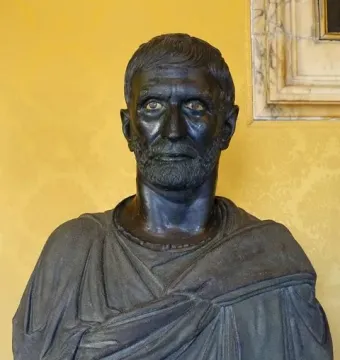
April 2019 © Daderot · Public domain
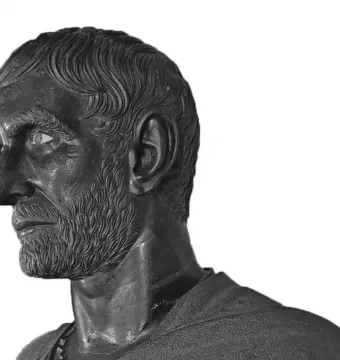
June 2022 © C.Salviani · CC BY 3.0
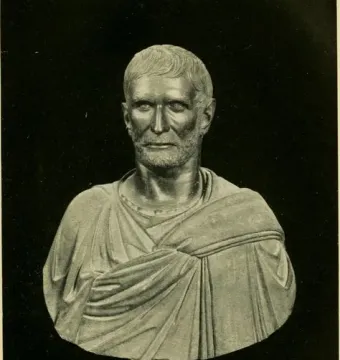
1914 © Havell, H. L. (Herbert Lord), d. 1913 · No restrictions
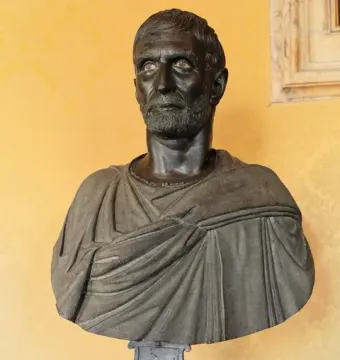
October 2017 © Burkhard Mücke · CC BY-SA 4.0
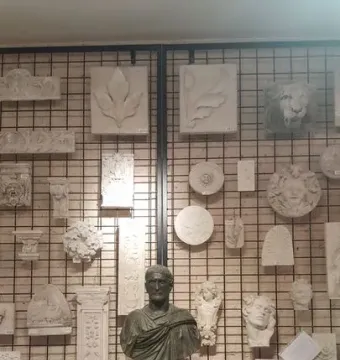
August 2016 © Romaine · CC BY-SA 4.0
Identification | |
| Title | Capitoline Brutus |
| Original language title | Капитолийский Брут; Brutus Kapitoliński; Bruto capitolino |
| Type | Ancient Roman bronze bust |
| Alternative names | Pseudo Brutus; so-called Capitoline Brutus |
Historical context | |
| Date | 4th/3rd century BC, though sometimes dated as late as the 2nd century BC or early 1st century BC; later interpretation also places it in the 1st century CE as an archaizing work |
| Historical period | Roman Republic |
Creator | |
| Maker | Unknown; possibly an Etruscan bronze artist influenced by Hellenistic and contemporary Greek portrait styles |
Discovery and provenance | |
| Discovery place | Rome |
| Discovery date | 1500 or the early 16th century |
| Discovery context | Found during excavations in Rome; nothing is known of its history before the 16th century |
| First recorded mention | 1549/1550 |
| First drawing | Maarten van Heemskerck, between 1532 and 1536 |
| Previous owner | Cardinal Rodolfo Pio da Carpi, who acquired it in 1564 and bequeathed it to the city of Rome in 1564 |
| Napoleonic removal | Taken to Paris in 1797 during the Napoleonic spoliations under the Treaty of Tolentino; it was returned to Rome in 1814/1815/1816 after Napoleon's fall and after the Congress of Vienna, with Canova's intervention |
| Earlier French use | It was used in Napoleon Bonaparte's triumphal procession in Paris in July 1798 |
Physical characteristics | |
| Preserved features | Inlaid eyes; undamaged hair, cheeks, and forehead |
| Face | Bearded male head with individualized features, prominent brow ridges, and an aquiline nose |
| Condition | Very well preserved |
| Height | 69 cm |
| Form | Bust; only the head is ancient, with a Renaissance lower bust section and toga-clad upper torso added during the Renaissance |
Materials | |
| Material | Bronze |
| Eye material | Ivory and glass paste, with iron mentioned in one source |
Technique | |
| Casting technique | Apparently lost-wax casting |
| Restoration and reassembly | The head was reassembled and mounted on a Renaissance bronze base styled after Roman imperial busts; the lower section below the neck and the toga-clad torso are Renaissance additions |
Appearance | |
| Style | Stoic, virile, and marked by gravitas |
| Clothing | Toga |
Iconography and meaning | |
| Historical significance of subject | Lucius Junius Brutus was regarded as one of the founding fathers of the Roman Republic and one of its first two consuls |
| Identification basis | The identification was proposed in the Renaissance and linked to comparisons with portraits on Roman Republican coinage |
| Current scholarly view | The portrait may instead represent an unknown man from the 4th or 3rd century BC, or be an imagined portrait rather than a true likeness |
| Traditional identification | Traditionally identified as Lucius Junius Brutus, the founder of the Roman Republic and first consul, but this is not confirmed and is now considered poorly substantiated |
Location and ownership | |
| Current location | Palazzo dei Conservatori, Capitoline Museums, Rome |
| Display history | On the Capitoline in Rome since 1564, except for the 1797-1816 removal to Paris |
| Collection affiliation | Capitoline Museums |
History and restoration | |
| Preservation context | Large ancient bronzes were often melted down in later periods, making this a rare survival of early Roman statuary |
Significance | |
| Artistic assessment | Considered a masterpiece of ancient portrait sculpture and an early example of Roman portraiture influenced by Hellenistic and Greek styles, with Italic and especially Etruscan features in details such as the hairstyle and beard |
| Notes on discovery context | Its discovery was welcomed in the Renaissance, when ancient Roman finds became especially valued because of humanism and renewed interest in antiquity |
| Copies and influence | It inspired many copies in revolutionary France; a Russian copy was made under Catherine II and soon melted down as an 'idol of the Jacobins', and another copy was cast for the Museum of Fine Arts named after Alexander III in Moscow at the beginning of the 20th century |
| Ancient references | Ancient sources mention a bronze statue of Lucius Junius Brutus said to have stood on the Capitoline |