
Statue of A'a from Rurutu
The statue of A'a is a wooden sculpture from Rurutu in the Australes archipelago, representing the deity A'a. It was probably made between 1591 and 1647, while the earliest traceable mention dates to 1821. Around that time, islanders gave the sculpture to missionaries of the LMS to mark their conversion to Christianity. It was then sent to London, where it was displayed first at the LMS museum and later at the British Museum. Since 2023, it has been loaned and exhibited at the Museum of Tahiti and the Islands in Punaauia. The work is regarded as one of the finest Polynesian sculptures to have survived, and has been admired by artists such as Picasso and Henry Moore.
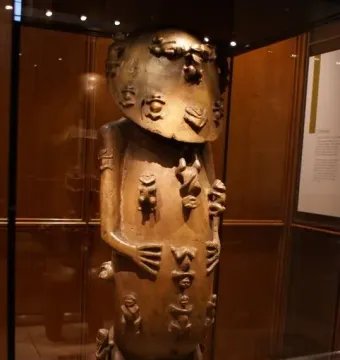
July 2007 © Paul Hudson · CC BY 2.0
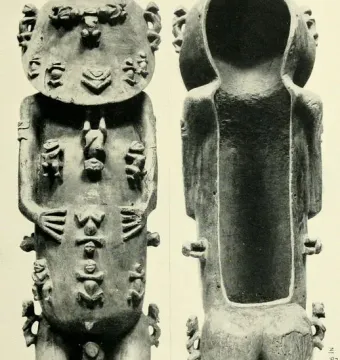
1910 © Internet Archive Book Images · No restrictions
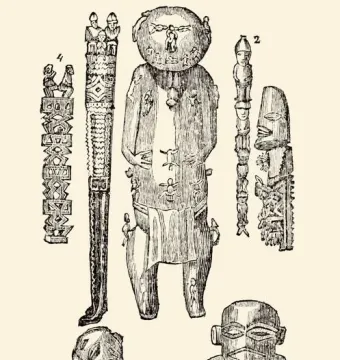
© Unknown authorUnknown author · Public domain
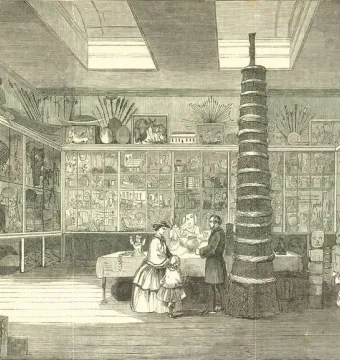
June 1859 © Illustrated London News · CC BY 3.0
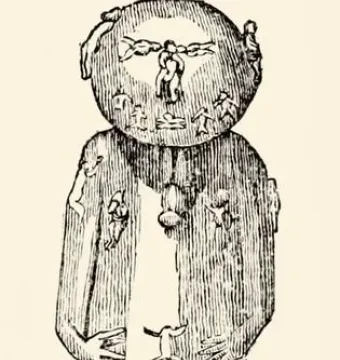
August 2012 © Wooden_idols_of_Polynesia_(1830).jpg · Public domain
.jpg)
Identification | |
| Title | Statue of A'a from Rurutu |
| Type | Wooden anthropomorphic statue |
| Subject | the Polynesian god A'a |
| Original language name | A'a statue of the god A'a, in reo rurutu |
Historical context | |
| Cultural origin | Polynesian |
| Place of origin | Rurutu, Austral Islands, French Polynesia |
| Date of creation | Probably between 1591 and 1647; radiocarbon dating in 2015 also suggested possibly as early as 1505 |
| Religious-historical context | The statue was presented as a sign of conversion to Christianity after the islanders converted |
Creator | |
| Attributed maker in oral tradition | Amaiterai |
| Alternative maker identification | Amaiterai may have been Omai, possibly a corruption of 'Omaiterai' ('Omai the Great') |
| Maker tradition | According to Rurutuan tradition, Amaiterai had visited London and encountered the Christian god there |
Discovery and provenance | |
| Date of transfer to London | 1822 |
| Current location | Museum of Tahiti and the Islands, Punaauia, French Polynesia (on loan from the British Museum since 2023 for three years) |
| Museum history | Held first in the London Missionary Society museum, then lent to the British Museum in 1890, and acquired by the British Museum in 1911 |
| Destination after transfer | London |
| First recorded event | Presented to missionaries of the London Missionary Society (LMS) |
| Recipient | The London Missionary Society (LMS) missionaries at Raiatea |
| Donor | The islanders of Rurutu |
| Reason for presentation | As a symbol of the islanders' conversion to Christianity |
| First recorded place | Raiatea, French Polynesia |
| First recorded mention | 9 August 1821 |
Physical characteristics | |
| Condition | Lower legs, right buttock, and left arm are damaged; the penis is completely broken off |
| Surface decoration | Thirty smaller figures are carved in high relief over the surface |
| Damage cause | Most other damage may be due to deterioration over time; the removal of the penis appears to have been deliberate |
| Mutilation agent | Unknown; possibly British missionaries or Polynesian converts |
| Base | No base; it is unknown whether it originally had one |
| Legs | Separated and slightly bent |
| Arms | Placed on the abdomen and carved in high relief |
| Form | Hollow figure with a removable rear panel for access to the interior |
| Dimensions | 117 cm high; 36 cm wide |
| Feet | No feet |
Materials | |
| Main material | Wood, probably sandalwood (most likely Santalum insulare); Rurutu tradition identifies it as pua keni keni wood (Fagraea berteriana) |
Technique | |
| Construction tools | Probably stone-bladed tools; iron tools may also have been used if parts were made after European arrival in Polynesia in the 1760s |
| Finishing materials | Sharkskin or stingray skin scrapers, breadfruit leaves, cowrie shells, and coconut oil |
Iconography and meaning | |
| Interior statuettes account | John Williams said there were 24 statuettes inside; Rurutu oral tradition says there were three representing the Trinity; another version adds 39 other tiki figures representing the island's clans |
| Interpretation of red feather | It may support the statue's sacred importance, since red feather color was associated with the sacred in Polynesia |
| 2015 interior find | A red feather was found inside the statue and identified as coming from a Kuhl's lorikeet |
| Fate of interior statuettes | The statuettes disappeared, probably destroyed in 1822 |
| Original purpose of cavity | The cavity's real or original purpose remains debated |
| Interior function | The cavity appears to have served as a receptacle for small statuettes of 'little gods' (tikis) |
| Lower abdomen asymmetry | An upright figure is on the right side and a spread-limbed figure on the left; it is unclear whether this asymmetry was deliberate |
| Distribution of smaller figures | They are symmetrically distributed across the statue except for the lower abdomen |
| Possible meaning of styles | The two styles may represent masculine and feminine forms respectively |
| Smaller-figure styles | Two distinct styles: 16 upright figures with arms across the torso, and 14 spread-limbed figures with arms and legs outstretched |
| Figure arrangement | Many smaller figures mark human features such as the eyes, nose, and mouth, while others do not obviously correspond to any human feature |
Location and ownership | |
| Recent loan | In 2023 the British Museum loaned the statue to the Musée de Tahiti et des Îles for three years |
| Current display status | Not currently on display |
| Exhibition history | Exhibited in London and later internationally, including in New York, Canberra, and Paris |
| Former institutional association | London Missionary Society museum collection |
| Institutional ownership | British Museum |
Significance | |
| Reputation | Considered one of the finest surviving examples of Polynesian sculpture |
| Modern assessment | Julie Adams described it as an 'international celebrity' in the 21st century |
| Academic recognition | Recognized for its singularity and the finesse of its execution |
| Artistic influence | Admired by artists such as Picasso and Henry Moore, who found it a source of inspiration |
| Historical interpretation | Some accounts describe it as a Christianized reinterpretation of history, with the Trinity reading used to deny outside conversion and rehabilitate a condemned pre-Christian past |
| Preservation narrative | It was spared destruction because it belonged to the king, who wanted to remind the people of the search for the 'word of wisdom' and their former disbelief |