
A Faun Teased by Children
A Faun Teased by Children is a marble sculpture by the Italian artists Gian Lorenzo Bernini and his father, Pietro Bernini. It was executed in 1616 and 1617, when Gian Lorenzo was still under twenty years old. The work is known from the source text as Fauno entretenido por cupidos and is currently in the collection of the Metropolitan Museum of Art in New York. The sculpture reflects the early output of Bernini, created in marble during his youth, in collaboration with his father.
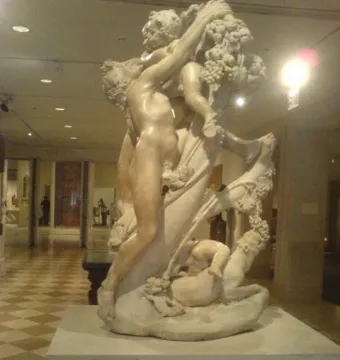
July 2006 © Schlamniel · Public domain
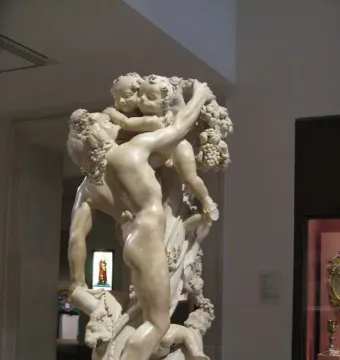
May 2012 © Yair Haklai · CC BY-SA 3.0
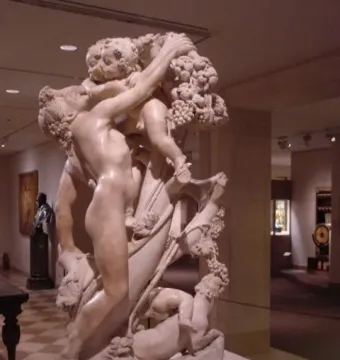
January 2006 © Rodney · CC BY 2.0
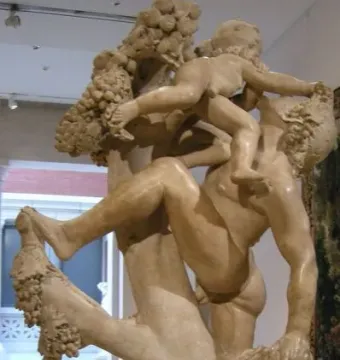
© sailko · CC BY-SA 3.0
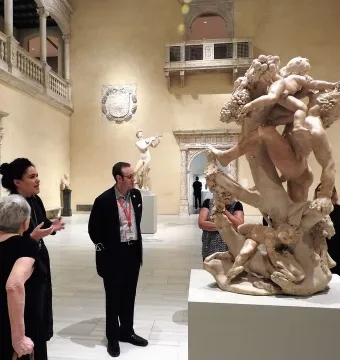
May 2017 © Jim.henderson · CC BY-SA 4.0
Identification | |
| Title | A Faun Teased by Children |
| Other titles | Fauno entretenido por cupidos; Um fauno provocado por crianças; Faune émoustillé par des Amours; Il Fauno molestato da cupidi; Bacchanal: A Faun Teased by Children |
| Type | Marble sculptural group |
Historical context | |
| Art-historical context | Bacchic groups like this were not uncommon in early 17th-century Rome and Florence |
| Date made | 1616–1617 |
Creator | |
| Artists | Gian Lorenzo Bernini and Pietro Bernini |
| Artist nationality | Italian |
| Family relationship | Pietro Bernini was Gian Lorenzo Bernini's father |
| Gian Lorenzo Bernini's age at creation | Not yet twenty years old |
Discovery and provenance | |
| Early attribution status | Not identified as a work by Bernini when it was kept in his house; later identified by Federico Zeri as an early work of Bernini |
| Reason for obscurity | A significant defect, especially the unfinished lower part of one putto's left arm, may have discouraged patrons and kept the work in Bernini's house |
| Later collection history | Entered a French collection in the 20th century |
| Auction history | Sold at a Paris auction house in 1972; reappeared on the London art market in 1973 and was sold again |
| Museum acquisition | Acquired by the Metropolitan Museum of Art in 1976 |
| Early location | Kept for a long time in Bernini's house, Palazzo Bernini, at 11 Via della Mercede, Rome |
Location and ownership | |
| Current location | Metropolitan Museum of Art, New York |
| Current collection | Metropolitan Museum of Art |
| Display status | Currently exhibited |
Physical characteristics | |
| Condition | The lower part of one putto's left arm is unfinished at the elbow, because the remaining thin marble was insufficient to complete the arm |
| Dimensions | Approximately 120 cm high and 90 cm wide |
| Form | Carved from a very shallow block |
| Number of figures | Five |
Materials | |
| Material | Marble |
| Marble color | Generally warm honey-colored, with paler tones on the animal coat and tree trunk and browner tones on the faun's and putti's bodies |
Technique | |
| Carving technique | Noted for superb carving and drilling/perforation technique |
| Structural support | Stabilized by the use of legs and arms as bracing, with adequate weight at the base to prevent tipping |
Appearance | |
| Main scene | A lighthearted struggle between a faun and three putti |
| Composition | The faun stands with one leg on either side of a central tree, climbing it while reaching for a fruit-bearing branch above; two putti push his head back and a third stumbles over the animal on the ground |
| Animal depicted | A ground animal, variously described as a dog, a lioness, or a panther, raises its head to eat grapes from a lower branch |
| Hanging pelt | A lion skin or panther skin hangs from a lower rear branch of the tree |
Iconography and meaning | |
| Bacchic character | The group may be read as Bacchic, with the hanging pelt and grape-eating animal suggesting Bacchus |
| Iconographic interpretation | The iconography is not completely clear; proposed readings include Pan or a drunken faun trying to gather fruit, with the fruit symbolizing eternal love through the living vine wrapped around the dead tree |
| Alternative interpretation | The sculpture may contrast earthly lust with divine, heavenly love; in one reading the putti are cupid-like amorini who either mock or repel the faun's indecorous aggression |
| Figure identification notes | The central figure is identified as a faun because it has human legs, while the children are putti because they are wingless; satyrs would have goat legs |
Significance | |
| Critical assessment | Critics regard it as one of the best Roman works of the early 17th century, praised for the classicism of its motifs and its carving and drilling technique |