
Santo Niño de Cebú
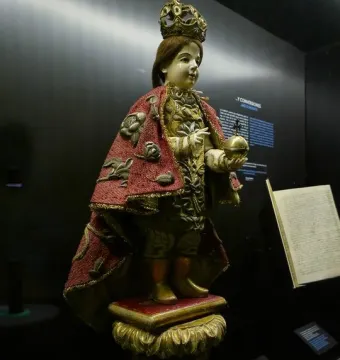
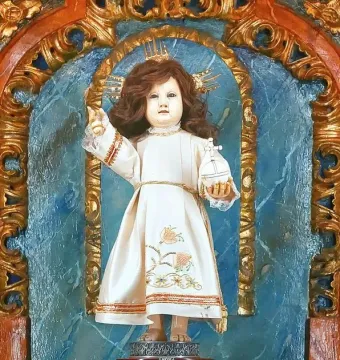
Santo Niño de Cebú is a highly venerated 16th-century statue of the Child Jesus, preserved at the Minor Basilica of Santo Niño in Cebu, Philippines. It is probably the oldest existing religious image in the country. According to the source text, the statue was given as a baptismal gift in 1521 by the explorer Ferdinand Magellan to the Queen of Cebu during his expedition in the region. The figure shows a strong aesthetic influence from sacred Flemish icons of the period and resembles the Child Jesus of Prague in its overall figure and clothing. Devotees honor the sacred image on the third Sunday of January with a major procession in Cebu and in other places where it is venerated.
September 2019 © Jl FilpoC · CC BY-SA 4.0
September 2025 © Enciclopedia1993 · CC BY 4.0
April 1945 © U.S. Army Signal Corps · Public domain
January 2024 © Carlayese26 · CC BY-SA 4.0
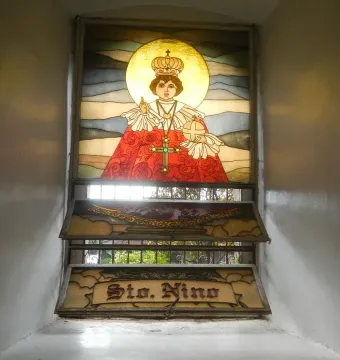
June 2019 © Judgefloro · CC0
Identification | |
| Title | Santo Niño de Cebú |
| Type | Venerated statue of the Child Jesus |
| Subject | The Infant Jesus (Child Jesus) |
| Alternative names | Santo Bambino di Cebu; Balaang Bata sa Sugbo; Infant Jesus of Cebu; Señor Santo Niño de Cebú; Santo Niño; Señor Santo Niño de Cebu |
Historical context | |
| Date | 16th century; presented in 1521; rediscovered in 1565 |
| Origin and attribution | Attributed in hagiography to Flemish artisans; possibly made in Belgium/Flanders; based on a vision of Teresa of Ávila |
| Historical significance | Probably the oldest existing religious image in the Philippines; one of the oldest Christian artifacts in the Philippines |
| Historical context | Associated with the conversion of Filipinos to Catholicism |
Creator | |
| Intermediary | Antonio Pigafetta |
| Occasion of gift | Given in connection with the recipients' Christian baptism in 1521 |
| Donor | Ferdinand Magellan |
| Original recipients | Rajah Humabon and his wife Hara Humamay (Queen Juana) |
Discovery and provenance | |
| Presentation date | 14 April 1521 |
| Discovery date | 28 April 1565 |
| Rediscoverer | Juan Camus |
| Discovery circumstances | Found intact in a wooden or pine box among the ruins of a burned native dwelling in Cebu |
| Transferred to | Augustinian monks |
Physical characteristics | |
| Height | Approximately 30 cm (about 12 inches) |
| Material | Dark wood |
| Style | Flemish style |
Appearance | |
| Clothing | Valuable textiles; ornate robes; multicolored robe; fine vestments |
| Regalia | Golden crown, Order of the Golden Fleece/Toisón de oro, globus cruciger, and sceptres |
| Jewelry | Adorned with jewelry mostly donated by devotees over several centuries |
| Facial expression | Serene |
| Pose and attire | Depicted in the pose and dress of a Spanish monarch |
| Depicted figure | The Child Jesus |
Iconography and meaning | |
| Stylistic influence | Strong influence from 16th-century sacred icons from Flanders |
| Comparative resemblance | Similar to the Child Jesus of Prague in figure and clothing arrangement |
| Symbolic interpretation | Seen by Pigafetta as a sign of alliance between Spain and Rajah Humabon |
Religious significance | |
| Veneration | Widely venerated by Filipino Catholics as miraculous; an object of veneration and pilgrimage |
| Religious significance | Considered one of the most revered sacred images in the Philippines |
| Canonical status | The only canonically crowned image of Jesus Christ in the Philippines |
| Miraculous reputation | Its survival and rediscovery were regarded as miraculous, and it has been believed to have miraculous power since then |
Location and ownership | |
| Associated procession locations | The Basilica in Cebu and other places where the Santo Niño is venerated |
| Associated festival | Sinulog, held annually on the third Sunday of January with a large procession |
| Associated city | Cebu City |
| Country | Philippines |
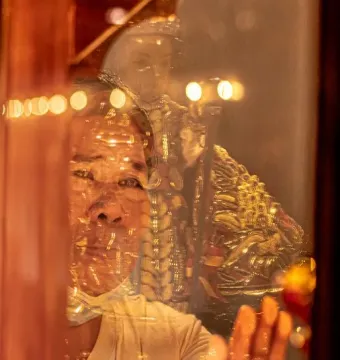
| Current display | Permanently encased behind bulletproof or reinforced glass |
| Current location | Chapel within the Basilica Minore del Santo Niño, Cebu City, Philippines |
History and restoration | |
| Later history | Became the center of a mass cult after its rediscovery in 1565 |
| Early worship form | Locals continued to worship it in the Sinulog manner |
| Church built at discovery site | A bamboo and nipa chapel/church was built in 1565 at the site where it was found; later rebuilt in coral stone |
| Later building on the site | The modern Basilica del Santo Niño was built there in 1739 |
| Ecclesiastical status | Elevated to the rank of Minor Basilica by Pope Paul VI on the church's 400th anniversary |
| Papal coronation | Canonically crowned on 28 February 1965 by Cardinal Ildebrando Antoniutti under Pope Paul VI's bull Uonabula Religionis |
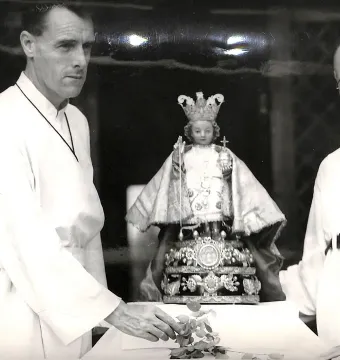
| World War II damage | During Japanese bombing of Cebu, the basilica roof was badly damaged; the image was displaced from the high altar and later hidden in a metal vault at the Redemptorist Church for seven months |
| Postwar restoration | After the war, its dark paint flaked off to reveal a lighter underlayer; it was later repainted darker brown |
| National cultural designation | Declared a National Cultural Treasure of the Philippines |
Significance | |
| Cultural significance | One of the most recognizable and beloved cultural icons of the Philippines; widely reproduced in Filipino homes, official institutions, and under different names across the country |
| Associated commemorations | Featured in the 400th anniversary of the Christianization of the Philippines and the 500 Years of Christianity in the Philippines quincentennial commemorations |