
Lansdowne Heracles
Lansdowne Heracles is a Roman marble sculpture dated to about 125 CE and now in the collection of the J. Paul Getty Museum’s Getty Villa in Malibu, Los Angeles. It shows Heracles as a beardless Lysippic youth, grasping the skin of the Nemean lion with his club resting on his shoulder. Discovered in 1790 at Tivoli, Italy, on the site of Hadrian’s Villa, it was first acquired by Thomas Jenkins and then purchased in 1792 by the first Marquess of Lansdowne. The statue was fragmentary when found and was restored in the 18th century; much of that restoration was later removed in the 1970s and partly replaced with epoxy resin casts. It is now understood as a Roman-era reinterpretation of Greek sculpture rather than a copy of a specific original.
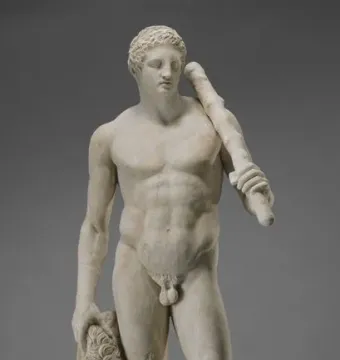
0125 © Unknown authorUnknown author / J. Paul Getty Museum · Public domain
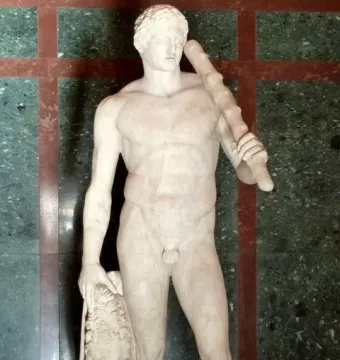
December 2010 © Dave & Margie Hill / Kleerup · CC BY-SA 2.0
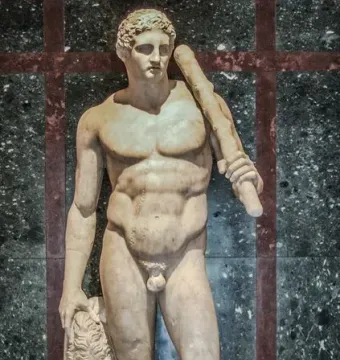
August 2007 © Spikebrennan · CC BY-SA 3.0
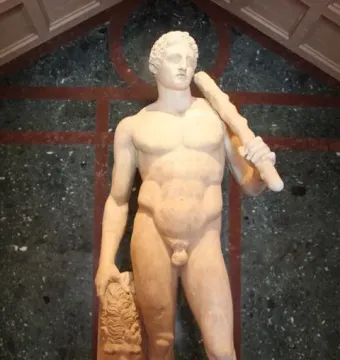
June 2010 © Gary Todd · CC0
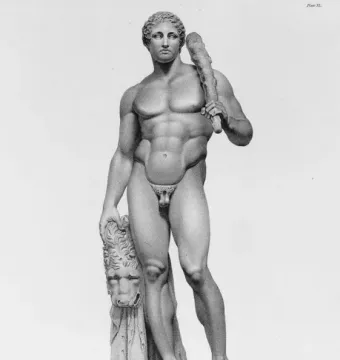
1809 © John Samuel Agar (1775-1858) · Public domain
Identification | |
| Title | Lansdowne Heracles |
| Type | Roman marble sculpture |
| Original name | Herakles; L'Héraclès de Lansdowne; Eracle; Ercole Lansdowne; Heracles of Tivoli |
Historical context | |
| Date | about 125 CE |
Creator | |
| Original Greek model | Possibly Lysippos of Sicyon; not regarded as a copy of a specific Greek original |
| Style reference | Lysippic; inspired by Greek sculpture of the 4th century BCE |
| Art-historical classification | Roman-era improvisation on the Greek sculptural style of the 4th century BCE |
Discovery and provenance | |
| Long-term location before sale | Lansdowne House, London |
| Purchase date by Getty | 1951 |
| Purchased by Getty | J. Paul Getty, businessman and art collector |
| Sold at auction | The Lansdowne sculptures were sold at auction |
| Auction date | 1930 |
| Findspot context | Found on the part of the former villa site that belonged to Count Giuseppe Fede |
| Acquisition date by Lansdowne | 1792 |
| Acquired by Lansdowne | William Petty FitzMaurice, 1st Marquess of Lansdowne |
| Initial owner after discovery | Thomas Jenkins, an English antiquarian and dealer in antiquities with strong ties to English aristocrats on the Grand Tour |
| Discovery place | Tivoli, Italy, near the Villa of Hadrian |
| Discovery date | 1790 |
Location and ownership | |
| Catalog number | 70.AA.109 |
| Collection | Getty Villa collection of the J. Paul Getty Museum |
| Current location | J. Paul Getty Museum, Getty Villa, Malibu, Los Angeles, California |
Physical characteristics | |
| Depiction | Standing nude Heracles, beardless and youthful, grasping the skin of the Nemean lion and resting a club on his shoulder |
| Pose | Standing in contrapposto |
| Height | 193.5 cm |
| Weight | 385.5 kg |
| Subject | Heracles (Herakles) |
Materials | |
| Material | Marble |
History and restoration | |
| Conservation treatment | Some 18th-century restorations were replaced with epoxy resin casts |
| Later reintegration | The restorations were later reintegrated with the sculpture |
| Conservator | Jerry Podany |
| Conservation aim | To show the original sculpture as much as possible free of alien additions |
| Restoration details | The nose, right forearm, several fingers, the back of the lion skin, part of the right thigh, and the entire left calf were completed and attached as discreetly as possible |
| Reason restorations were removed | Iron and lead pins connecting the restorations to the original marble were corroding, swelling, and threatening to spall off more marble |
| Restoration removal date | 1970s |
| Reason for restoration | Fragmentary sculptures did not suit Neoclassical taste |
| Restoration | Restored after rediscovery, probably by Carlo Albacini |
| Condition when found | Fragmentary; missing some parts |
Significance | |
| Artistic context | Like other Greek sculptures of the Classical period |
| Site significance | The Villa of Hadrian had yielded many fine copies and pastiches of Hadrianic Greek sculptures before the 1790 discovery |