
Night
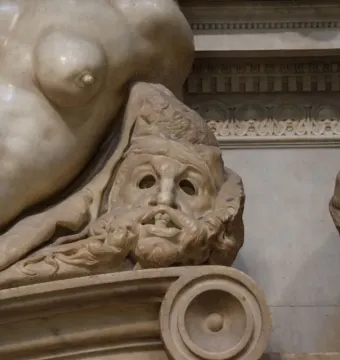
Night is a marble statue by Michelangelo, created between 1526 and 1531. It belongs to the decoration of the New Sacristy of the Basilica of San Lorenzo in Florence. The figure is one of the four allegories of the “Parts of Time” and stands on the left side of the sarcophagus of the tomb of Giuliano de’ Medici, Duke of Nemours. Its iconography has been read in several ways, including as a symbol of air, water, melancholy, or fertility. Among its distinctive attributes are the owl, a garland of flowers beneath the left foot, and a mask, which have also been interpreted as signs of sleep, dream, death, or even a veiled self-representation of Michelangelo.
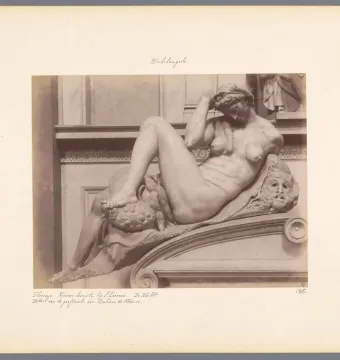
© Rijksmuseum · CC0
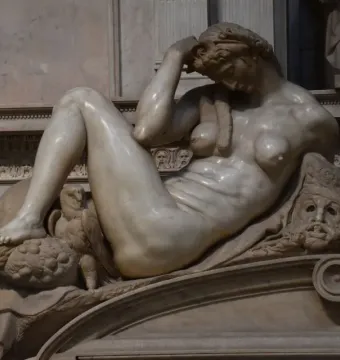
June 2019 © George M. Groutas · CC BY 2.0
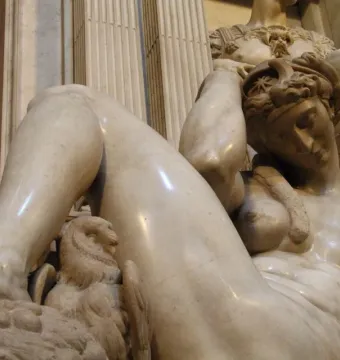
August 2014 © Rabe! · CC BY-SA 4.0
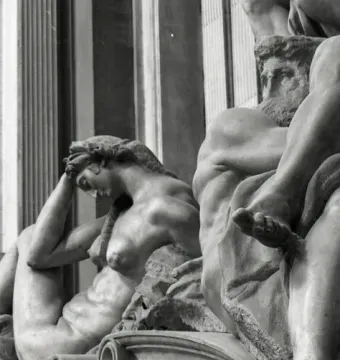
© Paolo Monti · CC BY-SA 4.0
June 2019 © George M. Groutas · CC BY 2.0
Identification | |
| Title | Night |
| Type | Marble sculpture |
| Subject | Night personified as a nude female allegorical figure |
| Original title | La Notte |
Creator | |
| Artist | Michelangelo Buonarroti |
Historical context | |
| Function | Funerary allegory connected with tombs and the passage of time |
| Completion status | The only fully completed sculpture among the allegorical figures |
| Status in series | One of the first sculptures to be completed |
| Completion date | Finished in 1531, according to Erpel |
| Project patronage | Actively supported by Clement VII; conceived by Leo X |
| Intended dedication | Memorial chapel for Giuliano de' Medici and Lorenzo de' Medici |
| Commissioner | Pope Clement VII |
| Artistic period | High Renaissance |
| Date created | 1526–1531 |
Discovery and provenance | |
| Model repository | Victoria and Albert Museum, London |
| Model date | Around 1524 |
| Model | A terracotta model survives |
| Current location | Medici Chapel, Florence |
| Location on tomb | Left side of the sarcophagus lid |
| Associated tomb | Tomb of Giuliano de' Medici, Duke of Nemours |
| Part of | Decoration of the New Sacristy (the Medici Chapel) of San Lorenzo, Florence |
Physical characteristics | |
| Torso movement | Twisted toward the viewer |
| Surface finish | Highly polished marble, especially on the torso |
| Eyes | Closed |
| Head adornment | Diadem with a crescent moon and a star |
| Hair | Long hair gathered in braids |
| Unfinished parts | Some parts of the left arm and hand and the diadem were not fully finished; the back is partly unfinished |
| Right arm position | Supports the head on the left thigh |
| Left arm position | Bent behind the back |
| Body position | Lying on a sloping sarcophagus lid |
| Pose | Semi-reclining and nude, with the left leg bent and the head tilted back |
| Maximum diagonal length | 194 cm |
| Dimensions | 155 × 150 cm |
Materials | |
| Material | Marble |
Technique | |
| Model material | Terracotta |
Appearance | |
| Completion note | The figure is the most fully realized among the reclining figures in the Medici Chapel series |
| Stylistic features | Powerful modeling, unusually masculine for a female figure, with an erotic quality |
| Expressive effect | Conveys a heavy awakening from non-being, with tension, anxiety, and ambiguity |
| Pose comparison | The reclining pose recalls ancient representations of Leda or Sleeping Ariadne, and especially Michelangelo's lost cartoon of Leda and the Swan around 1530 |
Iconography and meaning | |
| Mythological associations | Night as the mother of the star gods and the source of Sleep and Death |
| Ancient associations | Linked in antiquity with Leda as an embodiment of night, the mother of celestial lights, and an embodiment of love |
| Mask symbolism | May signify sleep, nocturnal dreams, or death as the sleep of the body awaiting resurrection |
| Flowers symbolism | Possibly poppies, symbolizing fertility and drowsiness through opium |
| Owl symbolism | A nocturnal animal that sees well at night |
| Attribute placement | The attributes are scattered around the figure rather than held in the hand |
| Attributes | An owl, a bouquet of flowers possibly poppies, and a mask |
| Additional symbolic meanings | Interpreted as an emblem of Air or Water, of the melancholic temperament, or of the fertility of night |
| Symbolic meaning | An allegory of Time and the transience of life |
| Interpretation | Allegory of Night |
| Iconographic role | One of the four allegories of the Parts of the Day |
Location and ownership | |
| Current display location | Medici Chapel, Florence |
History and restoration | |
| Model differences | Compared with the model, the statue has different lines in the eyes, nostrils, and mouth; the model's face is softer, the mask is turned more to the right, the left hand differs, the left foot's big toe points upward, and the model's back is fully finished |
| Departure from site | In 1534 Michelangelo went to Rome before installing the sculptures or completing the tomb |
| Source qualifier | Reported by Doni and other ancient sources |
| Restoration detail | Left arm repaired twice |
| Completion note | According to some ancient sources, the left arm was remade twice because of damage |
Significance | |
| Reception | Gained extraordinary fame and renown |
| Cause of fame | Also due to Giovanni di Carlo Strozzi's quatrain of praise |
| Literary response | Inspired Giovanni di Carlo Strozzi's quatrain and Michelangelo's reply, Risposta del Buonarroto, in 1545–1546 |
| Strozzi's quatrain | Invites the statue to awaken so it can appear alive and speak |
| Michelangelo's reply | Verses spoken by the statue itself, expressing that sleep and being of stone are preferable while harm and shame endure |
| Michelangelo's historical reference | Linked to the disorders in Florence during the rule of Cosimo I de' Medici |
| Later influence | Frequently reproduced and discussed in later art and literature, including works by Bartolomeo Ammannati, Cornelis Bos, Peter Paul Rubens, and Charles Baudelaire |
| Related lost work | Associated with Michelangelo's lost painting Leda, also called Night, which was copied by Rosso Fiorentino and later taken to France |