
Rondanini Pietà
The Rondanini Pietà is Michelangelo’s final marble sculpture, worked on from 1552 until the last days of his life in 1564. It is believed to be the last of three versions and revisits the theme of the Virgin Mary mourning over the body of Christ, first explored in his 1499 Pietà. The work is marked by its unfinished, elongated figures, which differ from Michelangelo’s earlier idealized style and have been compared to Gothic or Mannerist sculpture. He continued working on it just six days before his death. The sculpture is now housed in the Museo della Pietà Rondanini at Sforza Castle in Milan.
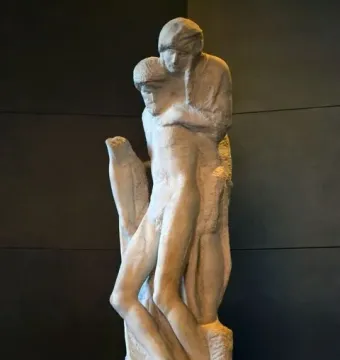
August 2012 © Phyrexian · CC BY-SA 4.0
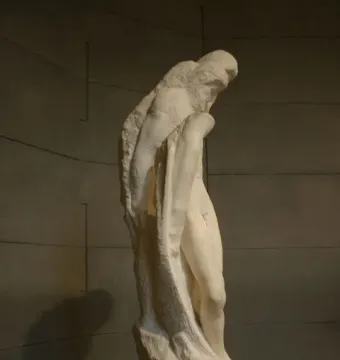
© G.dallorto · Attribution
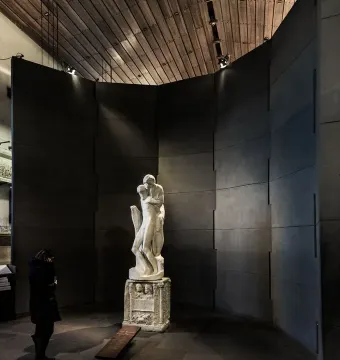
December 2012 © ☰☵ Michele M. F. · CC BY-SA 2.0
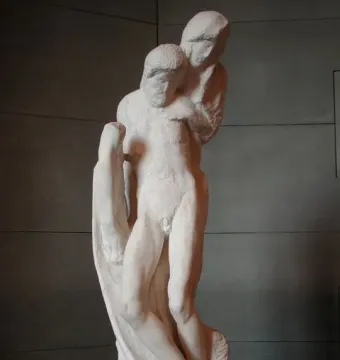
© Paolo da Reggio · CC BY-SA 3.0
July 2022 © Albarubescens · CC BY-SA 4.0
Identification | |
| Title | Rondanini Pietà |
| Alternative title | Pietà Rondanini |
| Type | Marble sculpture group, Pietà |
| Artist | Michelangelo Buonarroti |
| Height | 195 cm |
Historical context | |
| Date of work | c. 1550s–1564 |
| Work phases | An early attempt was made around 1550; a second version was begun around 1552–1553; the final major reworking began around 1554 |
| Last work status | Michelangelo's last work |
| Working until death | Michelangelo worked on it until a few days before his death; one letter dates his work to 12 February 1564, six days before his death |
| Intended purpose | Planned for Michelangelo's own tomb, not as a commissioned work |
| Intended burial place | Initially intended for Santa Maria Maggiore in Rome, perhaps later reconsidered for Florence |
Creator | |
| Related late works | Associated with Michelangelo's late Crucifixion drawings and The Deposition of Christ |
| Earlier related work | Michelangelo first explored the Pietà theme in his 1499 Pietà |
| Context of creation | Created in Michelangelo's final years, when he was increasingly preoccupied with his own mortality |
| Theme | The Virgin Mary mourning over the dead or dying body of Christ |
Discovery and provenance | |
| Gifted to | Antonio del Francese, Michelangelo's servant |
| Date gifted | August 1564 |
| Found after artist's death | It was found in Michelangelo's studio after his death |
| Earliest documented location | A Roman workshop in 1652 |
| Acquired by | The Rondanini family in 1744 |
| Former location | Palazzo Rondanini, Rome; later a Roman villa owned by the heirs |
| Acquisition by Milan | Purchased by the city of Milan in 1952 from the Sanseverino family |
| Current holding | Civic Collections of the Castello Sforzesco, Milan |
Location and ownership | |
| Name origin | Named after the Rondanini (Rondinini) family, which owned it for centuries in Palazzo Rondanini in Rome |
| Since at current location | Since 1952; on public display in the new museum since 2 May 2015 |
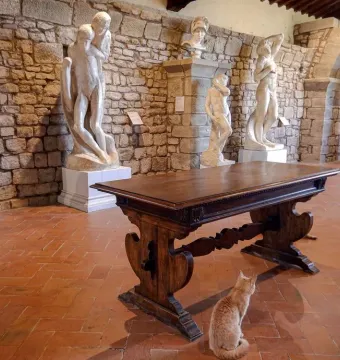
| Current location | Museo della Pietà Rondanini, Castello Sforzesco, Milan |
Physical characteristics | |
| Completion status | Unfinished |
| Surviving original element | Only the dismembered or severed right arm of Christ survived from the originally conceived sculpture |
| Figure arrangement | The final composition shows the Virgin and Christ in an elongated, highly reduced group, with Christ blending into the Virgin's body |
| Mary's pose | The Virgin Mary is depicted standing and supporting Christ |
| Detail level | Sparse in detail and resembling a sketch |
| Height of figures | The figures are elongated and attenuated |
Materials | |
| Material | Marble |
Technique | |
| Working method | Michelangelo conceived sculpture as latent in the marble, to be revealed by removing superfluous material |
| Later alterations | In his last days, Michelangelo cut away the marble block until only the remaining elements of the final composition survived |
Appearance | |
| Comparative style | Often compared with Gothic sculpture and sometimes with Mannerism rather than the Renaissance |
| Stylistic relation | A departure from Michelangelo's earlier idealized and more naturalistic figures |
| Style | Spectral, simple, and precarious, lacking the triumphant character of his earlier works |
Iconography and meaning | |
| Composition interpretation | From some angles Christ appears to carry Mary on his back, suggesting Christ's spirit consoling his mother's grief |
| Spiritual interpretation | The figures' bodily quality seems reduced to convey a more purely spiritual idea |
| Art-historical interpretation | Linked to Michelangelo's late movement away from naturalism and humanism toward mystical Neoplatonism |
| Alternative interpretation of completion | Some scholars argue it should not be considered unfinished, but viewed as a work revealed through changing viewpoints |
History and restoration | |
| Support base | Mounted on a Roman Trajanic funerary altar depicting Marcus Antonius and Giulia Filumena Asclepiade |
| Stability method | There are no positioning pins; thin lead sheets or strips at the sides of the base improve stability |
| Restoration | Conservation work in 2004 removed paint, stucco, mortar, varnishes, and yellow-brown patina from the sculpture and pedestal |
| Borghese fragment | A head of Christ found in Rome in the 1950s and once attributed to Michelangelo by Bruno Mantura in 1973; later tests excluded it from the same block as the Rondanini Pietà |
| Exhibition after restoration | The sculpture and the Borghese fragment were displayed together after restoration |
Significance | |
| Later influence | Marlene Dumas based her 2012 painting Homage to Michelangelo on the Rondanini Pietà |
Other | |
| Related people | Giorgio Vasari, Daniele da Volterra, Leonardo Buonarroti, Condivi, Pietro da Cortona, Gian Domenico Ottonelli, Charles de Tolnay, Federico Zuccari, Taddeo Zuccari, Bruno Mantura, Fernanda Wittgens, Count Roberto Vimercati-Sanseverino |