
Fountain (Babuino)
Fountain (Babuino) is one of Rome’s six talking statues. It depicts a reclining silenus, popularly called a "babbuino" in Roman dialect because of its rough, deformed, ape-like appearance. In 1571, Pope Pius V ordered a public fountain to be made, and the statue was placed there as decoration. After several relocations, the silenus returned to its original site in 1957, beside the church of San Atanasio dei Greci. Like the other talking statues, it was used to display pasquinades, the satirical and insulting notes through which Romans mocked high-ranking authorities. In 2015, the fountain was restored with a €25,000 donation from the Italian luxury brand Brioni.
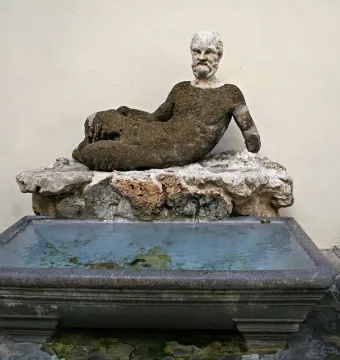
October 2011 © Jean-Pol GRANDMONT · CC BY 4.0
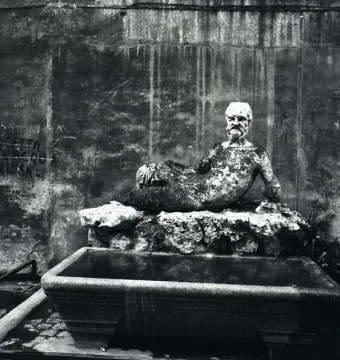
© Paolo Monti · CC BY-SA 4.0
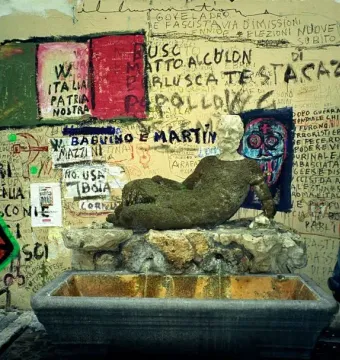
2002 © Jerzy Strzelecki · CC BY 3.0
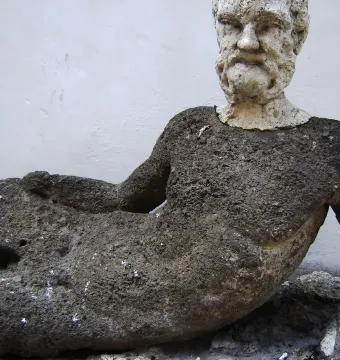
2007 © ProfDEH · CC BY 3.0
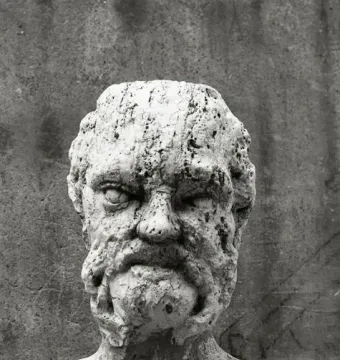
© Paolo Monti · CC BY-SA 4.0
Identification | |
| Title | Fountain (Babuino) |
| Alternative names | Il Babuino; Babbuino; Babuino |
| Type | Ancient public fountain; one of Rome's talking statues |
| Depicted figure | Reclining Silenus |
| English translation of name | Fountain of the Baboon |
Historical context | |
| Function in Roman culture | Used as one of Rome's talking statues for satirical pasquinades and political commentary |
| Nickname origin | The name babbuino/Babuino was given by the people of Rome because the figure was considered ugly and deformed, like a monkey or baboon |
| Nickname etymology | An unproven thesis proposes that babbuino is a phonetic variant of babbione, possibly derived from the Latin bambalio, bambalionis |
| Associated satire term | Babuinate |
| Historical practice | Pasquinades were anonymous, often violent and irreverent satires aimed at prominent public figures in Rome |
Creator | |
| Commissioned by | Pope Pius V |
Discovery and provenance | |
| Original installation | 1571 |
| Original setting | A public fountain at the facade of Alessandro Grandi's palace on Via Paolina Trifaria (formerly Clementina) in Rome |
| Commissioning arrangement | Pope Pius V granted water from the restored Vergine aqueduct to Alessandro Grandi's palace, and a public fountain was built there in exchange |
| Completion date | By 1576 |
| Later relocation | Moved to a niche adjacent to the palace in 1738; dismantled in 1877; returned to the street in 1957 |
| Relocation after 1877 | The statue was placed in the courtyard of the former Boncompagni palace (Palazzo Boncompagni Cerasi), and the basin was reused on Via Flaminia |
| Return to original area | 1957 |
| Discovery circumstances | The circumstances and place of discovery are not known |
Physical characteristics | |
| Surface condition | Encrustations and blackening suggest exposure to flowing water in antiquity |
| Base | Rocky base |
| Form | A reclining Silenus on a rock |
| Head attribution | The head is probably unrelated, perhaps from a silenus or a satyr |
Materials | |
| Body material | Porous stone |
| Head material | White marble |
| Basin material | Not stated |
Location and ownership | |
| Niche description | A niche flanked by two pilasters with capitals supporting an upper cornice with two dolphins |
| Current condition | The sculpture is reduced to a decorative element of the recovered ancient basin; the wall behind it has been painted with anti-vandalism paint to prevent graffiti |
| Heraldic decoration | Two dolphins, a heraldic symbol of the family of Pope Gregory XIII (Buoncompagni) |
| Original street name | Via Paolina |
| Street name derived from sculpture | Via del Babuino |
| Associated building | Former palace of Alessandro Grandi, later owned by the Boncompagni/Buoncompagni family |
| Current location | Next to the Church of Saint Athanasius of the Greeks, Via del Babuino, Campo Marzio, Rome, Italy |
History and restoration | |
| Construction period | 1571–1576 |
| Removal | 1877, during sewer construction works |
| Restoration before 2015 | The fountain and its surroundings were renovated in 2007 |
| Restoration in 2015 | Restored from 29 October to 17 December 2015 with funding from Brioni (25,000 euros) |
| Conservation measure | An iron fence supported by two stone columns was installed around the fountain after the 2007 renovation |
Significance | |
| Cultural influence | The fountain strongly influenced the imagination and interest of the people of Rome |
| Toponymic significance | It gave its name to Via del Babuino, replacing Via Paolina as the official street name |
| Related work | Pasquino |