
Swimming Reindeer
Swimming Reindeer is a 207 mm-long Magdalenian sculpture carved at the tip of a 13,000-year-old mammoth tusk. It depicts two reindeer swimming one behind the other. The piece was found in France in 1866 by Peccadeau de l’Isle while he was searching for evidence of early human presence near the Aveyron River. It was later shown at the 1867 Paris Universal Exposition and acquired by the British Museum in 1887. For years it was kept as two separate pieces until Abbé Henri Breuil recognized in 1904 that they formed a single sculpture.
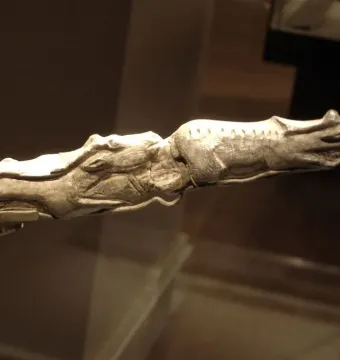
· CC BY 2.0
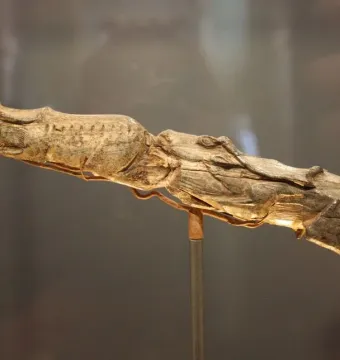
· CC BY-SA 2.0
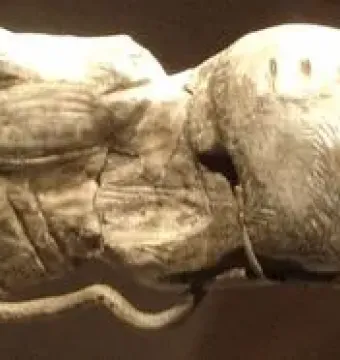
© Sleeping_Reindeer_3_2918856445_7d66cc4796_o.jpg · CC BY 2.0

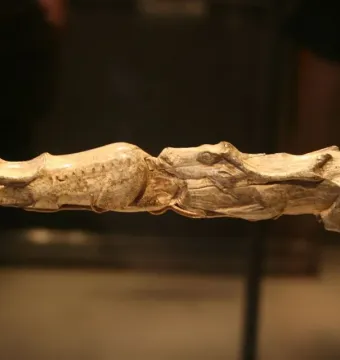
October 2011 © Discott · CC BY-SA 3.0
1912 © See File:Palæolithic Man and Terramara Settlements in Europe.djvu · Public domain
Identification | |
| Title | Swimming Reindeer |
| Original name | Renos nadadores |
| Other names | renas a nado; Schwimmende Rentiere |
| Type | Prehistoric sculpture |
Historical context | |
| Historical significance | Used as evidence that humans lived during the late Ice Age and coexisted with mammoths and reindeer in a climate similar to present-day Siberia |
| Period | Magdalenian |
| Date | about 13,000 years old |
Creator | |
| Artist | Unknown |
Discovery and provenance | |
| Discovery date | 1866 |
| Discovery location | Montastruc rock shelter, Bruniquel, France, on the bank of the Aveyron River |
| Discovery context | Found while Peccadeau de l’Isle was searching for evidence of prehistoric human presence during railway construction work |
| Discovery condition | Found in two separate fragments |
| Associated finds | Prehistoric flint tools; a carved spear thrower made from reindeer antler shaped like a mammoth; other objects from the last glacial period |
| Early exhibition | Exposition Universelle in Paris, 1867 |
| Later exhibition | Toulouse, 1884 |
| Acquisition | Purchased by the British Museum in 1887 for £500, after an initial asking price of 150,000 francs; funding came from the Christy Fund, a £5,000 bequest from Henry Christy |
| Key people in acquisition | Augustus Franks; Charles Hercules Read; Henry Christy |
| Identification history | Abbé Henri Breuil recognized in 1904 that the two fragments fit together as one sculpture, using the tail and snout as the basis for reassembly |
| Discoverer | Peccadeau de l’Isle; contemporary accounts also attributed the find to Victor Brun |
Physical characteristics | |
| Number of figures | Two reindeer, later understood to be two parts of a single sculpture |
| Condition | Very fragile ivory, kept in a controlled atmosphere and rarely moved |
| Length | 207 mm |
Materials | |
| Material | Mammoth tusk ivory |
| Material age | 13,000 years old |
| Material source | An extinct animal |
Technique | |
| Technique | Carved sculpture; engraved with a burin |
Appearance | |
| Leading animal | The female reindeer |
| Meaning of back markings | Unknown; possibly coloured markings or a count of animals killed |
| Back markings | Ten deeper cuts on each side of the back of the leading female reindeer |
| Surface treatment | The fur is marked with a burin to suggest different colouring and texture |
| Figure details | The female has visible teats; the male is distinguished by size, antlers, and genitals; both reindeer have antlers |
| Season depicted | Autumn |
| Depicted action | Swimming in a river crossing during migration |
| Depicted subject | A female reindeer followed by a larger male reindeer |
Iconography and meaning | |
| Interpretation of scene | An autumn migration river crossing, when reindeer would have been easier to hunt and their meat, skin, and antlers in optimal condition |
Significance | |
| Museum significance | Considered the oldest piece of art in any British museum; one of the oldest objects in the British Museum |
Location and ownership | |
| Current location | British Museum, London |
Other | |
| Practical function | Probably had no practical use |
| Interpretive note | Initially thought to be two separate reindeer carvings because the fragments did not obviously fit together |