
Talamone Pediment
The Talamone Pediment is a rare Etruscan-Hellenistic terracotta pediment discovered on the hill of Talamonaccio near Talamone. It decorated the Etruscan temple of Talamonaccio, a sanctuary of the Etruscan city of Telamon. The relief is the most important surviving artistic depiction of the myth of the Thebaid or the Seven against Thebes, showing the final battle between Eteocles and Polynices, with Oedipus in despair below and the dead sons carried away by soldiers. Other figures include Capaneus and the seer Amphiaraus, led to the Underworld by Vanth or the Erinyes. First found in the late 19th century, it was later reassembled in Florence, then after the 1966 flood and subsequent excavations reconstructed again. It is now kept in Orbetello, where it is displayed in a permanent exhibition.
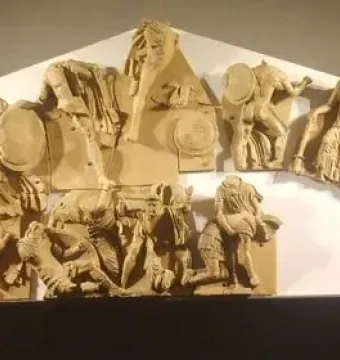
December 2006 © Sailko · CC BY 2.5
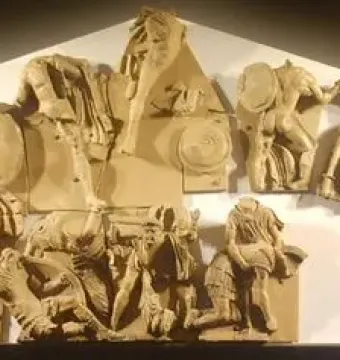
October 2009 © Tetraktys · CC BY 2.5
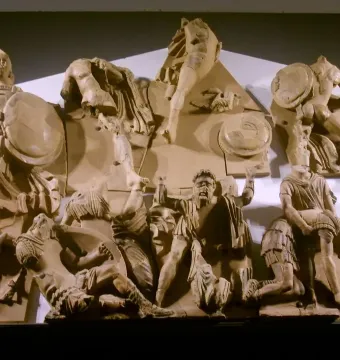
December 2006 © Sailko · CC BY 2.5
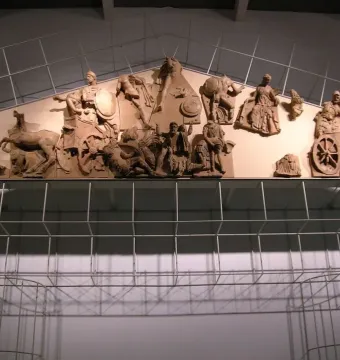
June 2005 © Nicolò Musmeci · Public domain
Identification | |
| Title | Talamone pediment |
| Type | Temple pediment relief |
| Original name | Il frontone di Talamone / Frontone di Talamone |
Historical context | |
| Culture | Etruscan |
| Period | Etrusco-Hellenistic period |
| Date | 150 BC (proposed); dating is not unanimously agreed |
| Rarity | A rare Etrusco-Hellenistic terracotta pediment; decoration on both sides is unusual in Etruscan temple architecture and remains without certain explanation |
Creator | |
| Scholars mentioned | Giuseppe Sordini; von Vacano; Françoise-Hélène Pairault Massa |
Discovery and provenance | |
| Initial transfer | Soon after discovery, the pieces were transported to Florence |
| Excavations | Regular excavations in the area were possible only after demilitarization in the 1960s; excavations dated 1962–1969 |
| Initial reconstruction | Reassembled in a room of the Archaeological Museum in Florence |
| Discovery location | Poggio Talamonaccio, near Talamone |
| Associated temple | Etruscan temple of Talamonaccio |
| Associated sanctuary | Sanctuary of the Etruscan city of Telamon |
| Archaeological context | Remains of a temple at the Etruscan center of Telamon, on the south-east slope of Talamonaccio hill |
| Discovery context | Found in several stages at the end of the 19th century; some fragments were noted by Giuseppe Sordini in 1892 behind the foundations |
| Further provenance note | After the construction of a military fort, two wall enclosures, houses, and roads belonging to the ancient Etruscan center and the medieval settlement were destroyed |
Physical characteristics | |
| Material | Terracotta |
| Object name | Pediment |
Appearance | |
| Main scene | The final combat between Eteocles and Polynices during the siege of Thebes |
| Central figure | Blind Oedipus kneeling at the center of the pediment |
| Other figures | Desperate Oedipus raising his hands to the sky; the dead bodies of his two sons being carried away by soldiers; Capaneus; Amphiaraus; Adrastus fleeing on a biga |
| Underworld scene | Vanth or the Erinyes carry Amphiaraus to the Underworld through a hole in the ground |
| Amphiaraus depiction | Amphiaraus falls with his battle chariot into the opening in the ground |
| Composition | The combat is shown at the center of the scene; figures are deliberately inclined forward to be seen better from below; the scene is rich and complex |
| Front pediment | The front pediment was also decorated, perhaps with a marine subject, but only a few fragments remain |
| Subject | The myth of the Seven against Thebes / the Thebaid |
Location and ownership | |
| Current location | Caserma Umberto I, Orbetello |
| Current display | Exhibited in a permanent display in its territorial provenance context |
| Original building position | Traditionally considered to have belonged to the temple front; von Vacano proposed the northern, rear side of the building |
| Visibility | Not visible from the bay below |
| Landmark function | A point of reference for ships coming from the south |
| Facade orientation | Facing the sea |
History and restoration | |
| Post-discovery reconstruction | After the 1966 flood of the Arno damaged the Florentine museum, the assembly was recomposed again; a new recomposition corrected inaccuracies and added later-found fragments |
| Transfer to Orbetello | In 2001 it was decided to transfer the pediment to Orbetello |
Significance | |
| Significance | Described as unique in its kind throughout Etruria |