
The Young Woman of Amajac
The Young Woman of Amajac is a Pre-Columbian sculpture housed in the National Museum of Anthropology in Mexico City. Discovered in January 2021 in eastern Mexico, it is dated to about 1450–1521, the Postclassic era of Mesoamerican history. The limestone figure stands 2 meters tall and shows a woman wearing a tunic-like garment and an ankle-length skirt. Her possible ornaments include round pendants known as oyoualli. The eye sockets are empty, suggesting that stones may once have been set into them. A peg at her bare feet allowed the sculpture to be placed upright in the ground.
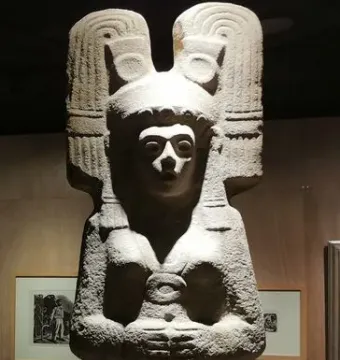
© Téenek artist · CC BY-SA 4.0
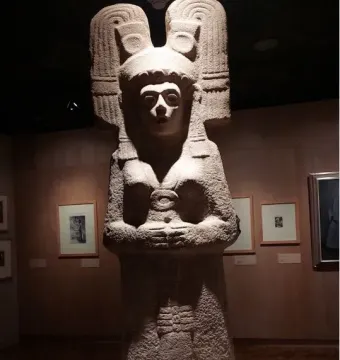
© Secretaría de Desarrollo Urbano y Vivienda / Gobierno de la Ciudad de México · CC BY 4.0
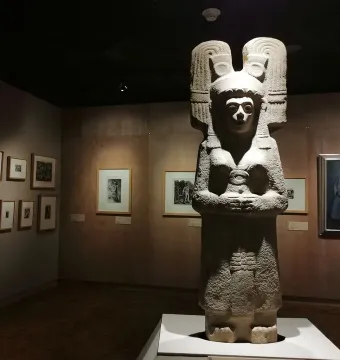
© Wotancito · CC BY-SA 4.0
Identification | |
| Title | The Young Woman of Amajac |
| Subject | An Indigenous young woman of high rank; the exact identity is unknown |
| Original Spanish title | La Joven de Amajac |
| Type | Pre-Columbian free-standing sculpture |
| Original-language title | Девушка из Амахака |
Historical context | |
| Date | c. 1450–1521 |
| Period | Postclassic era of Mesoamerican pre-Columbian civilization |
Creator | |
| Creator | Unknown |
Discovery and provenance | |
| Discovered by | A group of farmers |
| Material source | Limestone |
| Discovery location | A citrus field in Hidalgo Amajac, Álamo Temapache municipality, Veracruz, Mexico, near the Tuxpan River |
| Discovery date | 1 January 2021 |
| Discovery context | Found while farmers were preparing to till or plow the land |
Physical characteristics | |
| Height | 2 m |
| Width | 49 cm |
| Thickness | 29 cm |
| Figure height | 1.45 m |
| Weight | About 200 kg or more |
| Pose | Standing upright, barefoot, with hands held at abdomen level |
Materials | |
| Material | Limestone |
| Eye material | Likely stone, possibly shell and obsidian |
Appearance | |
| Facial features | Hollow eye sockets, a straight nose, and an open mouth |
| Mounting feature | A stake at the feet allowed the sculpture to be placed upright in the ground |
| Jewelry | Necklace, earrings, and circular pendants (oyohualli) |
| Headgear | A headdress with two locks of hair and a cap with jade elements |
| Clothing | Bare torso, blouse or tunic-like garment, and ankle-length skirt |
Iconography and meaning | |
| Probable identification | Researchers have suggested a goddess, a ruler, a noblewoman, or another elite figure; the exact identification is disputed |
| Symbolic interpretation | The hand position has been interpreted as referring to fertility |
Location and ownership | |
| Current location | National Museum of Anthropology, Mexico City |
| Current display site | Recinto Cultural de Hidalgo Amajac |
| Exhibition | La Grandeza de México (The Grandeur of Mexico) |
History and restoration | |
| Replica estimated cost | 7.5 million pesos (about US$376,000) |
| Replica planned height | About 6 m |
| Replica structure | Divided into four sections with an internal metallic skeleton to help cushion earthquakes |
| Replica material | Tezontle with a black basalt plinth |
| Replica fabrication | Designed by INAH workers and sculpted by stonemasons from Chimalhuacán using stone from a mine in Amecameca, State of Mexico |
| Related proposal | The replica replaced an earlier proposal for Tlalli, an Olmec colossal head by Pedro Reyes |
| Replacement context | The Columbus monument had been removed in 2020, and the site was also associated with a feminist protest space established in 2021 |
| Original intended site of replica | The 19th-century neoclassical pedestal formerly used by the Columbus statue |
| Replica location | Installed on an adjacent traffic island near the former Columbus roundabout on Paseo de la Reforma, Mexico City |
| Replica installation date | 23 July 2023 |
| Replica announcement date | 12 October 2021 |
| Replica for Mexico City | A replica was commissioned to replace the Monument to Christopher Columbus on Paseo de la Reforma in Mexico City |
| Display history | Displayed at the National Museum of Anthropology from August 2022, then temporarily returned to Hidalgo Amajac for a tribute and cultural festival |
Significance | |
| Archaeological significance | First sculpture of this kind found near the Tuxpan River |
| Interpretation by INAH | INAH compared it to the Huastec fertility goddess Tlazōlteōtl, but did not rule out an elite figure |
| Interpretation by officials | Alejandra Frausto Guerrero said it was likely an important female ruler and suggested it supports the idea of women's participation in Huastec political life |
| Political context | Associated with debates over decolonizing Paseo de la Reforma, protests against colonial monuments, and criticism and support from Indigenous and feminist groups |
Other | |
| Documentary | La Joven de Amajac, una mujer entre el naranjal, produced by the Ministry of Culture and INAH in November 2021 |
| Related sculpture | La jeune femme d’Amajac II, a smaller but very similar sculpture |
| Associated people | Alejandra Frausto Guerrero, Claudia Sheinbaum, Martí Batres, Pedro Reyes, Blanca González Rosas, and Indalí Pardillo |