
Giustiniani Hestia
Giustiniani Hestia is a finely executed marble sculpture, probably a Roman copy from the Hadrianic period of a bronze original dated to 470–460 BC. It is now preserved in the Torlonia collection in Rome and takes its name from its first owner, the banker Vincenzo Giustiniani. The work is notable as the only full-length marble replica of a classical bronze made for a Roman collection, reflecting Roman taste for Hellenistic Baroque forms. Its severe facial expression and ample drapery have led scholars to propose different attributions for the lost original, including Calamis. Traditionally identified as Hestia through antiquarian scholarship, it was recorded in Giustiniani inventories from the 1630s and later passed to the Torlonia family in the nineteenth century.
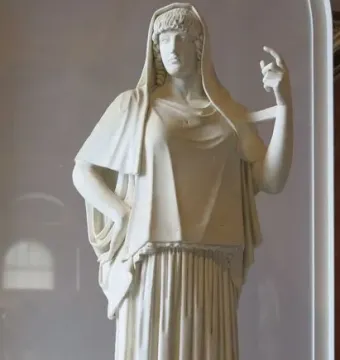
July 2024 © Tangopaso · Public domain
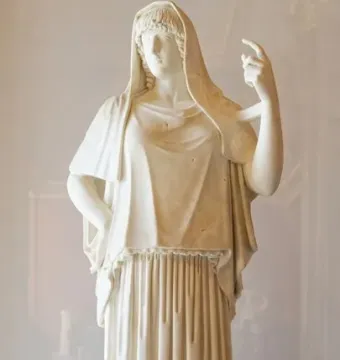
July 2024 © Marie-Lan Taÿ Pamart · Public domain
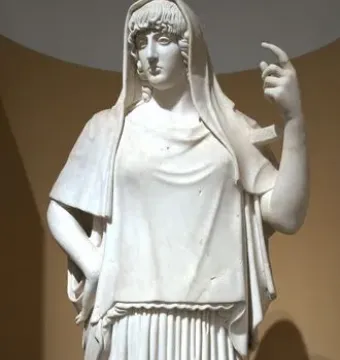
May 2021 © Sailko · CC BY 3.0
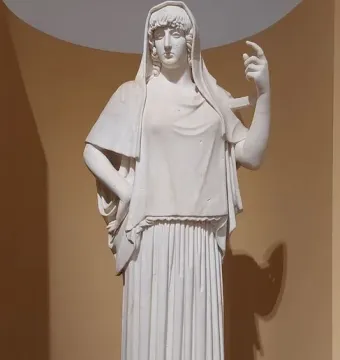
© TimeTravelRome · CC BY 2.0
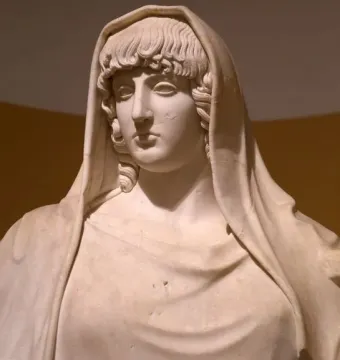
May 2021 © Sailko · CC BY 3.0
Identification | |
| Title | Giustiniani Hestia |
| Alternative name | Hestia Giustiniani |
| Original-language name | Гестія Джустініані |
| Type | Marble statue |
| Subject | Hestia, goddess of the household hearth and sacrificial fire in ancient Greek mythology |
Historical context | |
| Date of original | About 470–460 BC |
| Copy period | Hadrianic period |
| Original work status | Lost original |
Creator | |
| Original artist | Unknown; various Attic or Argive sculptors have been proposed, including Calamis and perhaps Hageladas |
Discovery and provenance | |
| First known owner | Vincenzo Giustiniani |
| Named after | Vincenzo Giustiniani, its first owner |
| Earliest documentation | Drawn for Cassiano dal Pozzo in the early 1630s; later illustrated in the Galleria Giustiniani inventory and François Perrier's Segmenta nobilium signorum et statuarum quae temporis dentem invidium evasere (1638) |
| First written mention | 1638 |
| Inventory description | "vergine vestale vestita, di marmo greco tutta antica alta palmi 9" |
| Ownership history | Sold by the Giustiniani heirs to the Torlonia family in the 19th century |
Location and ownership | |
| Former locations | Palazzo Giustiniani in Rome; Palazzo Corsini; Villa Albani; courtyard of Palazzo Torlonia on Via della Conciliazione |
| Inventory number | MT490 |
| Current location | Torlonia Collection, Rome |
History and restoration | |
| Restoration | Restored in the 1990s |
Physical characteristics | |
| Height | 193 cm |
| Description | Finely executed marble sculpture; clad female figure with a sleeveless peplos, heavy vertical folds, compact locks under a flowing veil, and a body so shrouded that the pose is relaxed only by a slight turn of the head |
| Condition | Wholly antique |
Materials | |
| Material | Marble |
| Original material | Bronze |
Iconography and meaning | |
| Identification | Conventionally identified as Hestia, also described as a clothed Vestal Virgin |
| Comparative work | Afrodite Sosandra |
| Stylistic features | Austere face, intense expressiveness, and drapery that outlines the body without diminishing its vigor |
Significance | |
| Art-historical significance | A turning point in the evolution of the standing female figure in Greek sculpture |
| Significance | The only known full-length marble replica of an Early Classical Greek bronze made for a Roman collection |
| Artistic context | Testifies to Roman taste for the Hellenistic baroque current |
| Winckelmann interpretation | Winckelmann used it as an example of the severe early phase of classical Greek sculpture |
| Context of identification | The Hestia identification is based on antiquarian studies of the 17th and 18th centuries and may be linked to the learned circle around Cassiano dal Pozzo |