
Antinous Mondragone
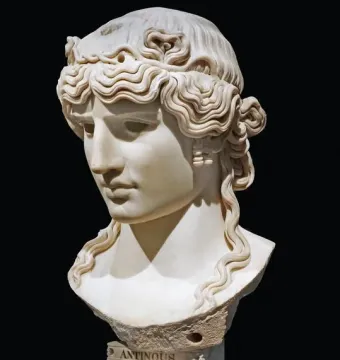
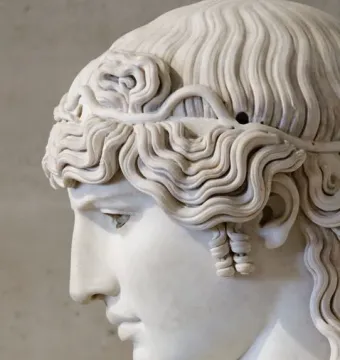
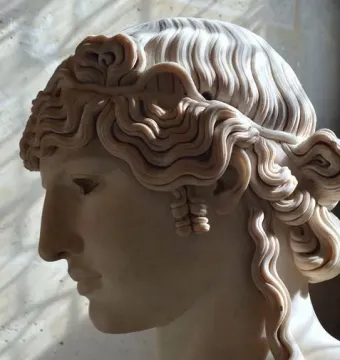
Antinous Mondragone is a colossal marble head, 0.95 metres high, representing the deified Antinous, the beloved of Emperor Hadrian. It was made between 130 and 138 CE during Hadrian’s reign and is thought to have been rediscovered near the ruins of the Roman town of Tusculum. After its rediscovery, it was kept at Villa Mondragone as part of the Borghese collection and was sold to Napoleon Bonaparte in 1807. The sculpture belongs to the Mondragone type of the Antinous cult, identified by its distinctive hairstyle with a reference to Dionysus. It is now conserved at the Louvre Museum in Paris.
March 2019 © Jean-Pierre Dalbéra · CC BY 2.0
© Unknown artistUnknown artist · CC BY 2.5
September 2015 © Carole Raddato · CC BY-SA 2.0
© Schmidt, Wittig · CC BY-SA 3.0 de
© Marie-Lan Nguyen · CC BY-SA 3.0
Identification | |
| Title | Antinous Mondragone |
| Iconographic type | deified Antinous type |
| Subject | Antinous |
| Alternative name | Antinoüs Mondragone |
| Subtype | Mondragone type |
| Type | colossal marble head; acrolithic sculpture |
Historical context | |
| Date made | 130–138 CE |
| Period | Hadrianic Roman period (reign of Emperor Hadrian, 117–138 CE) |
| Historical context | Made under Hadrian as part of the cult of Antinous |
| Cult type | One of three distinct statue types of the cult of Antinous |
| Origin of cult | Associated with Hadrian's grief after the death of Antinous |
| Death of Antinous | Died in 130 CE; the most widely accepted account is that he drowned in the Nile, though the circumstances are disputed |
| Relationship with Hadrian | Widely accepted that Antinous was Hadrian's lover and that they had a sexual relationship, though the relationship is poorly documented |
| Antinous's birth | Probably c. 110–112 CE |
| Antinous's age at death | About 18–20 years old |
| Antinous's origin | Bithynium (Claudiopolis), Bithynia |
| Cult association | One of many works made within the cult of Antinous |
Creator | |
| Stylistic comparison | Strongly recalls the statue of Athena Lemnia |
| Style | Executed in the spirit of classical Greek art of the 5th century BC |
| Prototype / model | The head of Athena Lemnia by Phidias is considered one of its prototypes |
Materials | |
| Material | White marble |
| Material detail | Single block of white marble; polished |
| Eyes | Eyes were originally inlaid and are now lost, probably made of colored stone |
| Headgear | The head likely had a lost bronze headdress, probably a lotus flower or uraeus |
| Possible original medium | Possibly a copy of a bronze original |
| Possible larger work | Possibly part of a colossal acrolithic statue |
Technique | |
| Construction | Acrolithic sculpture; the rest of the statue may have been made of wood |
| Holes for attachment | 31 holes of three different sizes |
| Purpose of holes | Probably used to attach an object to the head |
Appearance | |
| Original function | Probably originally part of a cult image or idol used for worship of the boy-god |
| Head position | Head turned downward to the right |
| Comparative resemblance | Made to resemble Dionysus or Apollo |
| Eyes | Empty eye sockets behind the eyelids |
| Surface treatment | Smooth, highly finished skin |
| Width | 37 cm |
| Facial features | Straight, incised eyebrows; large nose; full lips; full cheeks; slight tilt of the head; sad expression |
| Hair | Distinctive hairstyle with simple but elegant lines; identifies the Mondragone type |
| Type of work | Head sculpture / portrait head |
| Height | 95 cm |
| Iconographic reference | The hairstyle refers to the Greek god Dionysus |
Iconography and meaning | |
| Subject identification basis | Recognized by the distinctive features of its depictions |
| Stylistic character | Combines portrait accuracy with idealization |
| Symbolic association of headdress | Intended to associate Antinous with Osiris |
Location and ownership | |
| Sale | Sold to Napoleon Bonaparte in 1807 |
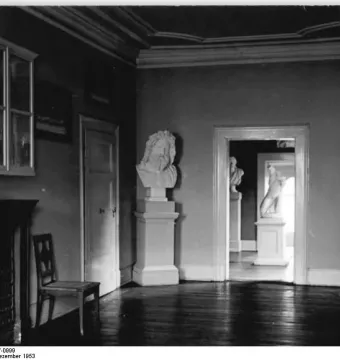
| Early display context | Installed among antiquities on pedestals in the gallery of Villa Mondragone, Monte Porzio Catone |
| Current location | Louvre Museum, Paris, France |
| Post-discovery location | Villa Mondragone, as part of the Borghese collection |
| Discovery location | Near the ruins of the Roman city of Tusculum, in the area of Frascati |
| Discovery | Said to have been rediscovered in the early 18th century; the exact date is not given |
History and restoration | |
| Earlier identification | A male head once thought to represent Julius Caesar |
| Later surface treatment | A brown wax layer was added later to give a matte finish |
| Later reconstruction | Plaster was added around the base of the neck to make it appear as a complete bust |
| Restoration outcome | The wax layer and plaster addition were later removed during restoration and cleaning |
Significance | |
| Artistic reputation | Considered one of the best portraits of Antinous |
| Significance | One of the most famous and most identifiable images of antiquity |
| Winckelmann's description | Johann Winckelmann called it 'the royal glory of art for all ages' and praised its fresh, hand-finished appearance |
| Szymonds's criticism | John Addington Symonds criticized it in 1879 for 'emptiness and lifelessness' |
| Cultural significance | Its image and cult helped create interaction between the Greek, Roman, and Egyptian spheres |
| Cult distribution | Antinous had a long-lasting and widespread cult, especially in the eastern empire; cult centers included Alexandria, Asia Minor, Antinoopolis, Hermopolis, Oxyrhynchus, Tebtynis, Mantineia, Athens, Bithynia, Smyrna, Nicomedia, Tarsus, mainland Greece, Italy, and the North African coast |
| Cult evidence | At least two temples in Antinoopolis; two temples in Mantineia; at least four sculptures in Athens; seven temples in Italy; at least 13 cities on the Greek mainland; about 27 cities in Asia Minor; at least 10 areas in Italy |