
Hercules of the Theatre of Pompey
Hercules of the Theatre of Pompey is a bronze statue in the Vatican’s Pio-Clementino Museum. It is a rare surviving example of an ancient gilded bronze sculpture. The figure depicts Hercules with his usual attributes: a club made of olive wood, the skin of the Nemean lion, and the golden apples of the Garden of the Hesperides held in his left hand. The statue is a copy of an older model and was discovered in 1864 near the Theatre of Pompey on the Campus Martius, carefully buried under slabs inscribed “F.C.S.” This inscription suggested it had been struck by lightning and buried in place, which may explain why it survived instead of being melted down. It is now displayed in the Round Room of the Pio-Clementino Museum.
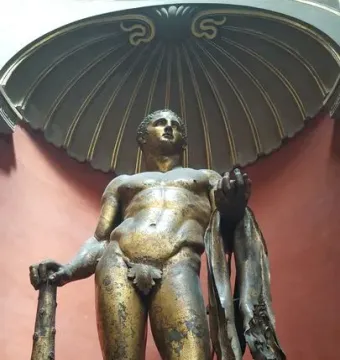
April 2017 © Jamie Heath · CC BY-SA 2.0
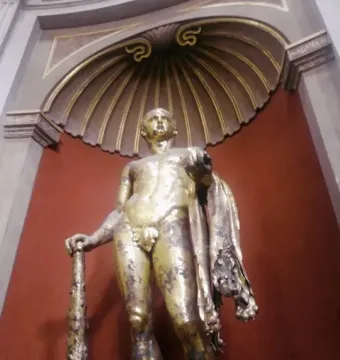
April 2024 © Արարատ Թրվանց · CC0
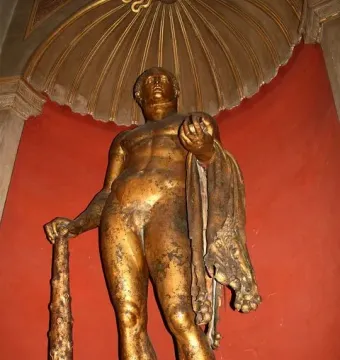
September 2011 © Jean-Pol GRANDMONT · CC BY-SA 3.0
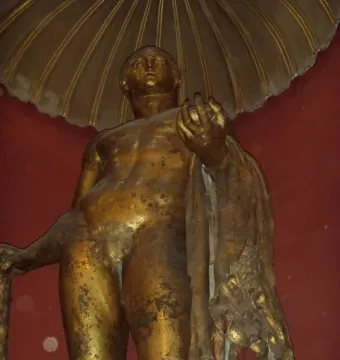
October 2009 © GeoTrou · CC BY-SA 3.0
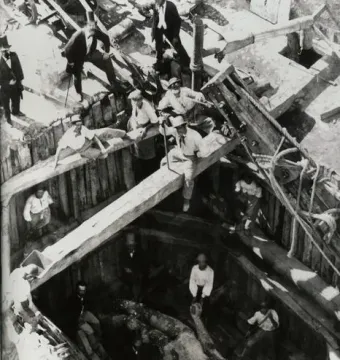
March 2007 © User:Amadscientist · Public domain
Identification | |
| Title | Hercules of the Theatre of Pompey |
| Original-language title | Herkules z Teatru Pompejusza |
| Type | Roman sculpture |
| Sculpture type | Statue |
| Alternative title | Hercules Mastai |
Historical context | |
| Date | Second half of the 2nd century |
| Prototype | Greek original from the beginning of the 4th century BC |
| Possible later intervention | Possible interventions in the upper part at the end of the 3rd century |
Creator | |
| Artist | Unknown |
Discovery and provenance | |
| Associated ritual | A sheep was sacrificed on the occasion |
| Date of donation to Pope Pius IX | 15 December 1865 |
| Donor | Pietro Righetti, vice minister of finance in the government of the Papal States |
| Discovery date | 1864 |
| Inscription interpretation | Indicates that the statue had been struck by lightning and buried on the spot |
| Inscription | F.C.S. (F C S; fulgor conditum summanium) |
| Discovery context | Found carefully buried beneath protective tiles / slabs, lying horizontally inside a pit covered by a travertine slab |
| Discovery location | Courtyard of Palazzo Pio Righetti near Campo de' Fiori, Rome, near the Theatre of Pompey on the Campus Martius |
| Date entered museum collection | 24 March 1866 |
Physical characteristics | |
| Dimensions | Not stated |
Materials | |
| Material | Gilded bronze |
| Restoration materials | Plaster and bronze |
Technique | |
| Restorer | Pietro Tenerani |
Appearance | |
| Proportions | Follows the canon of proportions associated with Lysippus |
| Contrast | In contrast to the bearded, corpulent Farnese Hercules |
| Musculature | Exaggerated |
| Stylistic comparison | Similar to the Hercules of the Forum Boarium |
| Style | Classicizing |
| Attributes | Lion skin draped over the left forearm; golden apples of the Hesperides in the left hand; club made of olive wood |
| Pose | Young Hercules leaning slightly on a vertical club, with the weight on one foot (Lysippan chiasmus) |
| Depicted figure | Heracles (Hercules) |
Location and ownership | |
| Current collection | Museo Pio-Clementino |
| Current location | Pio-Clementino Museum, Vatican |
| Current display location | Sala Rotonda (Round Room of the Pio-Clementino Museum) |
| Inventory number | MV.252.0.0 |
Significance | |
| Status | Rare surviving example of an ancient gilded bronze statue |
| Historical explanation for survival | It was not melted down because it was considered bad omen to melt a statue struck by lightning, a celestial element |
| Roman treatment of lightning-struck objects | They were not burned, but buried on the spot and treated as sacred |