
Filarete Door
The Filarete Door is the central one of five entrance portals on the front façade of St. Peter’s in Rome. This monumental double-leaf bronze door was made between 1433 or 1439 and 1445 by the Florentine sculptor and architect Antonio Avelino, known as Filarete, together with his workshop. Its six large panels show Christ Pantocrator and Mary, below them Paul and Peter, Pope Eugene IV handing over the key, and in the lower sections the martyrdom of the two apostles: the beheading of Paul and the crucifixion of Peter. Between the main scenes are events from the patron’s life. The floral border frieze includes scenes from Greek mythology, Aesop’s fables, Roman history as transmitted by Livy, and Virgil’s Eclogues.
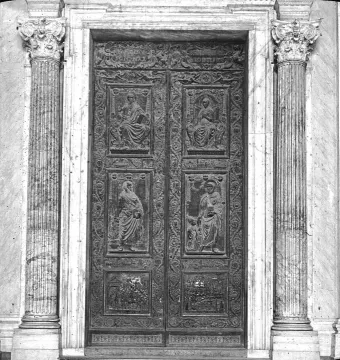
April 2004 © Brooklyn Museum · No restrictions
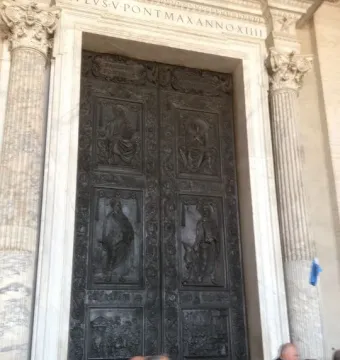
June 2014 © daryl_mitchell · CC BY-SA 2.0
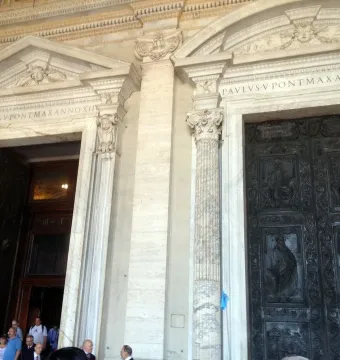
June 2014 © daryl_mitchell · CC BY-SA 2.0
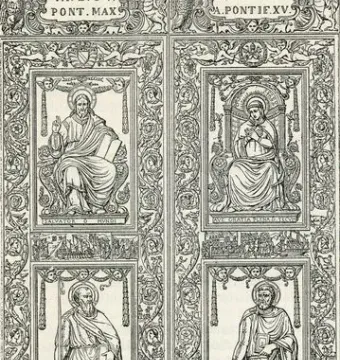
1894 © Incisore sconosciuto · Public domain
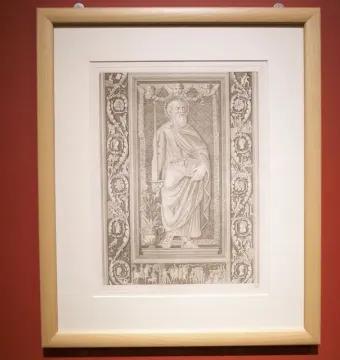
June 2018 © Milton Martínez / Secretaría de Cultura CDMX · Public domain
Identification | |
| Title | Filarete Door |
| Type | monumental double-leaf bronze portal door |
| Original title | Porta del Filarete |
Historical context | |
| Commission date | 1431 |
| Date of creation | 1433–1445 |
| Historical context | Created during the restoration of the ancient Roman basilicas promoted by Martin V and Eugenius IV, amid a politically turbulent period |
Creator | |
| Previous workshop association | Worked in the workshop of Lorenzo Ghiberti |
| Previous work | Worked on the casting of the north door of the Florence Baptistery |
| Commissioned by | Pope Eugene IV (Eugenio IV Condulmer) |
| Workshop | Filarete and his workshop |
| Artist background | Florentine sculptor and architect |
| Artist | Filarete (Antonio di Pietro Averlino / Antonio Avelino) |
Discovery and provenance | |
| Commission purpose | For the furnishing of Old St. Peter's Basilica, intended as a renewal of the Porta Argenta (Silver Gate) |
| Original installation location | Central entrance of Old St. Peter's Basilica in Rome |
| Reinstallation date | 1618–1619 / 1620 |
| Current location | Central portal of St. Peter's Basilica, Vatican City |
| Relocation note | Installed in the central opening of the new basilica after the demolition of the old basilica |
History and restoration | |
| Alterations on relocation | The leaves were extended at the top and bottom with wide strips, with dedications to Paul V, to adapt them to the height of the new basilica |
| Restoration date | 1962 |
Materials | |
| Primary material | Bronze |
| Core material | Wood |
| Cladding materials | Bronze plates on the outside; bronze sheet metal on the inside |
Physical characteristics | |
| Additional structure | The panels are framed by vine, acanthus, and festoon borders, with narrative strips between the images |
| Structure | Each leaf is divided into three superimposed panels |
| Number of leaves | Two |
| Dimensions of each leaf | 6.35 m high, 1.79 m wide |
Appearance | |
| Decoration | Figural reliefs with classical motifs, emperor profiles, portraits of contemporary figures, and ornamental borders |
| Surface decoration | Originally colored enamel decoration, now surviving only in faint traces |
Iconography and meaning | |
| Scene of Rome | A panorama of Rome beyond the Tiber with the Pyramid of Cestius, the Mausoleum of Hadrian, the Meta Romuli, and the terebinth tree |
| Rear-side scene | A celebratory round dance with wine, music, and dance, showing Filarete and his students, with a donkey rider, a camel rider, and other named figures |
| Self-portrait | Filarete represented himself in profile on the frame and in a rear-side scene leading his students |
| Symbolism | The door represents the universality of the Church and the continuity of the Imperium of Rome in a pre-Renaissance humanist spirit |
| Inscriptions | OPUS ANTONII DE FLORENTIA; ANTONIUS PETRI DE FLORENTIA FECIT MCCCCXLV; ANTONIVS ET DISCIPVLI MEI; and CETERIS OPERE PRETIVM PASTVS FVMUS VE MINI HILARITAS |
| Narrative strips | Episodes from the pontificate of Eugene IV, including the Council of Ferrara-Florence, John VIII Palaiologos's journey and reception, the Council session in Florence, the departure of the Greek delegation, and the coronation of Sigismund of Luxembourg |
| Lower scenes | The martyrdom of Saint Paul, including his beheading and his appearance to Plautilla, and the upside-down crucifixion of Saint Peter |
| Middle scenes | Saint Paul with the sword and book, and Saint Peter handing the keys to Pope Eugene IV |
| Main upper scenes | Christ enthroned (Salvator mundi) and the enthroned Madonna |
| Intended message | To exalt the Roman Church and its primacy as heir to pagan Rome, and to comment on the papacy's claim to primacy during the Council of Florence era |
| Iconographic program | Learned theological iconography influenced by early humanism, with Christian, papal, imperial, mythological, and literary themes |
Location and ownership | |
| Usual state | Usually closed and opened only on certain feast days |
| Historical site | St. Peter's Basilica / Old St. Peter's Basilica, Rome/Vatican City |
Significance | |
| Stylistic context | Late Gothic with new antiquarian interest in antiquity |
| Artistic novelty | Abandoned the traditional scheme of small panels in favor of larger panels |
| Inspirational sources | Rare surviving ancient bronze doors, especially those of the Pantheon |
| Historical orientation | An antiquarian attempt to recreate a plausibly classical style rather than a strictly philological reconstruction |
| Reception | Deprecared by Vasari |
| Stylistic character | A hybrid style combining strong volumetric modeling and spatial flatness, summary anatomy and minute decorative detail |
| Iconographic sources | Matthew 16:13–19, the Legenda aurea, and the apocryphal Acts of Peter |