
Thutmose III Sphinx
The Thutmose III sphinx is a bronze statuette dating to the reign of Thutmose III, who ruled from 1479 to 1425 BCE. Decorated with gold inlays and multiple symbols of royal power, it may originally have been part of a lock. The figure shows the pharaoh lying on the Nine Bows, the traditional enemies of Egypt brought into submission, and includes the djed pillars on its sides. Purchased by the Louvre in 1826, it is now part of the permanent collection of the Egyptian Antiquities department, in room 24 of the Sully wing on the first floor.
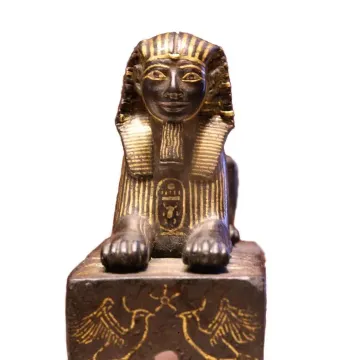
© Rama · CC BY-SA 3.0 fr
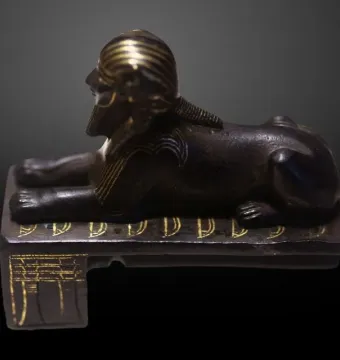
© Rama · CC BY-SA 3.0 fr
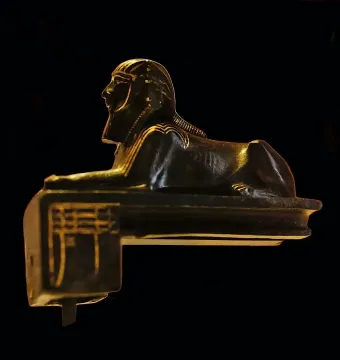
© Mbzt · CC BY 4.0
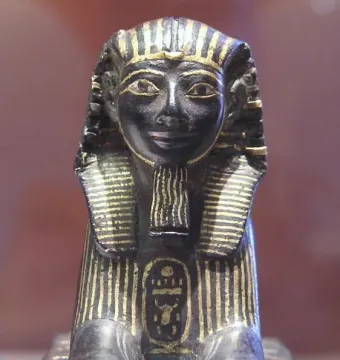
April 2005 © Neithsabes · Public domain
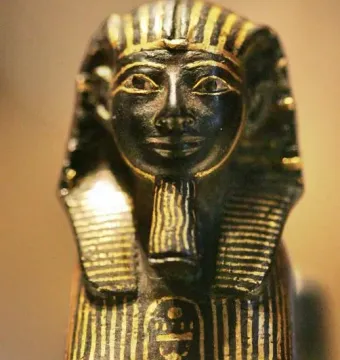
© Rama · CC BY-SA 3.0 fr
Identification | |
| Title | Thutmose III sphinx |
| Type | Bronze sphinx statuette |
| Alternative name | The Bronze Sphinx of Thutmose III |
Historical context | |
| Dynasty | 18th Dynasty of Egypt |
| Date | Thutmose III reign, c. 1479–1425 BCE (Low Chronology; alternative high chronology 1504–1450 BC) |
Creator | |
| Depicted ruler | Thutmose III (Menjeperra Dyehuthymose) |
| Ruler description | Sixth pharaoh of Egypt's 18th Dynasty; described as one of the most important and powerful monarchs of the three thousand years of pharaonic civilization |
Discovery and provenance | |
| Acquisition | Purchased by the Louvre Museum in 1826 |
Location and ownership | |
| Current collection | Permanent collections of the Department of Egyptian Antiquities, Louvre Museum |
| Current location | Display case 4, Room 637 (formerly Room 24), Sully Wing, first floor, Louvre Museum |
Physical characteristics | |
| Material | Bronze |
| Decorative material | Gold inlays |
Appearance | |
| Base decoration | Engraved with the Nine Bows |
| Depiction | A sphinx showing the pharaoh reclining on the Nine Bows, the traditional enemies of Egypt brought into submission |
| Decoration | Ornamented with symbols of royal power, including djed pillars on the sides |
Iconography and meaning | |
| Nine Bows meaning | Traditional enemies of Egypt |
| Nine Bows representation | When shown generically, represented by nine double semicircles (nb, 'all') arranged in three columns |
| Front inscription | Uses the Rekhyt bird in a rebus meaning 'all people give praise' |
| Hieroglyphs in rebus | Basket hieroglyph V30 (nb) for 'all'; Rekhyt bird hieroglyph G24 (rḫyt) for 'the people'; star hieroglyph N14 for 'praising' |
| Symbolic meaning | Highlights symbols of royal power |
| Linguistic device | Rebus |
Other | |
| Possible function | May have been an element of a lock or used to open a door; forms part of a cartouche-like device |
| Comparative reference | The Nine Bows can be seen on the base of the statue of Nectanebo II |
Significance | |
| Chronology note | Low Chronology has been the conventional academic dating since the 1960s; some circles prefer the high chronology |