
Mantineia Base
The Mantineia Base is a group of three sculpted bas-relief plaques. One panel shows Apollo, Marsyas, and a silenus, while the other two each depict a group of three Muses. The plaques were discovered in 1887 at the site of the ancient Greek city of Mantinea in Arcadia. They probably formed the decoration of a statue base and have been attributed to Praxiteles or his workshop. The reliefs are now kept in the National Archaeological Museum in Athens under inventory numbers MNA 215, MNA 216, and MNA 217.
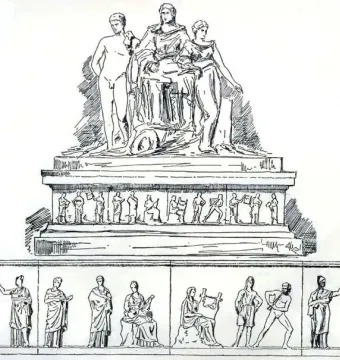
1891 © Archaeological Institute of America · Public domain
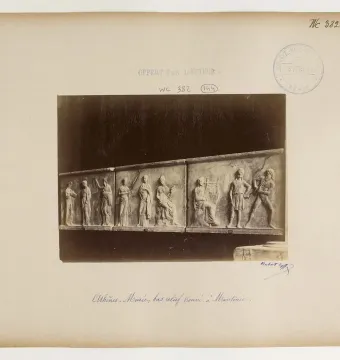
© Vaffier, Hubert (1834-1897). Photographe. Donateur · Public domain
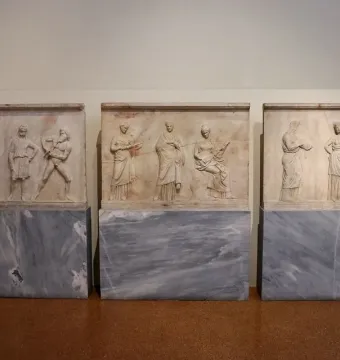
June 2018 © George E. Koronaios · CC BY-SA 4.0
Identification | |
| Title | Mantineia Base |
| Original-language name | La base de Mantinée |
| Type | Set of three sculpted low-relief plaques |
| Number of plaques | 3 surviving plaques |
Historical context | |
| Ancient source | Pausanias' description of Mantineia and a sanctuary of Leto and her children |
Creator | |
| Attribution | Attributed to Praxiteles or a member of his workshop |
Discovery and provenance | |
| Discovery date | 11 August 1887 |
| Discovery place | Mantineia, Arcadia |
| Discoverer | Gustave Fougères |
| Excavation context | Excavations by the French School at Athens |
| Findspot context | The plaques had been reused in the pavement/floor of a Byzantine church |
| Condition at discovery | The exposed upper side was worn by the feet of worshippers, but the side against the ground preserved the sculptural decoration in good condition |
| Findspot clue | One Muse head from plaque MNA 217 was found in the ruins of the theatre |
Location and ownership | |
| Inventory numbers | MNA 215, MNA 216, MNA 217 |
| Current location | National Archaeological Museum of Athens |
History and restoration | |
| Post-discovery treatment | Immediately transferred to the National Archaeological Museum in Athens and restored |
Materials | |
| Material | Pentelic marble |
| Previous material identification | Initially identified as Doliana marble near Tegea |
Physical characteristics | |
| Dimensions | MNA 215: 1.36 m high × 0.96 m wide; MNA 216: 1.35 m high × 0.96 m wide; MNA 217: 1.36 m high × 0.98 m wide |
| Thickness | 8–12 cm |
| Shared features | All three plaques have the same top and bottom mouldings and three fixing holes in the same positions |
Technique | |
| Relief style | Low relief on a plain background |
Appearance | |
| Composition style | Figures are simply juxtaposed without elaborate compositional arrangement |
Iconography and meaning | |
| MNA 215 iconography | Left figure holds an aulos; center figure holds the folds of her himation; right figure sits and plays a small string instrument |
| Interpretive note | The inferred fourth plaque is hypothetical and not directly preserved |
| Missing plaque hypothesis | A fourth plaque has been inferred, probably showing a third group of three Muses |
| Muses count in classical tradition | Nine |
| MNA 217 iconography | Left figure holds an unrolled scroll; center figure holds a rolled-up scroll in her left hand; right figure raises a kithara |
| Main scene | Apollo seated at left, Marsyas at right, and a bearded servant standing between them |
| Other plaques subject | The other two plaques depict groups of Muses |
| Central figure identification | Interpreted as the servant who skins Marsyas after Marsyas loses the musical contest against Apollo |
| Central figure depiction | A standing bearded man wearing a Phrygian cap, a chiton, and anaxyrides, holding a knife |
| Marsyas depiction | Bearded, with one leg bent and the other extended, playing the aulos |
| Apollo depiction | Seated, with long hair, wearing a chiton and himation, holding a cithara on his left knee and gathering a fold of his himation with his right hand |
| Mythological subject | The musical contest between Apollo and Marsyas, and its aftermath |
Interpretation | |
| Alternative arrangement | The plaques may have been aligned in a row, with Apollo and Marsyas in the center and the Muses on either side |
| Assessment of alternative function | This reconstruction is not supported by other archaeological evidence |
| Support for alternative function | Polybius says such contests took place every year in Arcadia |
| Another proposed function | Decoration for a platform or estrade used by competitors in annual music contests in Arcadia |
| Problem with alternative arrangement | No trace remains of side connections for the panels, which weakens this hypothesis |
| Proposed emendation | Emend Μοῦσα to Μοῦσαι ('Muses') |
| Problem with reconstruction | A base measuring about 1.36 × 1.36 m would be too small to accommodate the three statues mentioned by Pausanias |
| Status of emendation | The plural reading has been generally accepted |
| Textual issue | The transmitted text mentions a single Muse, but this is problematic because the surviving reliefs show Muses in the plural |
| Basis for reconstruction | A passage of Pausanias describing carvings on a base at Mantineia |
| Reconstruction by Fougères | The three plaques were proposed to form three sides of a rectangular pedestal decorated in low relief |
Other | |
| Certainty | Several reconstructions and readings are hypothetical or disputed |