
Khafre Enthroned
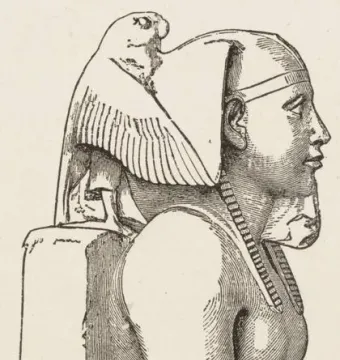
Khafre Enthroned is a ka statue of the pharaoh Khafre, ruler of ancient Egypt’s Fourth Dynasty. Carved from anorthosite gneiss, a valuable and extremely hard dark stone, it was brought down the Nile from the Khafre quarries west of Gebel el-Asr. The statue was made for the pharaoh’s valley temple near the Great Sphinx and is now in the Egyptian Museum in Cairo. It shows Khafre seated rigidly on a throne, wearing a nemes headdress, false beard, and kilt. The throne features lion bodies, lotus and papyrus plants, and the wings of Horus behind his head. The sculpture’s strict symmetry and stillness emphasize eternal kingship and the ka’s permanence.
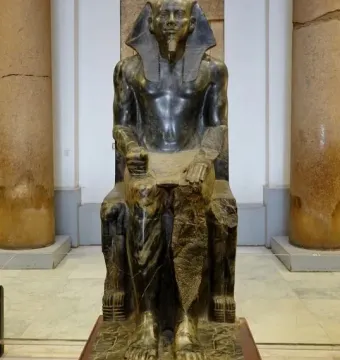
October 2019 © Olaf Tausch · CC BY 3.0
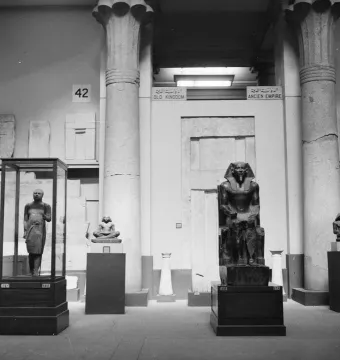
1962 · CC BY-SA 3.0
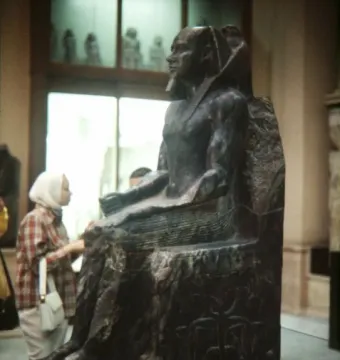
June 2002 © Gary Todd · CC0
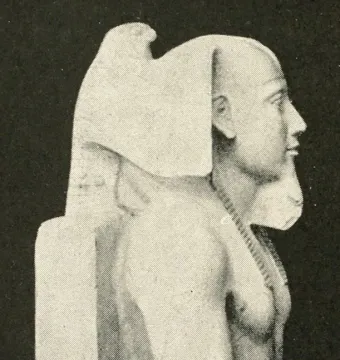
1902 © Internet Archive Book Images · No restrictions
1884 © Unknown author · CC BY-SA 2.5
Identification | |
| Title | Khafre Enthroned |
| Type | Ancient Egyptian funerary sculpture; seated statue; ka statue |
| Alternative title | Statue of Khafre seated on a throne; Statue Seated of Khafre; Statue Seated of Khafra |
| Inventory number | JE 10062; CG 14 |
Historical context | |
| Period | Old Kingdom; Fourth Dynasty of ancient Egypt |
| Date of creation | c. 2550–2480 BC |
| Associated historical figure | Khafre, fourth pharaoh of Egypt's Fourth Dynasty |
| Khafre's reign | c. 2558–2532 BC; another source gives c. 2547–2521 BC |
Creator | |
| Creator | Egyptian sculptors |
| Craftsmanship | Very high artistic skill |
Discovery and provenance | |
| Condition | JE 10062 is almost completely preserved; left forearm and part of the left leg are missing |
| Current location | Egyptian Museum, Cairo |
| Reason for burial | Unknown |
| Evidence for original placement | Floor depressions indicate where the statues originally stood |
| Original number in hall | 23 or 24 statues |
| Associated finds | Nine complete statues and fragments of a tenth statue; other accounts mention up to 23 or 24 statues |
| Findspot status | Not found in situ |
| Discoverer | Auguste Mariette |
| Discovery date | 1860 |
| Context | Part of the necropolis and funerary temple complex; associated with funeral rituals |
| Original function | Used in the funerary cult as a substitute body and seat for the king's ka |
| Original location | Valley Temple of the Khafre pyramid in Giza, near the Great Sphinx |
| Discovery location | A shaft or paved pit within the Valley Temple at Giza |
Physical characteristics | |
| Body depiction | Idealized, youthful, robust physique with defined muscles and ideal proportions |
| Surface finish | Smoothly polished |
| Clothing | Pleated tripartite kilt belted at the waist and reaching the knees |
| Beard | Royal false beard attached to the chin |
| Headdress | Linen nemes headdress with uraeus |
| Footrest | Flat platform decorated with nine bows |
| Throne | Cubic throne formed by two stylized lion bodies |
| Arm position | Arms rest on his thighs; the arms are attached to the body |
| Facial expression | Impassive and ageless |
| Gaze | Fixed hieratic gaze straight ahead |
| Symmetry | Bilateral symmetry, except for Khafre's clenched right fist |
| Composition | Compact, solid, and block-like with few projecting parts |
| Orientation | Frontal, directly facing the viewer |
| Pose | Khafre seated rigidly on his royal throne |
| Mode of representation | Fully rounded sculpture |
| Height | 168 cm (5 ft 6 in) |
Materials | |
| Stone material | Anorthosite gneiss; also described as a type of diorite or dark gray gneiss |
| Stone description | Dark, precious, extremely hard stone, sometimes described with white and yellowish veins |
| Stone source | Quarries on the Nile, including the Khafre quarries west of Gebel el-Asr and Toshka in Nubia near the Second Cataract; one source says the stone was brought down the Nile from royal quarries more than 640 km south of the findspot |
| Material significance | The distant stone source is presented as evidence of the king's far-reaching power |
Technique | |
| Carving technique | Carved from hard stone with great craftsmanship |
| Structural details | The beard is connected to the body by a thin bridge; the space between the lower legs is shallowly worked; drilled-hole traces and pegs are visible between the feet |
Appearance | |
| Color and veins | Dark stone with white and yellowish veins |
| Finish | Highly polished |
Iconography and meaning | |
| Portrait style | Idealized portraiture that does not aim to record individual features |
| Royal meaning | Proclaims the divine nature of Egyptian kingship and emphasizes Khafre's power and royal dignity |
| Ka concept | The statue functions as a dwelling place or seat for the ka, the vital force that could reside in an image after death |
| Eternality | Represents Khafre as timeless and motionless, existing in life and the afterlife |
| Throne symbolism | Lotus and papyrus motifs refer to Upper and Lower Egypt and the unification of the Two Lands |
| Horus motif | The falcon god Horus, or Behedety, is placed behind Khafre's head with outstretched wings and a shen ring, protecting him and identifying the pharaoh as the earthly embodiment of Horus |
| Nine bows symbolism | Symbol of the king's and kingdom's domination over foreign and internal enemies |
| Expression symbolism | The calm, immobile, symmetrical composition suggests order, control, and eternal stability |
Location and ownership | |
| Museum | Egyptian Museum, Cairo |
Significance | |
| Art-historical significance | Considered one of the greatest masterpieces of Egyptian statuary and one of the most important works of Ancient Egyptian art |
| Stylistic note | A classic sculpture of the pyramid age and a typical ruler portrait of its time |
| Historical reference | The throne motifs refer to the unification of Upper and Lower Egypt, traditionally associated with the beginning of the Dynastic period around c. 3150 BC |