
National Archaeological Museum of Athens - Sleeping Maenad
The Sleeping Maenad is a Greek-Roman sculpture from the Hadrianic period, inventory no. 261, in the National Archaeological Museum in Athens. Made of Pentelic marble, it was found in 1880 south of the Athenian Acropolis on the Makriyannis property and was probably part of the furnishing of a wealthy house. The statue dates to the reign of Emperor Hadrian (117–138) and reflects the classicizing style practiced in local Attic workshops at the time. It shows a slightly smaller-than-lifesized nude maenad reclining on a panther skin over rocky ground, with her head resting on her bent right arm. Several parts are missing, including the lower legs, feet, left arm, and parts of the right hand and drapery, while larger losses in the flesh have been restored in plaster.
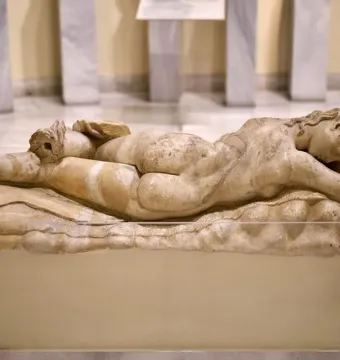
January 2023 © George E. Koronaios · CC BY-SA 4.0
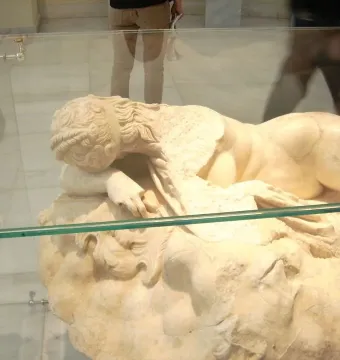
April 2008 © Marcus Cyron · CC BY-SA 3.0
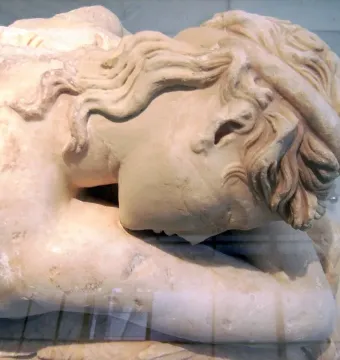
April 2008 © Marcus Cyron · CC BY-SA 3.0
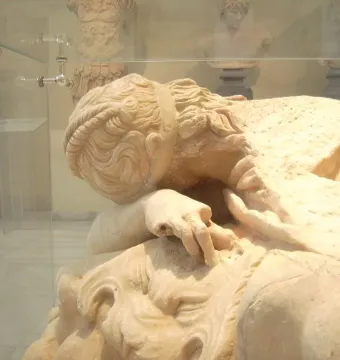
April 2008 © Marcus Cyron · CC BY-SA 3.0
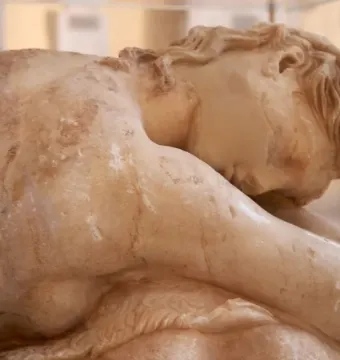
January 2020 © George E. Koronaios · CC BY-SA 4.0
Identification | |
| Title | Sleeping Maenad |
| Original French name | La Ménade endormie |
| Type | Sculpture |
| Cultural tradition | Greco-Roman |
| Inventory number | 261 |
Historical context | |
| Date | Hadrianic period, reign of Emperor Hadrian (117–138) |
Creator | |
| Attribution | Uncertainly identified with a work by Polykles from ancient tradition; another attribution mentions an unnamed Athenian Hellenistic sculptor |
Discovery and provenance | |
| Discovery date | 1880 |
| Discovery location | South of the Acropolis of Athens, on the Makrygianni/Makriyannis property |
| Discovery context | Found broken into several pieces |
| Probable original setting | Probably part of the furnishings of a wealthy resident's villa or luxury residence |
| Associated property | Property of the merchant and politician Giovanni Macrijanni, after whom the district takes its name |
Physical characteristics | |
| Dimensions | 1.36 m |
| Scale | Slightly smaller than life-size; one source says slightly larger than life-size |
Materials | |
| Material | Pentelic marble |
| Construction | The maenad and the rocky support were carved from a single block of marble |
Technique | |
| Style | Classicizing style, as practiced in local Attic workshops |
Appearance | |
| Subject | Sleeping nude maenad |
| Pose | Reclining, with the head resting on the bent right arm |
| Drapery | Partially covered by a himation that reaches only to about knee height |
| Support | Lying on a panther skin placed on an irregular rocky surface |
| Hair | Long hair gathered with a ribbon or band and falling to the nape of the neck, with locks forming small curls |
Iconography and meaning | |
| Mythological context | Maenads are companions of Dionysus in Greek mythology; the term is associated with orgiastic rites and the Dionysian Mysteries |
| Roman equivalent | Bacchantes |
| Literary reference | Euripides' Bacchae |
| Meaning of term | Derived from Ancient Greek μαίνομαι, meaning "to be mad" or "to be furious" |
| Typological comparison | Corresponds in pose and execution to the iconographic model of the Sleeping Hermaphrodite, but is smaller and more simply rendered |
| Comparative model | The Sleeping Hermaphrodite is a 2nd-century BC type known through Hellenistic or Roman copies, such as the Borghese Hermaphrodite, and was attributed to Polycleitus |
Location and ownership | |
| Current location | Room 32, National Archaeological Museum, Athens |
| Display condition | Displayed in a protective vitrine in the sculpture galleries, unlike most works in the museum |
History and restoration | |
| Condition | Several losses and modern restorations |
| Preservation state | Lower legs and feet partly missing; parts of the fingers of the right hand missing; parts of the torso and rock missing; the entire left arm missing; parts of the drapery or covering missing or damaged; larger missing areas in the skin filled with modern plaster |
Significance | |
| Interpretive note | Often interpreted as a statue intended to decorate a prestigious urban residence |