
Chimera of Arezzo
The Chimera of Arezzo is one of the best-known examples of Etruscan art. This bronze sculpture was discovered on 15 November 1553 in Tuscany during construction of the Medici fortifications near Arezzo. It is about 80 cm high and is dated to the late 5th or early 4th century BC. The figure shows the mythical creature in its death throes, wounded and with the goat’s head turned aside. An inscription on the right front paw, TINSCVIL, is generally read as a dedication to the Etruscan god Tinia, suggesting the bronze was a votive object. After passing through several Medici collections, it is now in the National Archaeological Museum of Florence.
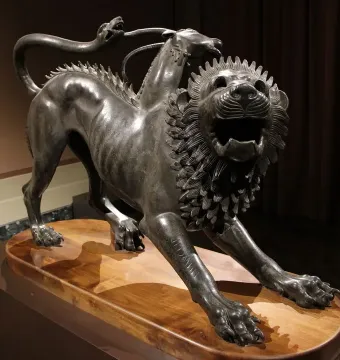
October 2020 © Francesco Bini · CC BY-SA 4.0
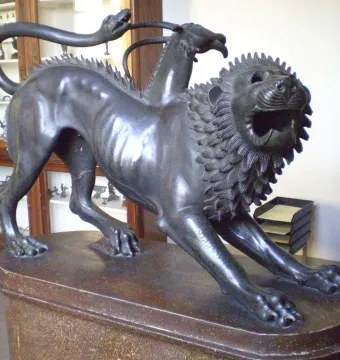
May 2007 © Lucarelli · Public domain
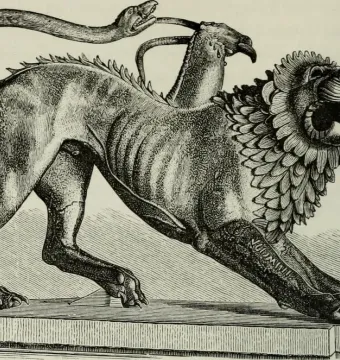
1878 © Internet Archive Book Images · No restrictions
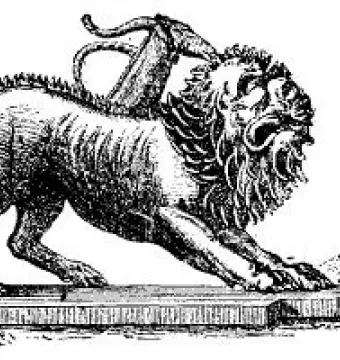
1906 © Nordisk familjebok (1906) · Public domain
July 2000 © Piero.paoletti · CC BY-SA 4.0
Identification | |
| Title | Chimera of Arezzo |
| Type | Bronze sculpture; votive object; aristocratic ex-voto |
| Original language name | La Quimera de Arezzo; Quimera de Arezzo; Quimera de Arezo; Quimera de Arécio; Chimera z Arezzo |
Historical context | |
| Culture | Etruscan |
| Date | Last quarter of the 5th century BC to beginning of the 4th century BC; around 400 BC; first half of the 4th century BC; probably 5th century BC |
Creator | |
| Technique | Lost-wax casting |
| Probable origin | Probably from a workshop in northern Etruria, possibly Orvieto, Chiusi, or Arezzo |
Materials | |
| Material | Bronze |
Physical characteristics | |
| Inscription location | On the right foreleg; on the front right leg |
| Dimensions | Height and maximum length are not specified in the fragment |
| Inscription language | Etruscan |
| Height | About 80 cm |
| Inscription | TINSCVIL |
| Current tail | 18th-century restoration |
| Condition at discovery | Missing the snake tail and the left front and rear paws |
Appearance | |
| Original appearance recorded at discovery | A natural-size bronze lion with a fierce appearance, wounded in the left thigh, with a bristling mane and gaping jaws, carrying the head of a slain goat on its back |
| Tail reconstruction detail | The serpent head on the tail bites one horn of the goat head; this is considered a mistaken reconstruction |
| Subject | The Chimera from Greek mythology |
| Depicted condition | Already wounded; shown after receiving a wound inflicted by Bellerophon |
| Pose | Defensive posture |
| Iconography | Three-headed monster with a lion's head and body, a goat head on its back, and a serpent head at the end of its tail |
Iconography and meaning | |
| Mythological narrative | The Chimera devastated Lycia until slain by Bellerophon |
| Associated figure | Bellerophon, riding Pegasus |
| Associated figures | Probably part of a larger group with Bellerophon and Pegasus; the Bellerophon figure has not been found |
| Associated deity | Tinia, the Etruscan chief god and equivalent of Zeus |
| Inscription meaning | Offering/dedicated to Tinia |
| Religious significance | Votive object dedicated to Tinia |
Discovery and provenance | |
| Identification by | Giorgio Vasari |
| Original ownership | Claimed for the collection of Cosimo I de' Medici, Grand Duke of Tuscany |
| Recovered fragment | A section of the tail was recovered among bronze pieces brought to Florence |
| Method of identification | By studying ancient Greek and Roman coins, including a silver stater showing the Chimera |
| Discovery date | 15 November 1553 |
| Initial identification | Initially thought to be a lion because the tail was missing |
| Associated finds | Found with numerous bronze statuettes and other bronze pieces, including children, birds, animals, a horse, and other small votive offerings to Tinia |
| Discovery context | Found accidentally while trenches were being dug outside the city walls during construction of the Medici fortifications; it was buried in antiquity as part of a bronze hoard/votive deposit for safekeeping |
| Discovery place | Arezzo, near Porta San Laurentino, Tuscany, Italy |
| Ancient context of findspot | An ancient Etruscan and Roman city in Tuscany; a religious sanctuary near the ancient Etruscan town of Arezzo |
Location and ownership | |
| Current location | National Archaeological Museum of Florence, Florence |
| Replica in Munich | A bronze cast made in 2015 for a special exhibition, now displayed outside the Antiquities Collection at Königsplatz |
| Replica near findspot | A bronze replica stands near the discovery site at Porta San Laurentino in Arezzo |
| Current status | Still preserved there today |
| Later location | Palazzo della Crocetta, now the National Archaeological Museum of Florence |
| Later location | Uffizi Gallery |
| Transfer year | 1718 |
| Later storage location | Cosimo I de' Medici's studiolo in Palazzo Pitti |
| Early display location | Palazzo Vecchio, Hall of Leo X |
History and restoration | |
| Restoration history | The tail was restored in 1784 or 1785 by Francesco Carradori, possibly with input from Luigi Lanzi or by Innocenzo Spinazzi; later restored again in the 19th century. The Cellini restoration is considered legendary and unconfirmed |
| Restoration note | The replacement serpent tail is incorrectly positioned so that it bites the goat's horn rather than turning against the attacker |
Significance | |
| Historical interpretation | Court intellectuals considered it a symbol of Medici domination of the Grand Duchy of Tuscany |
| Art historical significance | One of the most famous examples of Etruscan art |
Other | |
| Comparative object | The National Archaeological Museum of Florence preserves another similar chimera (inventory no. 23), 44 cm high, cast bronze, 4th century BC, with unknown provenance and once in the collection of Christine of Lorraine |
| Contemporary archival source | Deliberazioni del Magistrato, dei Priori e del Consiglio Generale, preserved in the State Archives of Arezzo, folio 102r |
| Related anecdote | Benvenuto Cellini reported that Cosimo I de' Medici enjoyed cleaning the smaller bronzes himself with goldsmiths' tools |
| Design influence | Adidas was inspired by the Chimera for the official FIFA World Cup 1990 ball Etrusco; the ball's trinity motif has some resemblance to the sculpture |