
Kouros
Kouros is an archaic statue of a young man in the National Archaeological Museum in Athens (NAMA), inventory number 4890. Carved from Parian marble, it is 1.89 metres high and is dated to around 540–530 BC, in the third quarter of the 6th century BC. It was discovered in 1972 at Merenda, the ancient Myrrhinous, together with the Kore Phrasikleia. The nude figure is fairly well preserved, though both feet, the right hand, the tips of the fingers, and the tip of the penis are missing. It stands frontally with one leg advanced, while the head faces forward. The hair is carefully worked with spiral curls and a diadem, and traces of red pigment remain on several details.
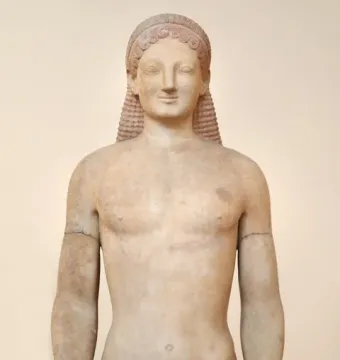
July 2023 © Francesco Bini · CC BY-SA 4.0
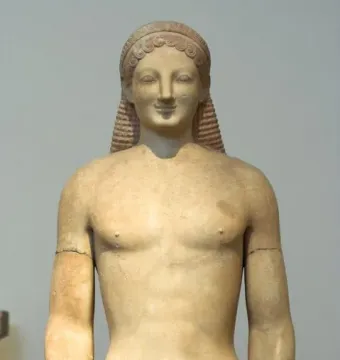
March 2014 © Zde · CC BY-SA 3.0
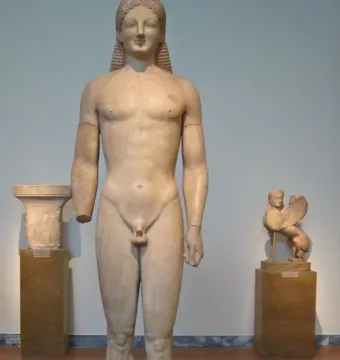
March 2009 © Sharon Mollerus · CC BY 2.0
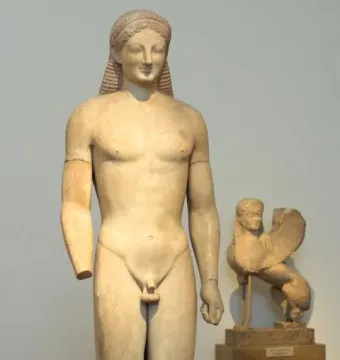
March 2014 © Zde · CC BY-SA 3.0
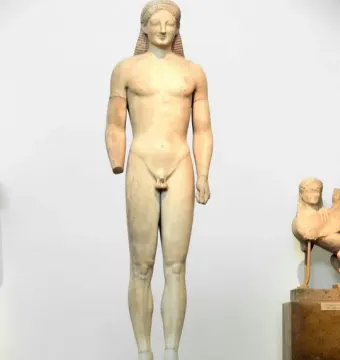
June 2007 © Fingalo · CC BY-SA 2.0 de
Identification | |
| Title | Kouros of Merenda |
| Type | Kouros |
| Sculpture type | Archaic statue of a young man (kouros) |
| Inventory number | NAMA 4890 |
| Alternative title | Merenda Kouros |
Historical context | |
| Period | Late Archaic Greek period |
| Date | c. 540–530 BC; also dated to the third quarter of the 6th century BC |
Creator | |
| Sculptor attribution | Attributed to Aristion of Paros; the base inscription names him as the sculptor |
Discovery and provenance | |
| Associated inscription | The associated base inscription identifies the grave monument of Phrasikleia |
| Possible family affiliation | Probably members of the Alcmaeonidae |
| Burial interpretation | How the two statues were buried is still uncertain; one theory is that they were buried before the Persian Wars to prevent desecration |
| Interpretation | The kouros and the Kore of Phrasikleia were probably meant to belong together; scholars speculate that they may represent a brother and a sister |
| Historical background | The Alcmaeonidae suffered exile and desecration caused by the tyrant Pisistratus |
| Associated person | Phrasikleia |
| Discovered by | Efthymios Mastrokostas |
| Discovery context | Found in situ in a shallow pit in the necropolis of the Attic deme of Myrrhinous, about 11 inches below the surface, facing the Kore of Phrasikleia |
| Discovery place | Merenda, ancient Myrrhinous, Attica, Greece |
| Discovery date | 1972 |
| Found with | The Kore of Phrasikleia |
Physical characteristics | |
| Hair | Elaborately styled with shell-shaped curls on the forehead, a diadem, and long curly hair falling down the back |
| Style | Typical kouros style of the period; more elegant and slender, with greater agility and subtler anatomical definition |
| Face | Youthful with the typical archaic smile |
| Abdomen | Abdominal muscles clearly visible |
| Eyebrows | Not clearly carved |
| Eyes | Small, almond-shaped, and executed in an archaic style |
| Arm position | Arms hung straight down at the sides, barely separated from the thighs, with the elbows slightly bent |
| Head position | Head raised and looking straight ahead |
| Pose | Standing frontal and rigid, nude, with the left leg slightly advanced |
| Condition | Extremely well preserved, though broken at the ankles and feet; both feet, the right hand, the tip of the penis, both arms, and both hands are missing |
| Height | 1.89 meters |
Materials | |
| Pigment remains | Red pigment remains on the hair, eyebrows, and nipples |
| Material | Parian marble |
| Decoration | The pubic hair and necklace were emphasized with color but not carved in relief |
Location and ownership | |
| Current location | National Archaeological Museum of Athens, Athens, Greece |
| Museum inventory | Sculpture collection of the National Archaeological Museum of Athens |
Significance | |
| Function | Funerary statue / grave statue |