
Meat-shaped Stone
Meat-shaped Stone is a piece of jasper carved in the shape of Dongpo pork. It is part of the collection of the National Palace Museum in Taipei, Taiwan. Although it is of only moderate importance from an art-historical point of view, it is a popular object much appreciated by visitors and has become famous. The work is named one of the museum’s most celebrated masterpieces and is considered one of its Three Treasures, alongside the Jade Cabbage and another object not named in the source text. The public has also chosen it as the most important item in the museum’s collections.
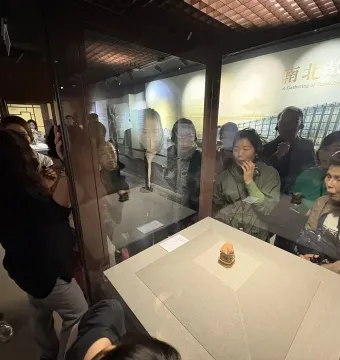
April 2025 © Chainwit. · CC BY 4.0
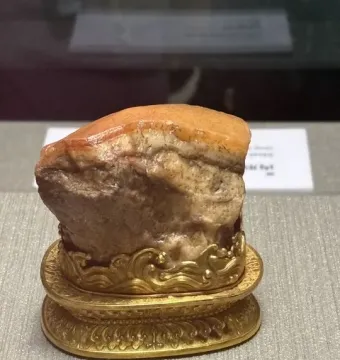
April 2025 © Chainwit. · CC BY 4.0
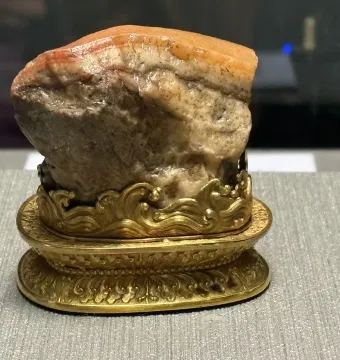
April 2025 © Chainwit. · CC BY 4.0
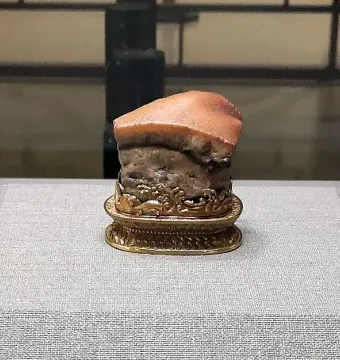
November 2018 © Ondřej Žváček · CC BY-SA 4.0
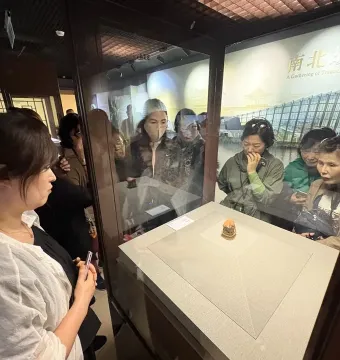
April 2025 © Chainwit. · CC BY 4.0
Identification | |
| Title | Meat-Shaped Stone |
| Original name | Rouxingshi |
| Type | sculpture |
| Original title | Fleischstein |
Historical context | |
| Dynasty | Qing dynasty |
| Date | 19th century |
| Provenance | placed in the National Palace Museum collection after the retreat of the government of the Republic of China to Taiwan |
Creator | |
| Artist | Unknown |
Materials | |
| Material | banded jasper |
| Material structure | layers of various shades naturally formed over time |
Technique | |
| Technique | carved |
| Use of natural color | the artisan exploited the stone's natural colors to imitate meat |
| Surface treatment | dyed |
Physical characteristics | |
| Dimensions | 5.73 cm long, 6.6 cm wide, 5.3 cm deep |
Appearance | |
| Surface appearance | naturally accumulated layers show various shades of color |
| Depicted subject | a piece of Dongpo pork (Chinese-style pork belly) |
| Surface appearance | given the appearance of pork rind or skin |
| Visual resemblance | closely resembles layers of fat and meat |
| Form | shaped like Dongpo pork |
Location and ownership | |
| Collection | National Palace Museum, Taipei, Taiwan |
| Location | Taipei, Taiwan |
Significance | |
| Art historical significance | moderate from the point of view of art history |
| Public popularity | very popular with visitors |
| Fame | became famous |
| Museum status | described as the most famous masterpiece in the National Palace Museum collection |
| Recognition | one of the Three Treasures of the National Palace Museum, along with the Jadeite Cabbage and the Mao Gong Ding |
| Public vote | chosen by the public as the most important item among the museum's collections |
| Description | a valuable object in the collection of the National Palace Museum |