
Corbridge Lion
The Corbridge Lion is an ancient Roman free-standing sandstone sculpture from Corbridge, Northumberland, England. It shows a male lion standing on a prone animal, possibly a deer, on a semi-cylindrical coping stone base. Measuring 0.95 m long, 0.36 m wide and 0.87 m high, it was originally made as decorative funerary ornamentation for a tomb. It was later reused as a fountainhead, with a water pipe passed through its mouth. Found in a water tank in 1907 during excavations led by Leonard Woolley on the Roman site at Corbridge, it is believed to date to the 2nd or 3rd centuries AD. It is now displayed in the Corbridge Roman site museum run by English Heritage.
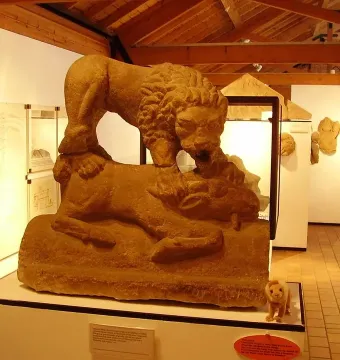
October 2005 © Alun Salt · CC BY-SA 2.0
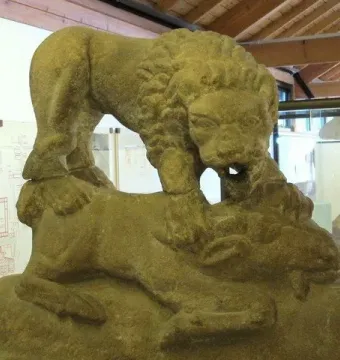
March 2013 © Mike Quinn · CC BY-SA 2.0
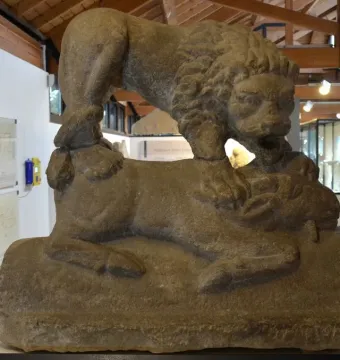
© Carole Raddato · CC BY-SA 2.0
Identification | |
| Title | Corbridge Lion |
| Type | Ancient Roman free-standing sculpture |
| Alternative name | Leão de Corbridge |
Historical context | |
| Date | 2nd or 3rd century AD |
| Original function | Decorative funerary ornament from a tomb or mausoleum |
| Original interpretation | Associated with funerary symbolism, including the victory of death over life |
| Later use | Reused as a fountain spout or head, with a pipe passed through its mouth |
Creator | |
| Excavation director | Leonard Woolley |
Discovery and provenance | |
| Finder's remark | The digger reportedly said he first thought there was an orange in the lion's mouth |
| Other related find 2 | One was found built into a wall in the village of Corbridge |
| Other related find 1 | Two were found with the enclosure wall of a 2nd-century mausoleum at Shorden Brae, in a necropolis beside the Stanegate about 600 metres west of the town |
| Related finds at Corbridge | At least five other stone lion sculptures are known from Corbridge |
| Other related find 3 | One, now lost, was in Bartholomew Lumley's private museum in the early 19th century |
| Woolley's account source | His autobiography Spadework and his autobiographical collection Preparation |
| Discovery circumstances | According to Woolley, workers accidentally found it while he was in Corbridge collecting wages |
| Site interpretation | A large building complex with corridor, tessellated floors, hypocausts, painted wall plaster, and private latrines; later interpreted as a wealthy residence |
| Discovery date | 1907 |
| Discovery context | Found during excavations in a water reservoir or water tank at Site II in Corbridge |
| Excavation site | Site II at Corbridge, interpreted at the time as a possible mansio or posting station |
Physical characteristics | |
| Dimensions | Approximately 0.95 m long, 0.36 m wide, and 0.87 m high |
| Condition | In good state of preservation; the Corbridge Lion is the best preserved of the Corbridge lion sculptures |
| Base | Semi-cylindrical stone coping base |
Materials | |
| Material | Sandstone |
Appearance | |
| Prey identification | Uncertain; possibly sheep or goat, though its proportions may also fit a cow |
| Evidence of reuse modifications | The lion's teeth were removed and its mouth was turned into a water outlet |
| Depiction | A male lion standing over a fallen or prone animal, possibly a deer |
| Evidence for water outlet | The lack of erosion below the mouth suggests a tube directed water away from the stone surface |
Location and ownership | |
| Current location | Corbridge Roman Site Museum, run by English Heritage |
| Current administrator | English Heritage |
| Museum collection | Part of the museum collection of the Roman town of Corbridge |
Significance | |
| Recognition | Considered by English Heritage to be one of the best known and most significant pieces in the Corbridge collection |