
Head of Eutropius
Head of Eutropius is a Roman portrait from Ephesus, dated to the mid-5th century and preserved at the Kunsthistorisches Museum in Vienna, inv. 1880. The traditional identification with the consul and praepositus sacri cubiculi Eutropius, who died in 399, is probably incorrect. Stylistically and on the basis of excavation data, the work is usually placed in the second quarter of the 5th century, around 425–450. It reflects the Ephesus or Aphrodisias production of the period, with a strongly expressive, anti-classical treatment of the face: elongated features, rigid lines, bulging, striated hair, wide eyes, and a beard that merges with the face.
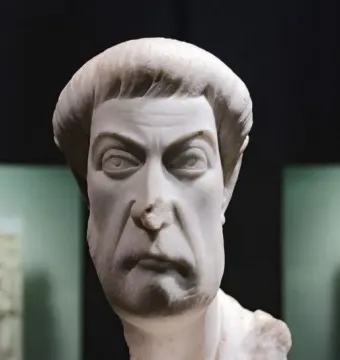
June 2016 © Manfred Werner (Tsui) · CC BY-SA 4.0
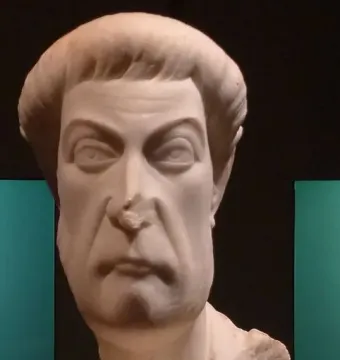
© Unknown artistUnknown artist · CC BY 3.0
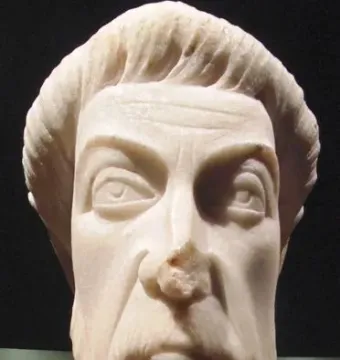
May 2017 © O.Mustafin · CC0
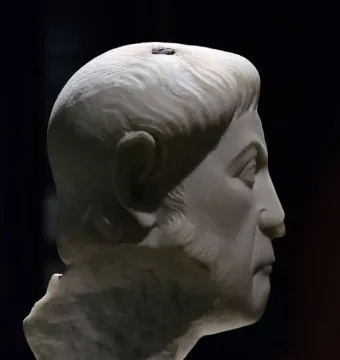
June 2016 © Manfred Werner (Tsui) · CC BY-SA 4.0
Identification | |
| Title | Head of Eutropius |
| Alternative name | the so-called Head of Eutropius; Bust of Eutropios |
| Possible philosophical echo | May echo Plotinus' praise of illness |
| Possible cultural association | Likely connected to underground pagan culture |
| Not to be confused with | The historian and official Eutropius, who was not born in Ephesos; or Eutropius, the consul of 399 |
| Subject | Eutropios |
| Object type | Late antique marble portrait bust |
| Subject identification | Traditionally identified with Eutropius, but this is very probably incorrect; the bust was named after the Greek inscription on a nearby console naming Eutropios |
Discovery and provenance | |
| Naming basis | Named after the name in the inscription |
| Discovery location | At the north end of the Marble Street in Ephesos |
| Earliest published mention | Mentioned in a 1916 exhibition catalogue |
| Origin | Ephesos |
| Associated object | A marble console found nearby in 1905 or 1906, probably the bust's original support |
| Associated inscription | Greek inscription with the name Eutropios on a nearby marble console, with a cross at the beginning |
| Discovery date | Before 1906 |
| Discovery context | Found during Austrian excavations |
| Find context | Lying on the Marble Street, buried under rubble from the collapsed south wall of the Theatre of Ephesos |
Location and ownership | |
| Current location | Kunsthistorisches Museum, Vienna |
| Inventory number | 1880 |
| Exhibition history | Exhibited in Vienna at Schloss Belvedere in 1916 |
Historical context | |
| Artistic theme | Late phase of the bearded philosopher-head type, originally developed in 5th-century BC Athens |
| Historical context | A 5th-century work that challenged the classicism of Theodosian court art |
| Artistic tendency | Sought new and more intense expressiveness |
| Stylistic attribution | Probably produced in Ephesus or Aphrodisias |
| Dating basis | Excavation context and style |
| Date | Mid-5th century, probably c. 425–450 |
Creator | |
| Group attribution | Probably from workshops in Ephesos |
Materials | |
| Material | Marble |
Physical characteristics | |
| Size | Under life-size |
| Condition | Damaged at the nose, right side of the face, and neck |
| Preserved part | Left shoulder preserved, with remains of a garment |
| Height | 30.5 centimetres |
| Depicted person | An adult man, probably older, with a beard and a thin face |
| Facial features | Extremely elongated face with rigid lines, swollen and striated hair, large wide-open eyes, sunken cheeks, downturned corners of the mouth, and a beard merged into the face |
| Dowel holes | Two dowel holes at the top of the head, one filled with iron |
| Head shape | Elongated |
Appearance | |
| Formal description | The figure appears dematerialized to emphasize spiritual and anti-corporeal traits |
| Iconographic features | Fixed and intense gaze; wavy, flowing hair; long beard |
Iconography and meaning | |
| Subject role | Likely donor of a marble pavement or street paving in his native city |
| Probable office | Probably proconsul of the province of Asia |
| Origin of subject | Probably native to Ephesos |