
Ciervo de Madinat al Zahra
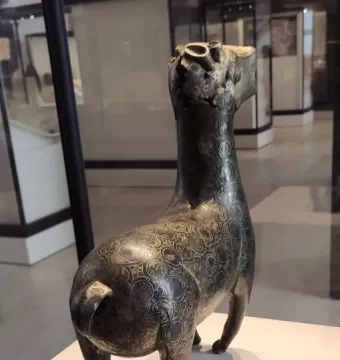
Ciervo de Madinat al Zahra refers to a pair of Umayyad bronze deer, a stag and a doe, dating from around 950–1001 during the Caliphate of Córdoba. They were discovered at Madinat al-Zahra, where they decorated the marble basin of a fountain in one of the palace suites. According to the source, the two figures were found by monks from the monastery of Saint Jerome of Valparaíso while searching for stones in the ruins of the palatine city. The doe was kept in the monastery treasure before entering the Archaeological and Ethnological Museum of Córdoba, while the stag disappeared after the Napoleonic conquest and later resurfaced at auction in 1997. It is now in the Museum of Islamic Art in Doha.
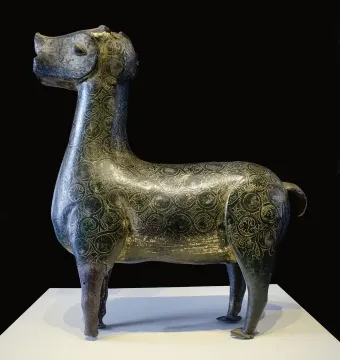
August 2016 © Ángel M. Felicísimo · CC BY 2.0
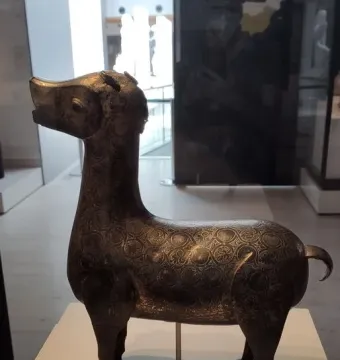
August 2021 © Américo Toledano · CC BY-SA 4.0
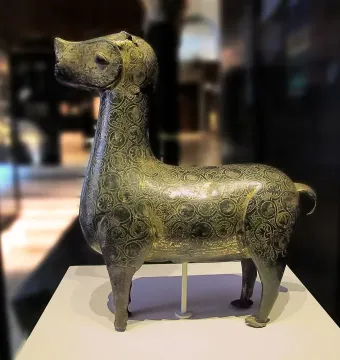
January 2015 © jacinta lluch valero · CC BY-SA 2.0
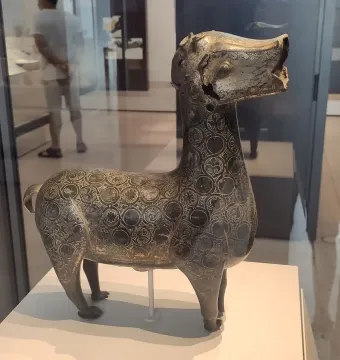
August 2021 © Américo Toledano · CC BY-SA 4.0
August 2021 © Américo Toledano · CC BY-SA 4.0
Identification | |
| Title | Ciervo de Madinat al Zahra |
| Subject | A stag and a doe |
| Type | Two bronze gargoyles; small bronze water fountain |
| Alternative name | The deer of Medina Azahara |
Historical context | |
| Date | Umayyad period, between 950 and 1001 AD |
| Historical period | Caliphate of Córdoba |
| Historical region | al-Andalus, on the Iberian Peninsula |
Creator | |
| Origin | Madinat al-Zahra (Medina Azahara) |
Discovery and provenance | |
| Alternative origin interpretation | Their proximity and resemblance to the fawns found in Medina Azahara suggest they may have been made in the same workshop, or at least in the Caliphate of Córdoba |
| Inventory number | 1943/41/1 |
| Acquisition date | 3 February 1940 |
| Acquisition institution | Museo Arqueológico Nacional de Madrid |
| Distance from discovery site to Medina Azahara | About 8 kilometers |
| Comparative objects | Fawns found in Medina Azahara |
| Possible origin | Possibly an import from the Fatimid Caliphate, perhaps Egypt |
| Original arrangement | The two sculptures were placed on a rectangular marble base and were intended to face each other on opposite marble pedestals |
| Associated fountain | A marble fountain basin |
| Historical source | Ambroise de Morales, chronicler of Philip II and monk of the same monastery, recounted the discovery in pages 38 and 39 of Las antigüedades de las ciudades de España |
| Discovery circumstance | According to Ambroise de Morales, monks of the Monastery of Saint Jerome of Valparaíso found the sculptures while searching for stones in the ruins of the palatine city |
| Discovery context | Found about 2 meters deep during sewer works for the courtyard of a house next to the Victoria gardens, near the Almodóvar Gate, where the road to Almodóvar del Río began |
| Discovery location | Córdoba, Spain |
Physical characteristics | |
| Secondary material | Marble |
| Material | Bronze |
| Number of figures | Two |
Location and ownership | |
| Current location | The doe is at the National Archaeological Museum of Madrid; the stag is at the Museum of Islamic Art, Doha, Qatar |
| Current location of the deer and doe | The deer is kept at the Doha Museum; the doe is kept at the Cordoba Museum |
| Current location of comparable objects | The Archaeological Museum of Córdoba and the Museum of Islamic Art, Doha, Qatar |
| The doe's later location | Part of the monastery's treasure before being transferred to the collection of the Archaeological and Ethnological Museum of Córdoba |
| The stag's later location | Part of the Monastery of Guadalupe in Cáceres |
History and restoration | |
| The stag's disappearance | Disappeared during the Napoleonic conquest |
| The stag's reappearance | Reappeared at an auction in 1997 |
Significance | |
| Historical context suggested by the text | The Caliphate of Córdoba had a major metallurgical industry |
Other | |
| Object displayed | The doe |