
Bust of Cardinal Scipione Borghese (First Version)
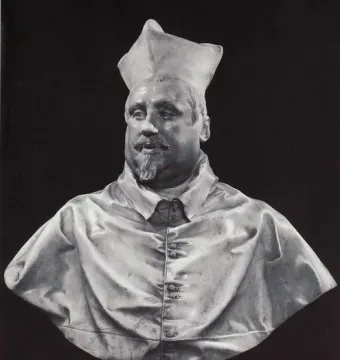
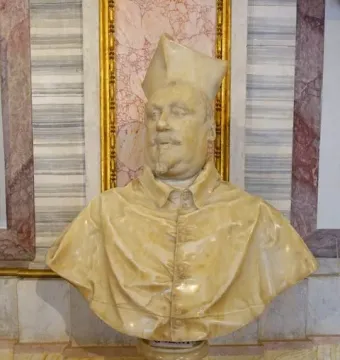
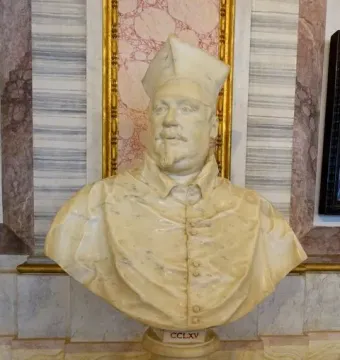
Bust of Cardinal Scipione Borghese (first version) is one of two marble busts by Gian Lorenzo Bernini, sculpted in 1632 for Cardinal Scipione Caffarelli-Borghese, the nephew of the pope. The work marked a turning point in Bernini’s career, showing the cardinal in a more outward, immediate manner than his earlier portraits. After the first version was finished, a major crack in the marble at the forehead was discovered during polishing, prompting Bernini to create a second version in secret. The busts were later moved to Villa Borghese, bought by the Italian state in 1892, and eventually returned to the Borghese Gallery in Rome in 1908, where they remain today. The crack in the first bust was highlighted during restoration in 1997.
August 2014 © Galleria Borghese Official Site · CC BY-SA 4.0
April 2019 © Daderot · Public domain
April 2019 © Daderot · Public domain
© Edme Bouchardon · Public domain
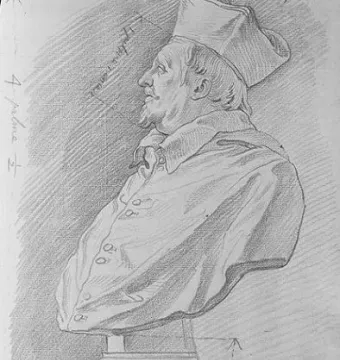
© Edme Bouchardon · Public domain
Identification | |
| Title | Bust of Cardinal Scipione Borghese (first version) |
| Type | Bust |
| Subject | Cardinal Scipione Caffarelli-Borghese |
Historical context | |
| Commissioning context | Urban VIII commissioned two busts from Bernini: one of himself and one of his friend Cardinal Scipione Borghese; Borghese had also commissioned other works from Bernini in the 1620s |
| Associated work | The Baldachin of St. Peter's Basilica |
| Creation context | Made during the years when Bernini was working on the Baldachin of St. Peter and no longer dedicating himself exclusively to sculpture |
| Subject's relation | Nephew of Pope Paul V |
| Date | 1632 |
Creator | |
| Artist | Gian Lorenzo Bernini |
| Commissioned by | Pope Urban VIII |
| Commission date | Summer 1632 |
Discovery and provenance | |
| Historical issue with accounts | Accounts mentioning Pope Paul V are treated with suspicion because he died in 1621 |
| Completion evidence | Supported by the 8 January 1633 Modena document, the 4 June 1633 Guidiccioni document, and the 23 December 1632 Borghese receipt |
| Receipt content | A receipt in the Borghese archives records a payment from the Borghese family to Bernini |
| Receipt date | 23 December 1632 |
| Archive locations | State Archive of Modena; archives of the Villa Borghese |
| Payment records | Documents record payments of 500 scudi, 500 zecchini plus a diamond worth 150 scudi, and 1,000 scudi |
| Documentary evidence | A document in the State Archive of Modena dated 8 January 1633 says Bernini had created the marble bust and been recompensed for it; a document by Lelio Guidiccioni dated 4 June 1633 also supports a 1632 date |
| Completion date | 1632 |
| Account by Filippo Baldinucci | Cardinal Borghese first saw the original bust without knowing of a second version, expressed pleasure while concealing disappointment at the flaw, and was then shown the flawless second version |
| Account by Domenico Bernini | Cardinal Borghese saw the unfinished bust, was impressed, asked that it be finished and shown to his uncle Pope Paul V, then realized the second bust was different after the defect was discovered |
| Biographical accounts | Domenico Bernini and Filippo Baldinucci |
| Accounts of making time | Filippo Baldinucci said it took fifteen nights; Domenico Bernini said three days |
| Second version creation | Bernini secretly carved a second version with a new block of marble |
| Discovery of flaw | Discovered by assistants while polishing; the bust was almost finished |
| Second version reason | A defect in the marble, described as a crack or fissure across the forehead, prompted Bernini to make a second version |
| Number of busts | Two versions |
Physical characteristics | |
| Material | Marble |
| Format | Bust |
| Depicted pose | Looking to his right |
| Expression | Lips open as if about to begin speaking |
| Clothing | Cardinal's robes and biretta |
| Movement | Shown with noticeable movement and liveliness |
| Second version detail | One button is about to come undone |
Technique | |
| Material rendering | The carved surfaces are rendered to convey tactile quality |
| Light treatment | Light is diffused to produce chiaroscuro effects |
Appearance | |
| Artistic approach | Bernini captured a specific gesture rather than creating a static idealized figure |
| Likeness | Psychological as well as external |
| Robe details | Dramatic folds and creases suggest the movement of the sitter's body |
| Portrait effect | A highly immediate portrait that captures the sitter's character in a brief psychological state and almost presupposes an observer |
Location and ownership | |
| Current location | Galleria Borghese, Rome |
| Current status | Both versions are preserved there |
| Later provenance | The first version was taken to Villa Borghese, acquired by the Italian state in 1892, displayed at the Galleria dell'Accademia in Venice until 1908, and then reunited with the Borghese collection at the Galleria Borghese |
History and restoration | |
| Restoration date | 1997 |
| Restoration result | The 1997 restoration made the fissure in the first bust visible |
Significance | |
| Stylistic significance | It marks a turning point in Bernini's career and is often considered the superior version |
| Critical assessment | Howard Hibbard said Bernini's handling of the marble gave it a new dimension of reality |
| Second version assessment | The second version is by Bernini but is considered much less spontaneous; Rudolf Wittkower said it lacks the animation and vitality of the first |
| Alternative view of second version | Charles Avery called it one of the greatest portraits of all time in any medium and a work of genius |
Other | |
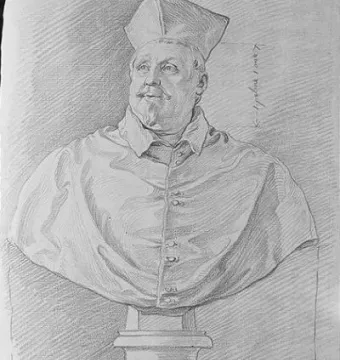
| Preparatory drawing location | Morgan Library, New York |
| Preparatory drawing attribution | By Bernini |