
Neptune and Triton
Neptune and Triton is a 17th-century marble sculpture by the Italian architect and sculptor Giovanni Lorenzo Bernini. It was made between 1620 and 1624 and stands 182 cm high. The work is now exhibited in the Victoria and Albert Museum in London. Originally, it was used by Cardinal Peretti Montalto as a fountain in the courtyard of his villa in Rome. The sculpture later passed through several owners, including Thomas Jenkins, Sir Joshua Reynolds, and Charles Pelham, before being bought by the museum in 1950. Its scene comes from Virgil’s Aeneid, showing Neptune calming the sea while Triton sounds a horn.
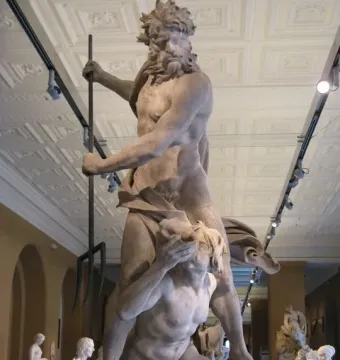
August 2009 © Yair Haklai · CC BY-SA 3.0
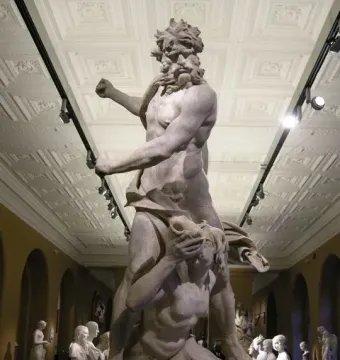
© sailko · CC BY-SA 3.0
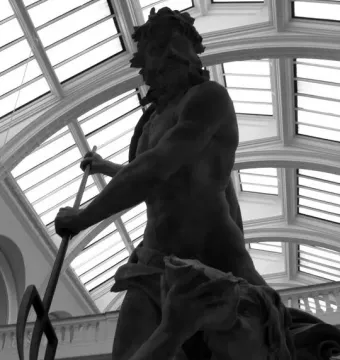
November 2005 © CGP Grey · CC BY 2.0
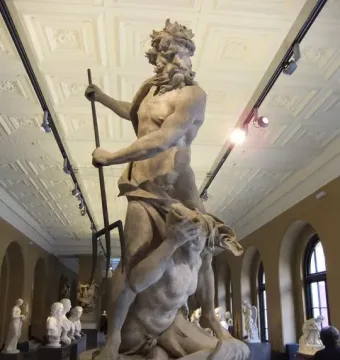
May 2011 © Rept0n1x · CC BY-SA 3.0
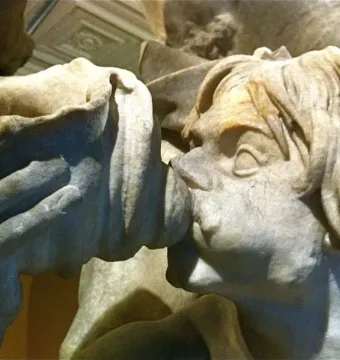
December 2011 © Alastair Dunning · CC BY 3.0
Identification | |
| Title | Neptune and Triton |
| Type | Sculptural group |
| Titles in other languages | Neptune et Triton (French); Neptuno y Tritón (original title); Nettuno e Tritone (Italian); Neptuno e Tritão (Portuguese) |
Historical context | |
| Date of creation | 1620–1624, with execution given as March 1622 to February 1623 and also 1622–1623 in some sources |
| Commissioned by | Cardinal Alessandro Damasceni Peretti Montalto |
| Commission date | 1620 |
| Original function | A fountain decoration for the gardens of Villa Peretti Montalto in Rome |
| Original location | Villa Peretti Montalto, Rome; sources place it on the Viminal Hill and also on the Esquiline Hill |
| Original setting | Installed in the pre-existing oval pool called the Peschiera or Peschierone, designed by Domenico Fontana between 1579 and 1581 |
Creator | |
| Status in artist's career | One of Bernini's earliest works |
| Artist | Gian Lorenzo Bernini |
| Artist profession | Architect and sculptor |
| Artist nationality | Italian |
Discovery and provenance | |
| Provenance | Acquired by Thomas Jenkins in 1786; sold the same year to Joshua Reynolds; after Reynolds's death in 1792 it passed to Charles Anderson-Pelham, 1st Baron Yarborough; moved to his Chelsea house, Walpole House; transferred by descendants to Brocklesby Park, Lincolnshire, in 1906; purchased by the Victoria and Albert Museum in 1950 |
| Exhibited | Royal Academy, London, in 1938 |
Physical characteristics | |
| Height | 182.2 cm |
Materials | |
| Material | Marble |
Appearance | |
| Triton form | Bernini gives Triton two tails that simulate human legs |
| Drapery detail | Neptune's drapery resembles a dolphin's head |
| Composition | Neptune stands astride Triton, with Triton crouching below him on a half-shell base |
| Triton depiction | Triton is shown as a much younger figure, probably a boy, with defined musculature, leaning forward between Neptune's legs, gripping Neptune's leg, and blowing a shell horn |
| Neptune depiction | Neptune is shown as a mature bearded nude male with a mantle, pronounced musculature, twisting his torso and pointing his trident toward the sea |
Technique | |
| Original water feature | Water jets originally burst from Triton's horn |
| Placement | The sculpture was designed to function as a fountain, with Triton's horn conceived to expel water |
Iconography and meaning | |
| Subject | A scene from Virgil's Aeneid and Ovid's Metamorphoses, though the sculpture does not faithfully represent either episode |
| Mythological figures | Neptune calms the sea to ensure Aeneas's safe passage, while Triton blows a horn signal |
| Interpretation of Triton's action | Triton's blowing announces the approach of the king of land and oceans |
| Scholarly interpretation | Bernini may have merged and reworked literary accounts from Virgil, Ovid, and possibly other sources |
| Scholarly interpretation | The sculpture has been read as referring either to a Virgilian passage about calming the sea or to an Ovidian passage about Neptune and shell-blowing, but neither source is represented exactly |
| Scholarly interpretation | Neptune's pose, frowning gaze, and proud stance have been interpreted as expressing divine power and ferocious strength |
| Scholarly interpretation | Triton's submissive pose and tense expression create a contrast with Neptune's dominance and contribute to Bernini's animating of myth |
| Scholarly interpretation | The broken silhouette, dynamic movement, and strong naturalism were viewed as radical or innovative for Bernini's early career and as an early example of Baroque freedom |
| Scholarly interpretation | Neptune's drapery has been interpreted as an allusion to dolphins, transformation, or Ovid's Metamorphoses |
Location and ownership | |
| Current location | Victoria and Albert Museum, London |
| Current owner | Victoria and Albert Museum |