
San Juan Patrón
San Juan Patrón is one of the accompanying images associated with the Cristo Negro de Esquipulas, a Catholic crucifixion image venerated in the Basilica of Esquipulas in Esquipulas, Guatemala. The source text places it among the companion figures of the Christ image, together with the Virgin of Sorrows and Mary Magdalene, in a devotional context renewed in January 2021 when a replica was donated to the Cathedral of San José in Antigua Guatemala. The Cristo Negro is especially celebrated on January 15, when many pilgrims arrive from Guatemala, El Salvador, Honduras, and Mexico. The feast is also observed by immigrant communities in U.S. cities such as Los Angeles, Phoenix, New Jersey, and New York.
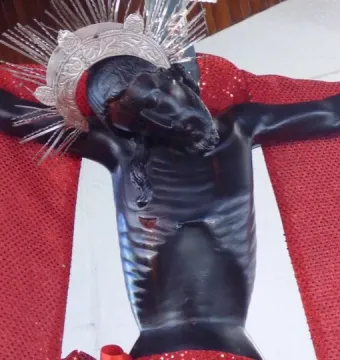
April 2017 © Rodtico21 · CC BY-SA 4.0
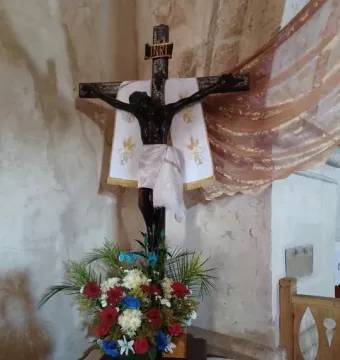
May 2022 © Simon Burchell · CC BY-SA 4.0
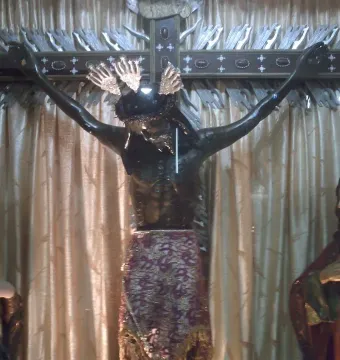
2007 © Wilfredor · CC BY-SA 3.0
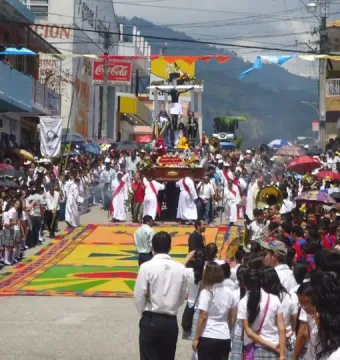
March 2014 © Elder Flores · CC BY-SA 3.0
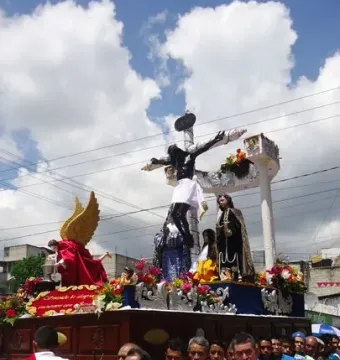
March 2014 © Elder Flores · CC BY-SA 3.0
Identification | |
| Title | San juan patrón |
| Common names | The Black Christ of Esquipulas; Cristo Negro; Milagroso Señor de Esquipulas; Milagroso Crucifijo; The Miraculous Lord of Esquipulas; The Black Christ (Christ Noir); Czarny Chrystus |
| Type | Wooden crucifix sculpture of Christ |
Iconography and meaning | |
| Subject | Jesus Christ on the cross |
Historical context | |
| Venerated since | the 16th century |
| Patronal feast day | 15 January |
| Annual pilgrimage | The feast day draws very large pilgrimages, especially from Guatemala and neighboring Central American countries; pilgrims also come from El Salvador, Honduras, Mexico, and other places, and celebrations are also held in U.S. cities such as Los Angeles, Phoenix, New Jersey, and New York |
| Legend of origin | Tradition says the image was found in a cave and was believed to have healing power |
| Associated legend | Pious legends say Spanish missionaries darkened the image to convert natives who worshiped the pagan deity Ek-Kampulá |
Creator | |
| Attributed artist | Quirio Cataño |
| Artist nationality | Portuguese |
| Date of creation | 1594 |
| Commissioned by | Don Cristobal de Morales, vicar of the diocese |
Discovery and provenance | |
| Delivered in presence of | Fray Gómez Fernández de Córdova, Bishop of Guatemala |
| Traditional transport story | Residents of Esquipulas collected the sculpture from Santiago de los Caballeros; villagers along the route asked that it remain overnight, said to be the origin of the pilgrimage tradition |
| Original contract location | The parish of Quezaltepeque, reportedly for a long time |
| Delivery location | Esquipulas |
| Contract copy made by | Fray Andrés de la Navas y Quevedo, Bishop of Guatemala (1683–1701) |
| Reason for commission | An exceptional cotton harvest allowed the inhabitants to order a sculpture of Jesus on the cross |
Physical characteristics | |
| Color | Very dark black; later restoration observations reportedly found the original wood was light-colored |
| Material | Wood |
| Height | More than 2 meters tall for the image in Miahuatlán, Oaxaca |
Appearance | |
| Description | Darkened wooden image of Christ |
Location and ownership | |
| Accompanying figures in 2021 donation | Virgin of Sorrows; Mary Magdalene; Saint John the Apostle |
| Replica and family custody in Chiapas | A Christ of Esquipulas replica in San Cristóbal de Las Casas has been kept in the Díaz Utrilla family for more than three generations and more than 160 years; it has been restored over time due to age |
| Arizona replica event | On 13 September 2013, the Brotherhood of the Christ of Esquipulas was established in the Diocese of Phoenix with the arrival of a replica acquired through Javier Vélez |
| Florida replica event | On 6 January 2018, a replica from Guatemala was delivered to Iglesia de San Isidro, Pompano Beach, Florida, for veneration by Guatemalan and Latino communities |
| Other veneration sites | El Santuario de Chimayó in Chimayo, New Mexico honors the image; replicas are also venerated in many places in Mexico, Venezuela, Ecuador, Arizona, and Florida |
| Associated donation | On 11 January 2021, Dr. Jorge Ruano Rossil donated a replica of the Cristo de Esquipulas with accompanying images to San José Cathedral, Antigua Guatemala, during the COVID-19 pandemic |
| Pilgrimage area | Central America |
| Current veneration location | Basílica de Esquipulas / Basilica of the Crucified Christ of Esquipulas, Esquipulas, Guatemala |
| Main shrine | Cathedral Basilica of Esquipulas, Esquipulas, Guatemala |
| Distance from Guatemala City | 222 km |
History and restoration | |
| Mid-20th-century political use | In the late 1940s and early 1950s, the image was used to symbolize opposition to Juan José Arévalo and Jacobo Árbenz, who were seen as socialists or communists |
| Canonical coronation | A pending application for canonical coronation of the image was submitted to the Vatican |
| Peace negotiations | The sanctuary was used for peace talks between the Sandinistas and Contras and hosted a meeting with the presidents of Guatemala, Nicaragua, Honduras, and Costa Rica; this led to a 1986 agreement between the Sandinistas and Contras |
| 1980s significance | By the 1980s, the image's color had become its defining characteristic, and it was seen as a place where a war-ravaged nation could seek peace and justice |
| Papal visit | Pope John Paul II celebrated Mass at the Basilica of Esquipulas and venerated the Black Christ during his 1996 trip to Guatemala |
| 19th-century political context | In the late nineteenth century, the cult was affected by conflicts between conservative Catholic supporters and anticlerical Guatemalan liberals |
| Evangelization context | Evangelization of the region began in 1530, after the conquest of Esquipulas |
| Later relocation | Moved to the newly built basilica in Esquipulas on request of Archbishop Francisco José de Figueredo y Victoria |
| Initial installation | Parish church of Esquipulas |
| Color explanation | The black color is traditionally said to have been deliberately chosen by the sculptor to resemble the skin of the Chortí Maya of Esquipulas; Eduardo Andrade later argued it resulted from centuries of candle smoke and pilgrims' touch |
Significance | |
| Religious significance | Object of devotion and veneration for millions of Central American Catholics |
| Miraculous powers | The sculpture is attributed with miraculous powers; a tradition of miracles is said to date back to 1603 |
| Miracle story of gold | A very poor Mexican servant was said to have taken three stones from the Tepoctum River on the way back from pilgrimage; the stones turned into gold, enabling the family to escape poverty |
| Miracle story of healing | In 1618, Pedro Ruiz of Granada was healed after prostrating himself before the sculpture; eighteen of his twenty ulcers disappeared within an hour and the remaining two could then be treated |
| Associated festival | The patronal feast of Esquipulas |
| Festival date | Every Ascension Thursday; 15 January in many places |
| Pilgrimage rituals | The image is placed on an altar and carried in procession through the streets each year; pilgrims decorate vehicles with colorful straw garlands called gusanitos and return home with them; local celebrations include candlelight walks, cabalgatas, Masses, processions, street decorations, and food offerings |
| Pilgrimage attendance | About one million pilgrims per year |
| Associated meaning | Considered a place of reconciliation and a symbol of resistance to evil identified with white domination; in some traditions it represents a Black Messiah expected by believers |