
Lady of Cádiz
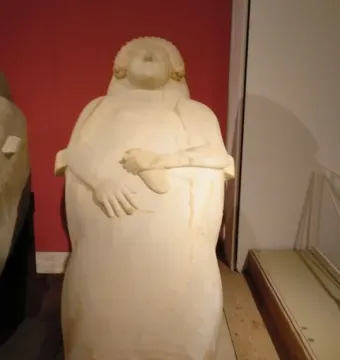
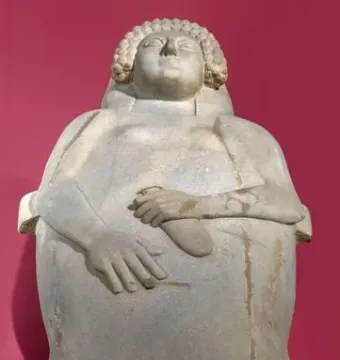
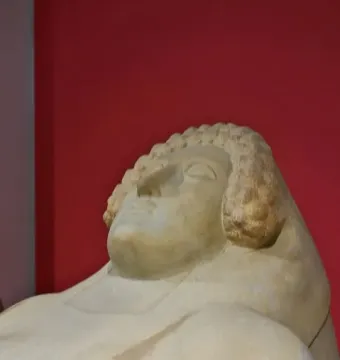
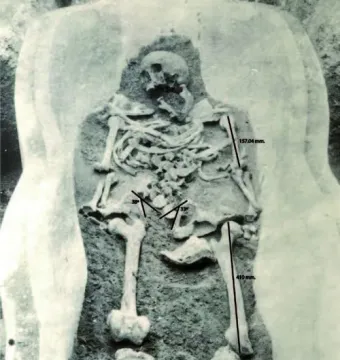
Lady of Cádiz is the name given by modern archaeologists to a Phoenician anthropoid sarcophagus dating from around 480 BC. Found in Cádiz, then known as Gadir, it is the second of two Phoenician sarcophagi discovered in Spain, and both are now exhibited in the Museum of Cádiz. Although long described as a female sarcophagus, recent investigations indicate that the person buried in it was actually a robust man about 45–50 years old. The marble coffin is noted for its oriental character and Hellenistic influence, with a head in round relief, a crown of hair, a plaited beard, and a long sheath-like robe.
September 2019 © Axel Cotón Gutiérrez · CC BY-SA 4.0
August 2015 © Ángel M. Felicísimo · CC BY 2.0
June 2021 © Jl FilpoC · CC BY-SA 4.0
June 1887 © Rafael Rocafull y Monfort · Public domain
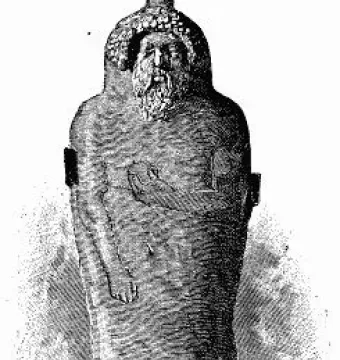
© Unknown authorUnknown author · Public domain
Identification | |
| Title | Lady of Cádiz |
| Spanish name | Dama de Cádiz |
| Object type | Phoenician anthropoid sarcophagus |
| Alternative name | Phoenician Lady of Cádiz |
Historical context | |
| Date | c. 480 BC |
| Cultural period | Phoenician period |
Discovery and provenance | |
| Later discovery depth | Three to six metres below the surface |
| Earlier related find significance | The 1887 bearded anthropoid sarcophagus was then considered the best representation of Phoenician presence on Spanish soil |
| Later discovery date | From 3 January 1890 |
| Later discovery location | Near the 1887 discovery site |
| Concealment practice | The sarcophagi were hidden externally, following a Phoenician burial custom |
| Later finds | Numerous loculi identical in material and structure to those found in 1887 |
| Loculi depth | About two metres |
| Loculi arrangement | Three parallelopipeds with cruciform pavements on the lower part |
| Publication source | Scientific American account published four years after the discovery |
| Production place | Sidon, Phoenicia |
| Earlier related find location | Necropolis of Punta de la Vaca, Cádiz |
| Earlier related find date | 30 May 1887 |
| Associated finds | Skeletons, small bronze instruments, and trinkets of oriental manufacture |
| Associated tomb context | Found in one of three rough tombs of shelly limestone |
| Discovery depth | About five metres below the surface |
| Discovery context | Found during excavation for the foundations of a new building at the former house of Pelayo Quintero Atauri |
| Discovery location | Ruiz de Alda street, Cádiz |
| Discovery date | 26 September 1980 |
| Number of Phoenician sarcophagi found in Spain | Two |
| Historical significance of find location | Cádiz was the most important Phoenician colony on the Iberian Peninsula |
| Ancient place name | Gadir |
| Find location | Cádiz, Spain (ancient Gadir) |
Location and ownership | |
| Current location | Museum of Cádiz |
| Museum transfer | Taken over by Ramón Corzo Sánchez, filled with sand to preserve the remains, and transferred to the Museum of Cádiz |
Creator | |
| Artists | Greek artists |
Materials | |
| Material | White marble |
Physical characteristics | |
| Condition of decoration | The marble retains subtle traces of color |
| Surface decoration | Preserves traces of the original polychromy |
| Scale | Much larger than life-size |
| Width | 0.67 metres |
| Length | 2.15 metres |
| Shape | Anthropoid form |
Appearance | |
| Depicted figure | A young woman of serene beauty |
| Gender represented | Female |
| Depicted person | A man of mature age with noble features and an aquiline nose |
| Hair | Thick hair combed up on the forehead like a crown |
| Facial hair | Beard plaited in the Asiatic fashion |
| Head treatment | Almost entirely executed in round relief |
| Arms | Naked to the elbow and slightly projecting |
| Feet | Summarily indicated, emerging from a long sheath-like robe |
| Right hand | Originally held a painted crown, now lost |
| Left hand | Grasps a fruit |
| Adornment | Simple and discreet |
Iconography and meaning | |
| Fruit symbolism | The fruit is interpreted as an emblem of fecundity |
| Social meaning of adornment | Phoenician-Gaditan society did not display social status through jewelry |
Technique | |
| Artistic influence | Hellenistic influence combined with Phoenician artistic tradition |
| Execution | Monolithic anthropoid sarcophagus |
| Stylistic influence | Inspired by Egyptian burial forms |
Significance | |
| Interpretation of buried person | Recent investigations suggest the burial was a robust man aged about 45–50 years |
| Comparative interpretation | Recognized by Scientific American as exclusively Phoenician in character |
| Comparative parallels | Compared with similar monuments from Phoenicia, Cyprus, Sicily, Malta, Sardinia, and other Phoenician centers |
| Chronological implication | Attributed to an era later than that of Pericles |
| Historical significance | Considered one of the oldest works of its kind with certainty |
| Cultural significance | Important evidence for Phoenician customs in their homeland and across the Mediterranean |
| Historical consequence | Its discovery led to the creation of the archaeological section of the Museo de Cádiz |
History and restoration | |
| Restoration | Restored for exhibition by Antonio Álvarez |
Other | |
| Related archaeologist | Pelayo Quintero Atauri (1867–1946) |
| Related museum director | Former director of the Museo de Bellas Artes de Cádiz, now the Museum of Cádiz |
| Earlier hypothesis | He believed that a male sarcophagus implied the existence of a female one |
| Search history | He devoted much of his life to searching for the female sarcophagus and died without finding it |
| Later rediscovery context | It was later found beneath a palm tree in the former house of Pelayo Quintero Atauri |
| Related earlier discovery | A male bearded anthropoid sarcophagus found in 1887 at Punta de la Vaca, Cádiz |