
Djedefre sphinx head (E 12626)
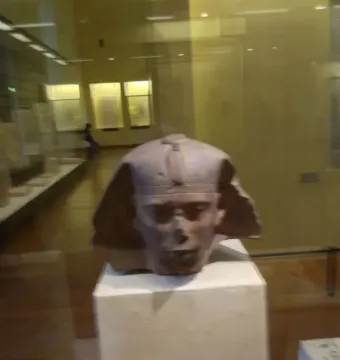
Djedefre sphinx head (E 12626) is a quartzite fragment from an ancient Egyptian statue of Pharaoh Djedefra, who ruled around 2566–2558 BCE during the Fourth Dynasty. The head was found in the early 20th century by the Institut français d’archéologie orientale among rubble and sculptural fragments in the funerary temple attached to Djedefra’s pyramid at Abu Rawash. Its facial features include straight, nearly linear eyebrows, defined cheekbones, an expressive gaze, and a receding chin. The smooth nemes headdress and the break behind the neck suggest the figure originally formed part of a reclining lion, leading to the conclusion that the complete statue was a sphinx.
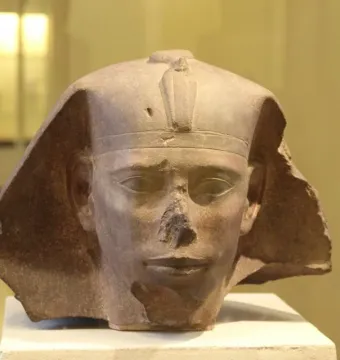
July 2016 © Gary Todd · CC0
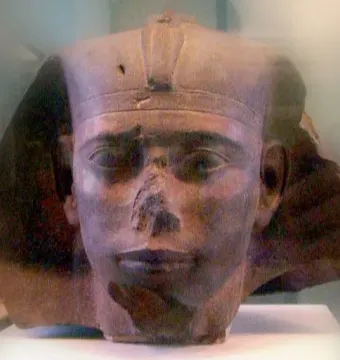
December 2010 © Sebi · Public domain
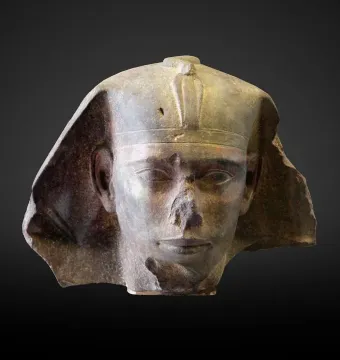
© Rama · CC BY-SA 3.0 fr
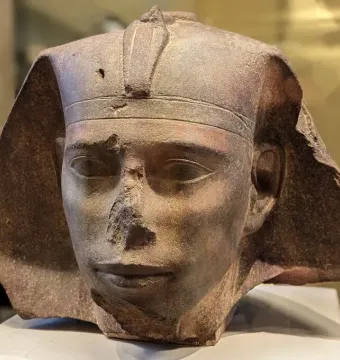
October 2023 © Shonagon · CC0
May 2013 © Hayholt · CC BY-SA 4.0
Identification | |
| Title | Djedefre sphinx head-E 12626 |
| Object type | Fragment of an ancient Egyptian statue |
| Inventory number | E 12626 |
Historical context | |
| Date | c. 2566–2558 BC |
| Dynasty | Fourth Dynasty |
| Historical context | Old Kingdom, during Djedefre's reign |
Creator | |
| Subject | Pharaoh Djedefre (Dyedefra) |
| Historical role | Successor of Khufu and predecessor of Khafre |
Discovery and provenance | |
| Discovery context | Found among numerous sculpture fragments and remains of sculptures of Djedefre and Hetepheres |
| Related monument location | Abu Rawash, a few kilometers north of Giza |
| Related monument | Djedefre's pyramid at Abu Rawash |
| Discovery location | Ruins of the mortuary/funerary temple attached to Djedefre's pyramid at Abu Rawash, north of Giza |
| Discovering institution | French Institute of Oriental Archaeology |
| Discovery date | Early 20th century |
Physical characteristics | |
| Preserved element | Only the head survives |
| Condition | Fragmentary; only the head is preserved |
Materials | |
| Material | Quartzite |
Appearance | |
| Headgear | Smooth nemes headdress |
| Facial features | Straight, almost linear eyebrows; defined cheekbones; expressive, indulgent gaze; receding chin |
| Original form | Probably a sphinx, with the head attached to a reclining lion body |
| Reason for sphinx interpretation | The cut profile of the head and the break behind the neck suggest attachment to a reclining lion body |
Iconography and meaning | |
| Portrait interpretation | Probably not a faithful portrait of the ruler, although the facial features are distinctive and appear in known images of Djedefre |
Location and ownership | |
| Current location | Louvre Museum, Paris |
Significance | |
| Historical significance | Attributed to the reign of Djedefre; among the oldest surviving sphinxes in Egyptian history, possibly predating the Great Sphinx of Giza |
| Comparative reference | The Great Sphinx of Giza is generally attributed to the reign of Khafre, Djedefre's brother and successor |