
Portonaccio Sarcophagus
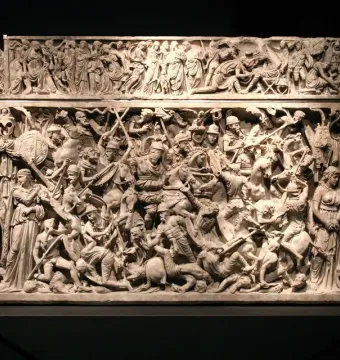
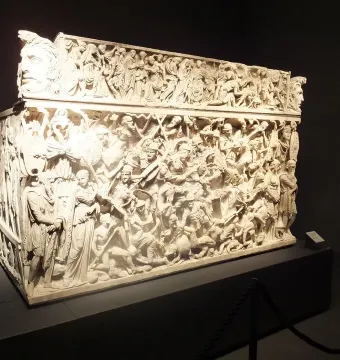
Portonaccio Sarcophagus is an ancient Roman sarcophagus found in the Portonaccio district of Rome and now kept in the Museo Nazionale Romano, Palazzo Massimo. Dated to about 190–200, it was used as the burial place of a Roman general involved in the campaigns of Marcus Aurelius. The sarcophagus is part of a group of around 25 late Roman battle sarcophagi, mostly dating from 170–210 and made in Rome, or in some cases Athens. These works derive from Hellenistic monuments from Pergamon in Asia Minor and were likely commissioned for military commanders. Portonaccio Sarcophagus is the best-known and most elaborate example of the main Antonine group.
2019 © Vicenç Valcárcel Pérez · CC BY-SA 4.0
June 2014 © Amphipolis · CC BY-SA 2.0
October 2013 © Ryan Baumann · CC BY 2.0
October 2011 © Jean-Pol GRANDMONT · CC BY 4.0
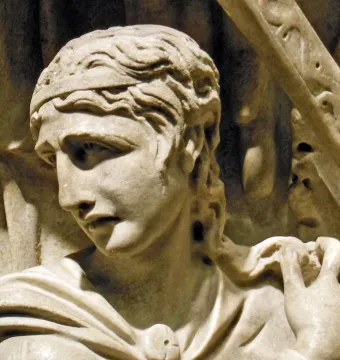
May 2014 © MM · CC BY-SA 3.0
Identification | |
| Title | Portonaccio sarcophagus |
| Type | Ancient Roman sarcophagus |
Historical context | |
| Artistic context | Roman art |
| Comparison object | Also compared with the so-called Amendola sarcophagus from the previous twenty-five years |
| Comparison object | Similar to the Ludovisi sarcophagus, a late work from around 250 CE |
| Presumed patrons | Presumably commissioned for military commanders |
| Group inspiration | Derived from Hellenistic monuments from Pergamon in Asia Minor, showing Pergamene victories over the Gauls |
| Group production places | Made in Rome or, in some cases, Athens |
| Group date range | Most of the group apparently dates from 170–210 CE, with one exception |
| Group membership | One of about 25 late Roman battle sarcophagi |
| Notability within group | The best known and most elaborate sarcophagus in the main Antonine group |
| Subject matter | Military campaigns of emperors |
| Associated historical figure | Marcus Aurelius |
| Date | c. 180–200 CE |
| Period | Ancient Rome, Flavian period through the Antonine dynasty |
| Historical theme | Victories of Roman generals over barbarian peoples along the imperial frontiers |
Discovery and provenance | |
| Inscription | The inscription suggests that the sarcophagus housed a general, but the name is not given in the fragment |
| Probable original owner | A Roman general, possibly Aulus Iulius Pompilius Titus Vivius Laevillus Piso Berenicianus |
| Original use | Used as the tomb of a Roman general involved in Marcus Aurelius's Germanic-Sarmatian campaigns of 172–175 CE |
| Discovery location | Portonaccio district, Rome, near Via delle Cave di Pietralata |
| Discovery year | 1931 |
Creator | |
| Style and attribution | Possibly by the same artist as the Column of Marcus Aurelius |
Physical characteristics | |
| Lid decoration | Low-relief frieze |
| Cover structure | Two large acroteria depicting barbarian masks |
| Form | Very tall box-shaped chest |
| Front decoration | Entire front covered with high-relief battle scenes |
| Height | 1.53 metres |
Materials | |
| Material | Not specified in the fragment |
Appearance | |
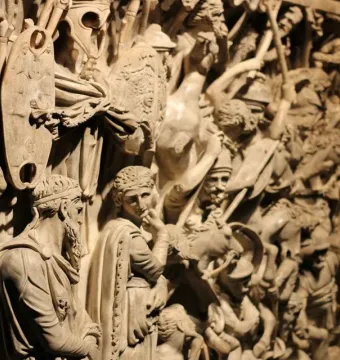
| Relief treatment | Many parts of the figures emerge in the round |
| Treatment of defeated enemies | They are shown without pity, as loud, contemptible, and crushed by Roman superiority |
| Characterization of style | Narrative relief with a complex multi-register battle composition, marked by extraordinary movement, strong chiaroscuro, expressionistic faces, and dramatically entangled bodies |
| Lid style | Continuous narration with unnatural sinuous drapery folds, increasing expressiveness at the expense of naturalism |
| Portrait status | The faces of the general on both the chest and the lid are unfinished |
| Depicted figures on lid | The general and his wife are shown twice, once together holding hands in the center and again separately at the ends |
| Scenes on lid | Presentation as an infant, education, marriage, and clementia shown to barbarians in an act of deditio |
| Lid subject | A biographical life story scene |
| Main subject of front relief | Battle between Roman and barbarian figures |
| Background treatment | The background is fully occupied and never neutral |
| Relative scale of figures | The barbarians are the same scale as the general, while the other battling figures are smaller |
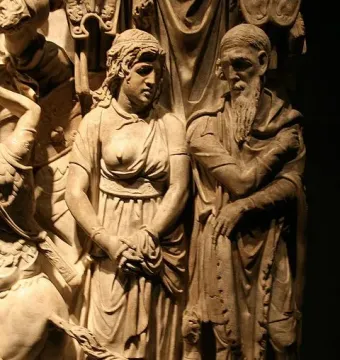
| Left captive identification | Either a Germanic person or a Sarmatian-Iazyges |
| Right captive identification | Probably a Suebian warrior, perhaps Marcomannic, Quadi, or Buri, identified by the Suebi knot hairstyle |
| Side figures | At both ends are trophy groups of weapons and pairs of captive barbarian leaders, one man and one woman in each pair |
| Central figure | A mounted general in an assault pose at the center, with his face uncarved |
| Battle composition | Arranged in four registers: two upper levels with charging Roman cavalry, one with Roman infantry, and the lowest with defeated barbarians |
| Perspective treatment | Normal perspective is disregarded; soldiers and horses in the lower foreground are slightly smaller than those in the upper background |
Technique | |
| Carving technique | Deep undercutting and deep drill cuts (trépano) |
Style and influence | |
| Lid quality | Technically and inventively inferior to the sarcophagus body |
| Possible stylistic traits on lid | Some plebeian and provincial characteristics |
| Stylistic development | Shows the overcoming of Hellenistic modes |
| Composition quality | Much more frantic and articulated than earlier analogous examples, arranged on multiple registers rather than in monomachies |
| Stylistic influence | Shows influences similar to those of the Column of Marcus Aurelius in Rome |
Iconography and meaning | |
| Iconography | Roman victory over barbarians, trophy groups, captive barbarians, and a deditio scene |
| Modern scholarly interpretation | Some modern scholars think the biographical scenes may have been reduced to generalized scenes applicable to anyone |
Location and ownership | |
| Current location | Museo Nazionale Romano, Palazzo Massimo, Rome |
History and restoration | |
| Condition of portraiture | The deceased's face was left uncarved or unfinished, possibly because the workshop expected the buyer to provide a portrait model or because the sculpture was made without a specific commission |
| Alternative explanation for unfinished face | For the proposed owner, there may not have been time to carve it, or the sculptor may not have known his face |
Significance | |
| Artistic significance | Possibly the finest example of private sculpture of the 2nd century CE |