
Sphinx of Agost
The Sphinx of Agost reflects the posture typical of archaic Attic sculpture, with the head facing forward, the body in profile, and the human face predominating over the feline body. Its close relationship to another sphinx found in Piraeus and preserved in the National Archaeological Museum of Athens supports a date between 570 and 545 BC, and its classification by G.M.A. Righter. At the same time, several features point to its Iberian roots: it was probably attached to a wall rather than freestanding, and its tail passes between the hindquarters like that of a lion. The sculpture is exhibited in the National Archaeological Museum of Spain in Madrid.
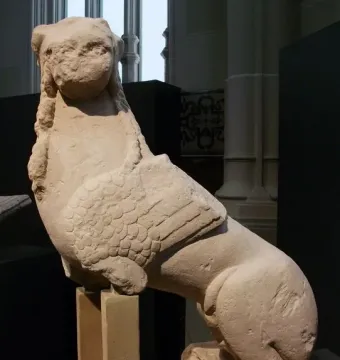
October 2009 © Joanbanjo · CC BY-SA 3.0
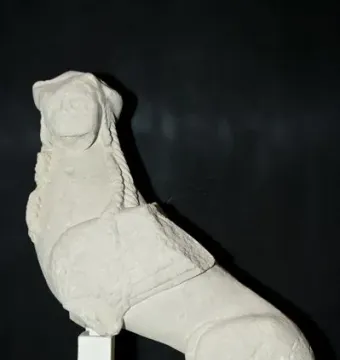
0525 © Martínez Levas, Ángel (photo) · CC BY-SA 4.0
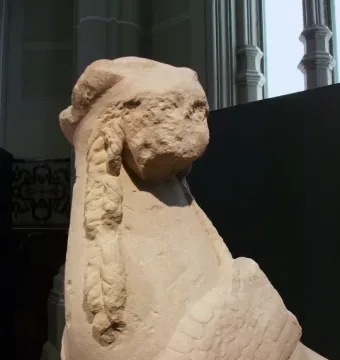
October 2009 © Joanbanjo · CC BY-SA 3.0
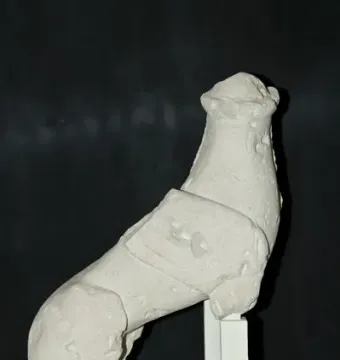
0525 © Martínez Levas, Ángel (photo) · CC BY-SA 4.0
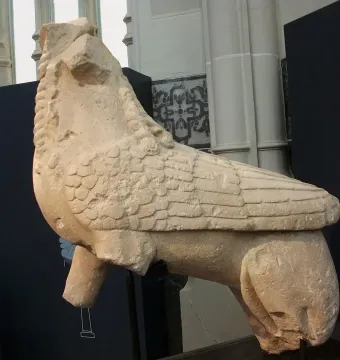
October 2009 © Joanbanjo · CC BY-SA 3.0
Identification | |
| Title | Sphinx of Agost |
| Type | Sphinx sculpture |
| Original title | Le Sphinx d'Agost |
Historical context | |
| Culture | Iberian |
| Period | Iberian period |
| Style | Attic Archaic sculptural style with Greek influence |
| Date | c. 570–545 BC |
Creator | |
| Author | Unknown |
Discovery and provenance | |
| Associated object | A bull |
| Post-discovery history of associated bull | Its trace was lost shortly after the 1893 discovery |
| Proposed provenance | Probably from an Iberian tomb |
| Associated object | Another sphinx preserved in the Louvre Museum, Paris |
| Discovery context | Found together with another sphinx and a bull |
| Discovery date | 1893 |
| Findspot | Camp de l'Escultor archaeological site, on the edge of Agost, Alicante, Spain |
Physical characteristics | |
| Height | 82 cm |
| Condition | Badly damaged |
| Pose | Head facing forward, body in profile, with the human head predominating over the feline body |
| Tail form | Tail passes between the hind legs |
| Depicted subject | A sphinx with the head of a woman, body of a winged lion, and a serpent's tail |
Materials | |
| Material | Limestone |
Technique | |
| Mounting | Probably fixed to a wall |
Appearance | |
| Comparative form | Unlike Greek sphinxes, which were free-standing, this one was attached to a wall |
| Comparative tail form | Unlike Greek examples, whose tail curls over and rests on the thigh, this sphinx's tail passes between the hind legs |
Iconography and meaning | |
| Function | A funerary sphinx intended to guard and defend the dead and possibly carry the soul to the afterlife |
| Stylistic interpretation | Shows an indigenous artist influenced by Greek beliefs about the world of the dead; the artist probably had not seen the model directly |
Significance | |
| Sphinx background | Sphinxes are known from the Bronze Age in Mesopotamia and Egypt, with Egypt as the probable remote origin; in Egypt, male sphinxes acted as guardians of the dead, and a female sphinx appears in the Fourth Dynasty representing Queen Hetepheres II |
| Comparative development | Eastern and Greek sphinx traditions later developed independently; in Greek art the human aspect became more important and the most common posture became seated |
Location and ownership | |
| Current location | National Archaeological Museum of Spain, Madrid |