
Apoxyomenos
Apoxyomenos is an ancient Greek votive sculpture showing an athlete scraping sweat and dust from his body with a strigil. The most famous version was created by Lysippos of Sikyon around 330 BCE, although the bronze original is lost. It is known from Pliny the Elder’s account and from a Pentelic marble copy in the Museo Pio-Clementino in Rome, discovered in Trastevere in 1849. Slightly larger than lifesize, the figure reflects Lysippos’s new canon of proportion, with a smaller head and longer, thinner limbs. Set in true contrapposto with an outstretched arm, it became the standard version in textbooks and a landmark of Classical sculpture.
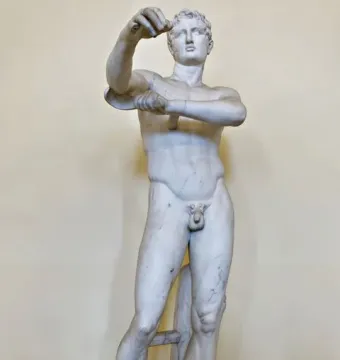
May 2022 © Игорь Гордеев · CC BY-SA 4.0
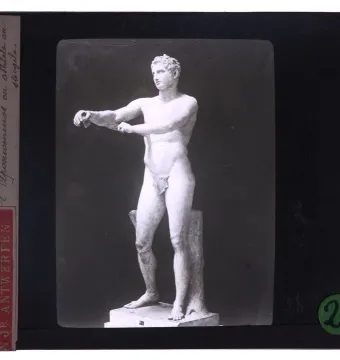
© Maison de la Bonne Presse · Public domain
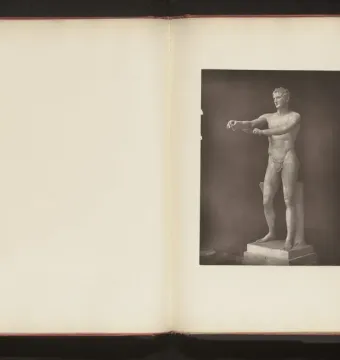
© Rijksmuseum · CC0
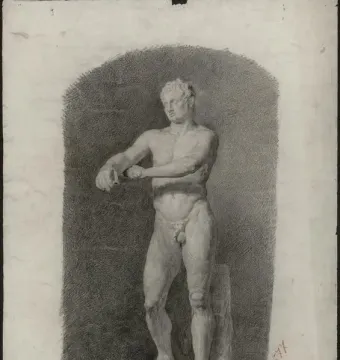
1881 © Varvara Baruzdina · Public domain
Identification | |
| Title | Apoxyomenos |
| Alternative names | Apoxiomeno; Apoxyomenus; Anaxiomen |
| Ancient Greek name | ἀποξυόμενος (apoxuómenos) |
| Meaning of name | “the one who scrapes himself” |
| Etymology | From Ancient Greek ἀποξύω (apoxúô), meaning “to scrape, to scratch” |
| Type | Ancient Greek sculpture; votive sculpture |
| Subject | An athlete cleaning sweat, dust, and oil from his body with a strigil (or similar curved implement) |
| Convention | A conventional subject/theme in ancient Greek sculpture |
Historical context | |
| Art period | Classical Greek art |
| Stylistic context | Associated with the post-Classical period and the beginning of the break with the classical ideal of beauty |
Creator | |
| Artist | Lysippos of Sicyon |
| Artist role | Court sculptor of Alexander the Great |
| Notable status of original | Pliny the Elder called it Lysippos’s principal work |
| Attributed artistic principle | Lysippos said that while other artists made men as they really were, he made them as they appeared to be |
Date | |
| Possible date of Pliny’s mentioned version | 330–320 BC (according to Claude Rolley) |
| Date of original | ca. 330 BCE |
Materials | |
| Original material | Bronze |
| Best-known surviving copy material | Pentelic marble |
| Other surviving version material | Bronze |
| Another head material | Bronze |
Status | |
| Original status | Lost |
Discovery and provenance | |
| Related Ephesian bronze current location | Kunsthistorisches Museum, Vienna |
| Related Ephesian bronze | A fragmentary bronze statue of the Apoxyomenos type found at Ephesus in 1896 |
| Medici/Uffizi version | A classicising neo-Attic version in the Medici collections at the Uffizi |
| Croatian Apoxyomenos | A bronze original found in 1996 in the northern Adriatic Sea near Lošinj, Croatia, considered a variant of the Apoxyomenos type |
| Croatian Apoxyomenos discoverer | René Wouten |
| Croatian Apoxyomenos discovery condition | Found on the seabed, covered with sponges and other marine life; the head had detached but all parts were preserved |
| Croatian Apoxyomenos height | 192 cm |
| Croatian Apoxyomenos date | Probably 2nd–1st century BCE |
| Other surviving head | A bronze head supposedly found on the Peloponnese, later in Bernardo Nani’s collection in Venice and now at the Kimbell Art Museum, Texas |
| Another copy mentioned | The Hermitage in Saint Petersburg holds a copy of the head found in the 19th century |
| Related Ephesian bronze attribution debate | Scholars debate whether it is a 4th-century original or a later Hellenistic copy; workshop repetitions may count as originals |
| Best-known copy associated finds | Fragmentary bull statue and a bronze horse were found with it |
| Best-known copy discovery | Found in 1849 in Trastevere, Rome, at Vicolo delle Palme (later renamed Vicolo dell’Atleta) |
| Public reaction | Roman protests in the theatre led Tiberius to restore it for public display |
| Later Roman relocation | Tiberius had it removed to his bedroom/palace on the Palatine |
| Date installed in Rome | Around 20 BCE |
| Earlier scholarly hypothesis | Before the Ephesian bronze was unearthed, scholars proposed a 5th-century BCE original based on the Medici/Uffizi version |
| Roman patron | Marcus Vipsanius Agrippa |
| Known from | Pliny the Elder’s description in Natural History |
Location and ownership | |
| Other surviving head current location | Kimbell Art Museum, Texas |
| Current location of best-known copy | Museo Pio-Clementino, Vatican City |
| Croatian Apoxyomenos current location | Mimara Museum, Zagreb |
| Best-known surviving copy | The Vatican Apoxyomenos |
| Later Roman owner | Emperor Tiberius |
| Original Roman location | The Baths of Agrippa in Rome |
Physical characteristics | |
| Size | Slightly larger than life-size |
| Proportions | Elongated proportions, with a slightly smaller head, longer and thinner limbs, a short torso, long legs, and relatively slender arms |
| Head proportion | About 1:8 of total height, compared with Polykleitos’s 1:7 |
| Composition | One arm is outstretched, creating a sense of movement and visual interest from multiple angles |
| Stance | Wide-legged stance with a light, balanced weight shift that seems on the verge of changing pose |
| Pose | True contrapposto |
Appearance | |
| Expressive qualities | Conveys dynamism, strength, and power |
| Spatial effect | It seems to move freely in space and has almost no single principal viewpoint |
| Style | Characterized by a restless silhouette and naturalistic details |
Iconography and meaning | |
| Ancient variants mentioned by Pliny | Versions of the same motif were also associated with Polykleitos and Daidalos of Sicyon |
| Art-historical meaning | A major achievement of Lysippos and a key example of his new canon of proportions |
History and restoration | |
| Vatican copy display history | Exhibited almost immediately in the Vatican Museums; first in the Camera del Mercurio in the Octagonal Court, later moved to the Braccio Nuovo, returned in 1924 to the Camera dell’Hermes, and placed permanently in the Gabinetto dell’Apoxyomenos in 1932 |
| Vatican copy restoration | Restored in 1924 by the Galli, replacing earlier restoration work by Tenerani; the restoration removed the block in the right hand, remade the strigil, replaced several pins, and integrated the outstretched fingers |
| Vatican copy cleaning | Deep and complete cleaning in 1994 |
Significance | |
| Antiquity reputation | The type was famous already in antiquity |
| Modern reception | After its discovery, the Vatican copy became very famous worldwide and its plaster casts circulated widely in Europe and beyond |
| Standard reproduction use | Plaster casts quickly entered national academy collections and became the standard version in textbooks |
| Other reproduction use | A cast copy was requested for the Academy of Fine Arts in Madras |
| Scholarly assessment | Considered one of the main achievements of Lysippos; B. R. Vipper described its fleetingness, variability, and mobile balance as its main artistic achievement |