
Coatlicue Statue
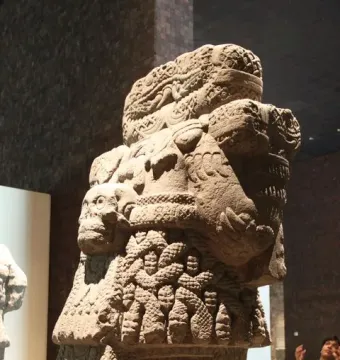
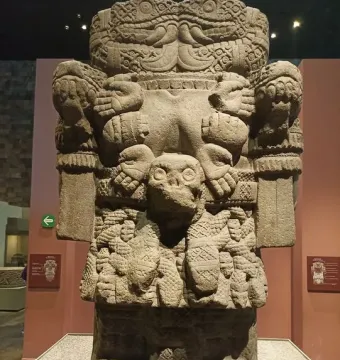
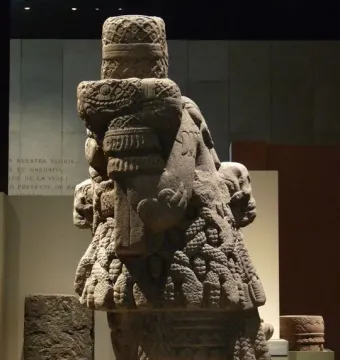
The Coatlicue statue is an Aztec sculpture probably depicting the goddess Coatlicue. It is now in the collection of the National Museum of Anthropology in Mexico City and is regarded as the largest surviving Aztec sculpture, as well as one of the best known. Carved from andesite, it stands 2.52 meters tall. The statue was unearthed on 13 August 1790 in the Zócalo, near the Metropolitan Cathedral, and was likely part of the decoration of the Templo Mayor in Tenochtitlán. Dated to between 1487 and 1520, it shows a decapitated female figure with a skirt of intertwined rattlesnakes and a necklace of human hearts, hands, and a skull.
July 2012 © Gary Todd · CC0
August 2025 © Eruvalcaba · CC BY-SA 4.0
1883 © Jackson, William Henry, 1843-1942, photographer · Public domain
July 2009 © El Comandante · CC BY-SA 3.0
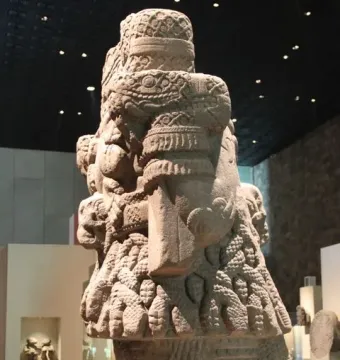
July 2012 © Gary Todd · CC0
Identification | |
| Title | Coatlicue statue |
| Type | Aztec sculpture |
Historical context | |
| Culture | Mexica (Aztec Empire) |
| Date | Probably completed between 1439 and 1520; some sources propose 1439 or 1491, but the exact date is contested |
Creator | |
| Artist | Anonymous Mexica artist |
Discovery and provenance | |
| Burial history | Buried after the Spanish conquest of Tenochtitlan in 1521, probably below the water table |
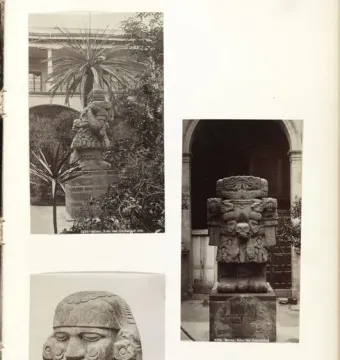
| Rediscovery history | Unearthed on 13 August 1790; later disinterred in 1803 for Alexander von Humboldt and again in 1823 for William Bullock |
| Associated discoveries | The Sun Stone was found nearby on 17 December 1790, and the Tizoc Stone was excavated in 1791 |
| Original location | Tenochtitlan, probably in a prominent position in front of a temple, likely as part of the decoration of the Templo Mayor |
| Discovery circumstances | Found during excavation of a water conduit/canal |
| Discovery place | Main square of Mexico City, in front of the National Palace |
| Discovery date | 13 August 1790 |
Physical characteristics | |
| Height | 2.52 metres (8.3 ft) |
| Weight | Twelve tons |
| Thickness | 1.50 m |
| Form | Monolithic colossal sculpture carved in the round |
Materials | |
| Material | Andesite |
History and restoration | |
| Surface treatment | Originally polychromed |
| Interpretation of base | Antonio de León y Gama incorrectly thought the statue had been displayed at an angle, raised from the ground and supported by columns; later scholarship concluded it stood on its base |
| Preservation | Survived the destruction of Mexica statues and buildings after 1521 and remained remarkably well preserved |
| Reception after discovery | Creoles and Europeans reportedly found it ugly and repulsive, while Indigenous people worshipped it, bringing flowers and candles |
| Later history | Moved in 1790 to the National Autonomous University of Mexico for preservation and study, buried there out of sight, shown to Humboldt in 1803, reburied, and unearthed again in 1823 for Bullock; it remained in the university courtyard until the first National Museum was established |
Appearance | |
| Base decoration | The underside of the base is carved with a relief or inscription of Tlaltecuhtli, normally hidden from view |
| Clothing | Skirt of intertwined rattlesnakes |
| Body decoration | Covered with snake-like figures, with claws on the hands and feet and bands on the calves with hanging feathers and bells |
| Head | Two snakes emerge from the neck and form a mask-like head where the figure was decapitated |
| Condition | Decapitated |
| Posture | Leaning forward, with a symmetrical front and back that give the impression of moving forward |
| Necklace | Necklace of alternating human hearts and human hands ending in a skull |
Iconography and meaning | |
| Coatlicue meaning | "Snake-skirt"; also glossed as "she of the skirt of snakes" or "she in a dress of snakes" |
| Interpretive uncertainty | The statue's identification has long been debated |
| Earlier identification | Antonio de León y Gama identified it as Teoyaomiqui, the deity of death and sacred war |
| Alternative identifications | Proposed as Cihuacoatl, Tlaltecuhtli, Coyolxauhqui, a personification of the Earth, or a sculptural representation of the Tzitzimime |
| Mythological context | The Coatlicue identification is based largely on Aztec origin myths recorded in the Florentine Codex; other interpretations connect the statue with sacrificial and earth-related imagery |
| Related figures | Yolotlicue, Teoyaomiqui, Coyolxauhcihuatl, Huitzilopochtli, Cihuacoatl, Tlaltecuhtli, Coyolxauhqui, Tzitzimime |
| Depicted figure | Probably the goddess Coatlicue, though the identification is disputed |
Significance | |
| Scholarly significance | Its discovery, together with the Sun Stone and Tizoc Stone, sparked new research into the Templo Mayor and debates about Aztec symbolism, religion, and sculpture |
| Importance | One of the largest surviving Aztec sculptures and one of the best known |
Location and ownership | |
| Current location | National Museum of Anthropology, Mexico City, Mexico |
Other | |
| Related sculpture | Yolotlicue, a nearly identical statue that replaces the snake skirt with a skirt of human hearts; discovered in 1933 |
| Possible original number of sculptures | Fragments in Mexican museums suggest there may originally have been three or even five similar sculptures |
| Associated people | Antonio de León y Gama, Alfredo Chavero, Alexander von Humboldt, William Bullock, Elizabeth Boone, Cecilia Klein |