
Flying Horse of Gansu
Flying Horse of Gansu is a Chinese bronze sculpture from the Later Han dynasty (23–220 CE), now in the Gansu Provincial Museum. Also known as the Galloping Horse Treading on a Flying Swallow, it came from a tomb at Leitai near Wuwei, discovered in 1969. The horse is shown in full gallop and is balanced on one leg, with a flattened swallow supporting the raised hoof. It is regarded as an exceptional full-round animal sculpture, notable for both its realism and its archaic linear treatment. The work became widely famous after Guo Moruo recognized its value in the museum storage in the early 1970s.
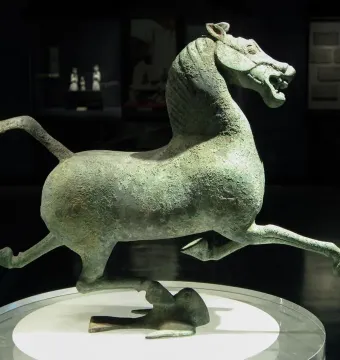
2007 © G41rn8 · CC BY-SA 4.0
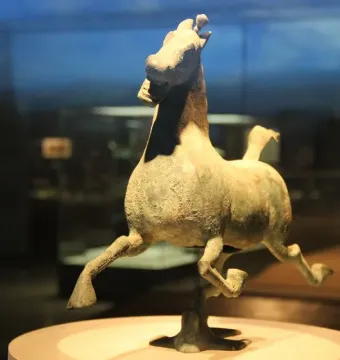
May 2013 © Gary Todd · CC0
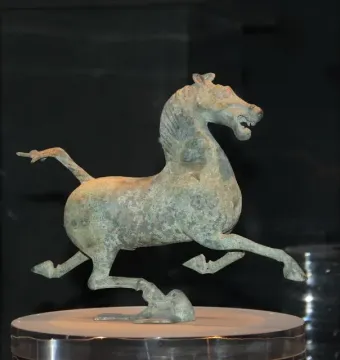
May 2013 © Gary Todd · CC0
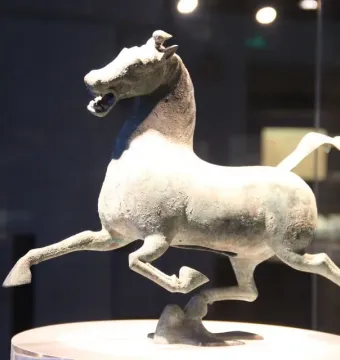
May 2013 © Gary Todd · CC0
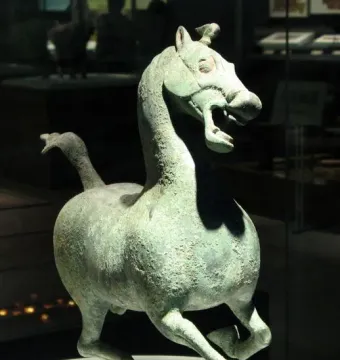
2007 © G41rn8 · CC BY-SA 4.0
Identification | |
| Title | Flying Horse of Gansu |
| Alternative names | Galloping Horse Treading on a Flying Swallow; Galloping Horse Treading on a Swallow; Flying Horse of the Han dynasty; Flying Horse; Gansu Flying Horse; Bronze galloping horse (铜奔马, Tóng bēn mǎ); Bronze Running Horse; bronze running horse; 马踏飞燕, Mǎtà fēiyàn |
| Original-language name | 銅奔馬; 馬踏飛燕 |
| Type | Chinese bronze sculpture; bronze horse statuette |
| Depicted subject | A horse in gallop / flight, shown treading on or standing on a flying swallow |
Historical context | |
| Date | Han dynasty, probably 2nd century CE; some sources give 2nd–1st century BC or Eastern Han (25–220 CE) |
| Funerary context | Part of the furnishings of a Han dynasty tomb assemblage |
| Burial attribution | The tomb was identified by inscriptions on three silver seals as belonging to General Zhang; it is also described as the tomb of Governor Zhang Yechang / a Han dynasty army general tasked with maintaining the imperial frontier defenses |
| Horse breed represented | A so-called heavenly horse associated with horses introduced from Sogdiana / the Ferghana Valley |
Creator | |
| Artistic tradition | Chinese sculpture and animal portraiture |
Discovery and provenance | |
| Discovery date | 1969 |
| Discovery location | Leitai tomb under Leitai Temple near Wuwei, Gansu, China |
| Discovery circumstances | Discovered by local villagers while digging air-raid shelters during the Cultural Revolution; the bronzes were initially taken home in plastic bags and later reported to provincial authorities |
| Associated finds | More than 200 bronze figures of men, horses, and chariots were found with it |
| Tomb description | A three-chambered tomb beneath a monastery / temple |
| Tomb condition | The tomb appears to have been looted shortly after burial, but the chamber containing the bronzes had not been entered |
| Museum transfer | The grave goods were taken to the Gansu Provincial Museum in Lanzhou |
Physical characteristics | |
| Head and body features | Head raised, long muzzle, vigorous / brave / mettlesome expression |
| Balance structure | A flattened swallow under the hoof provides hidden support without being visibly pressed down |
| Pose | The horse is shown in midair, balanced on one leg / one hoof, with the other three feet not touching support |
| Dimensions | 45 × 10 × 34.5 cm |
Materials | |
| Material | Bronze |
Technique | |
| Construction | Full three-dimensional sculpture with a hidden supporting element |
Appearance | |
| Stylistic description | Stylized but realistic, with an archaic character and a linear, symmetrical treatment of the body and legs |
| Movement depiction | The body expresses a gallop, though the leg positions are anatomically incorrect for the gait |
| Comparative style | Noted as having something close to Ancient Greek sculpture |
Iconography and meaning | |
| Bird motif | A flying swallow is included as a symbol of speed; scholars noted that the bird may not actually be a swallow |
| Interpretation | The sculpture may also represent a tianma, a heavenly horse from Chinese mythology |
Location and ownership | |
| Current location | Gansu Provincial Museum, Lanzhou, Gansu, China |
History and restoration | |
| Recognition history | Guo Moruo recognized its exceptional value in the early 1970s after visiting the museum storerooms with King Sihanouk and reportedly called it the best object in the museum |
| Protection status | In 2002, the State Administration of Cultural Heritage of China included it on the initial list of 64 cultural relics forbidden to be taken out of China for exhibition abroad |
Significance | |
| Artistic significance | Regarded as an exceptional example of full sculpture, three-dimensional form, and animal representation |
| Regional significance | The most famous historical relic of Gansu Province and a popular symbol of Gansu |
| National significance | It has become a symbol of the Chinese nation |
| Tourism symbol | In 1983 / 1984, the China National Tourism Administration selected it as the symbol of Chinese tourism and of the administration's Best Tourist City of China program |
Other | |
| Replica in Lanzhou | A large replica stands in front of Lanzhou railway station |
| Replica in Geneva | A bronze copy was presented to the United Nations Office in Geneva in 1987 and is displayed in the Palace of Nations |
| Replica in Lexington | Another copy was donated to Lexington, Kentucky, on 15 June 2000 |