
Holodomor Memorial to Victims of the Ukrainian Famine-Genocide of 1932–1933
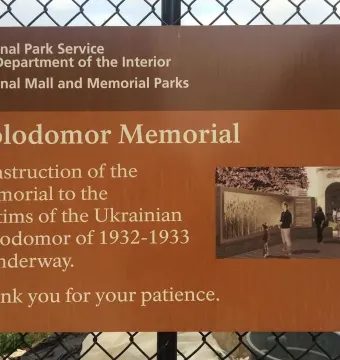
The Holodomor Memorial to Victims of the Ukrainian Famine-Genocide of 1932–1933 is a memorial in Washington, D.C., honoring the victims of the 1932–1933 famine in Ukraine. The decision to build it was made in 2006 by U.S. President George W. Bush with congressional support, following a long campaign by the Ukrainian community in the United States. In 2009, the design by architect Larisa Kurilas, an American of Ukrainian origin, won an open competition. The memorial was built in 2014–2015 with funding from the Ukrainian state budget and private donations. It features a bronze bas-relief of a wheat field whose ears gradually disappear, symbolizing famine, and a granite reverse side decorated with motifs of Ukrainian folk embroidery.
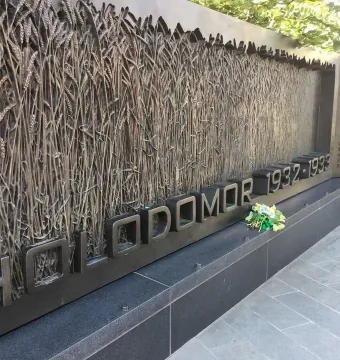
© NPS Photo · Public domain
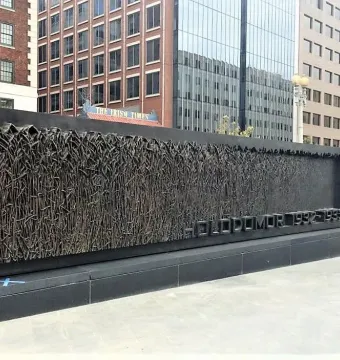
September 2015 © MaxHerz · CC BY-SA 4.0
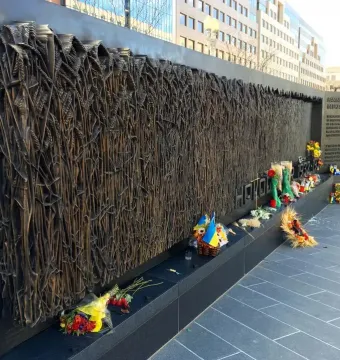
© https://www.flickr.com/photos/blakespot/ · CC BY 2.0
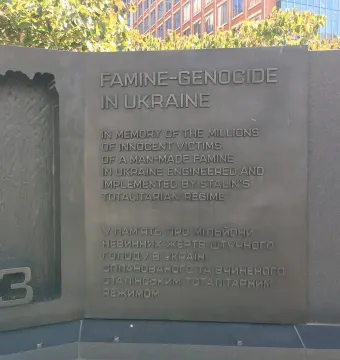
July 2017 © Geraldshields11 · CC BY-SA 4.0
September 2015 © MaxHerz · CC BY-SA 4.0
Identification | |
| Title | Holodomor Memorial to Victims of the Ukrainian Famine-Genocide of 1932–1933 |
| Subject | Victims of the Holodomor, the Ukrainian famine-genocide of 1932–1933 |
| Alternative name | Field of Wheat |
| Original name | Меморіал жертвам українського Голодомору-Геноциду 1932—1933 років |
| Short name | Holodomor Memorial |
| Type | Memorial sculpture / monument |
Historical context | |
| Purpose | To honor the victims of the Ukrainian famine-genocide of 1932–1933 and educate the American public |
| Background | Result of a long campaign by the Ukrainian community in the United States to have the Holodomor recognized as genocide |
| Historical context | Built amid renewed awareness of the Holodomor and political controversy over whether it should be recognized as genocide |
| Historical interpretation | Described as genocide of the Ukrainian people by more than ten countries, including Ukraine |
| Event commemorated | The mass famine in the Ukrainian SSR in 1932–1933, later officially called the Holodomor in independent Ukraine |
| Dedication | Millions of Ukrainians who were starved to death in the 20th century |
Creator | |
| Digital design / scanning by | Lawrence Welker Jr. using a laser 3D scanner |
| Construction company | Forrester Construction Co. |
| Bronze casting by | Laran Bronze, Pennsylvania |
| Architectural support | Hartman-Cox Architects |
| Designer significance | Largest work of her career |
| Designer nationality | American of Ukrainian descent |
| Designer | Larisa Kurylas |
Discovery and provenance | |
| Idea for the memorial | After the 2003 House statement, members of the Ukrainian Congress Committee of America proposed erecting a monument to all victims of the famine; the idea was supported by congressmen |
| Funding support | Supported by the Ukrainian-American community, private foundations, and the Government of Ukraine |
| Government funding allocation | US$2 million from the Government of Ukraine, decided on 12 August 2013 |
| Largest donation | US$2.5 million from businessman Dmytro Firtash through the Firtash Foundation |
| Funding | Built with funds from the state budget of Ukraine, private donations, the Ukrainian diaspora in the United States, and Dmytro Firtash (US$2.5 million) |
| Political controversy | The project was approved by the Government of Ukraine even though President Viktor Yanukovych, elected in 2010, did not recognize the famine as genocide |
| Political context | After the Orange Revolution, Yushchenko pursued a policy of reviving Ukrainian national patriotism and sought to draw greater international attention to the Holodomor |
| Government involved | Government of Ukraine |
| Resolution sponsor | A member of the House of Representatives from Michigan |
| Resolution introduction date | 2 February 2005 |
| U.S. Senate resolution | On 29 September 2006, the U.S. Senate unanimously passed Resolution No. 562 |
| Ukrainian president at the time | Viktor Yushchenko |
| U.S. House statement | In 2003, the U.S. House of Representatives called the famine "an intentional act of terror and mass murder" against the Ukrainian people committed by Soviet authorities |
| Official design approval | Approved in July 2012 by the U.S. Commission of Fine Arts and in September 2012 by the U.S. National Capital Planning Commission |
| U.S. commission conclusion | In 1988, the U.S. Commission on the Ukraine Famine concluded that the famine was caused by the Soviet authorities' seizure of the harvest |
| Decision to build | Approved in 2006 by U.S. President George W. Bush with support from congressmen |
| Congressional approval | U.S. Congress approved creation of the memorial in 2006 |
| Design competition | The winning design was selected in an open competition in 2009 |
| Concept selected in competition | In 2011, the Government of Ukraine held a competition and Kurylas's idea "Field of Wheat" won |
| Resolution content | Declared approval of a project to build a memorial on federal land in the District of Columbia in memory of the victims of the Ukrainian famine-genocide of 1932–1933 |
| Final planning approval | 24 September 2012, city planning commission final approval for construction |
| Government approval period | 2012; the project was successively approved by several authorities including the National Park Service |
| Construction permit issued | 3 October 2013 |
| Federal authorization law | On 13 October 2006, U.S. President George W. Bush signed a law authorizing the Government of Ukraine to place a memorial on federal land in Washington, D.C. |
| Related U.S. recognition effort | In 1983, the Ukrainian community in the United States began a campaign for U.S. congressional recognition of the 1932–1933 Holodomor as genocide, but it was unsuccessful |
Physical characteristics | |
| Principal sculptural element | A six-meter bronze wall of wheat |
| Site shape | A small triangular plot of land |
| Pedestal | The monument is located on a pedestal |
| Weight | 4 tons |
| Height | 2.5 meters (8 feet) |
| Size | 9 meters long |
| Length | 10 meters (30 feet) |
Materials | |
| Materials | Bronze; stainless steel bolts |
| Materials | Bronze bas-relief; black granite cladding; slate paving; bronze bench; trees with purple-purplish heart-shaped leaves |
| Additional material | Granite |
| Main material | Bronze |
Technique | |
| Artistic inspiration | Inspired by a work by Kyiv architect and graphic artist Vasyl Krychevsky, made in 1933, the year of the famine |
| Inspiration for the memorial | Larysa Kurylas was inspired by the works of Kyiv architect and graphic artist Vasyl Krychevsky from the early 20th century |
| Design process | Kurylas brought four sheaves of wheat from Canada and made digital photographs of the ears to create the realistic bronze wheat field |
| Design process | Wheat stalks personally collected by Kurylas on relatives' farm near Winnipeg, Manitoba, Canada, were 3D-scanned and converted by computer into a mold for the bronze relief |
| Fabrication method | Cast in bronze |
| Form | Bronze bas-relief |
Appearance | |
| West end feature | A garden with a bronze bench from which the entire monument is visible |
| Inscription language | Ukrainian and English |
| Inscription approval | According to The Washington Post, the Cabinet of Ministers of Ukraine approved the inscription |
| Inscription content | Expresses respect for the memory of the victims of the famine |
| Ukrainian inscription | У ПАМ’ЯТЬ ПРО МІЛЬЙОНИ НЕВИННИХ ЖЕРТВ ШТУЧНОГО ГОЛОДУ В УКРАЇНІ, СПЛАНОВАНОГО ТА ВЧИНЕНОГО СТАЛІНСЬКИМ ТОТАЛІТАРНИМ РЕЖИМОМ |
| English inscription | HOLODOMOR 1932—1933; FAMINE-GENOCIDE IN UKRAINE; IN MEMORY OF THE MILLIONS OF INNOCENT VICTIMS OF THE MANMADE FAMINE IN UKRAINE ENGINEERED AND IMPLEMENTED BY STALIN`S TOTALITARIAN REGIME |
| Inscription | "Holodomor 1932–1933. In memory of millions of innocent victims of the artificial famine in Ukraine, planned and carried out by the Stalinist totalitarian regime" |
| Paving effect | The slate paving imitates uneven furrows of barren plowed land, evoking the time of famine |
| Inscriptions | English and Ukrainian inscriptions |
| Rear background | Eight trees were planted behind the monument, creating a dark backdrop for the composition |
| Tree details | Eight trees with purple-purplish heart-shaped leaves |
| Back side design | Geometric pattern with motifs of Ukrainian folk embroidery |
| Visual motif | A realistic wheat field / bas relief of a wheat field |
| Style / visual effect | Progressive disappearance of the wheat ears from left to right |
| Design description | A field of wheat whose ears gradually disappear when viewed from left to right |
| Visual effect | The wheat ears gradually disappear toward the end of the composition |
| Main motif | A wheat field |
| Appearance | A massive bronze field of grain ears |
| Reverse side decoration | Decorated with motifs of Ukrainian folk embroidery |
Location and ownership | |
| Opening location | Center of Washington, D.C., United States |
| Site | Near a popular restaurant and adjacent to sidewalks |
| Site | A triangular plot of land near the U.S. Congress (the Capitol) and Union Station; federal land in the District of Columbia |
| Associated destination | Taras Shevchenko Memorial |
| Relative location | Diagonal to the Smithsonian's National Postal Museum and about one block from Union Station |
| Site | Near the U.S. Capitol and Union Station, on federal land in the District of Columbia, at the intersection of North Capitol Street, Massachusetts Avenue, and F Street NW |
| Location | Washington, D.C., United States |
| Specific location | Near the United States Capitol building at the intersection of North Capitol Street, Massachusetts Avenue, and F Street N.W. |
History and restoration | |
| Petro Poroshenko's first visit | 31 March 2016, during an official visit to the United States |
| Closing hymn | Prayer for Ukraine |
| Associated exhibition | An exhibition devoted to the famine events opened at Union Station as part of the opening events |
| Associated religious services | Services were held in Ukrainian Orthodox and Greek Catholic churches |
| Associated concert | A concert by Ukrainian and American artists was held at the George Washington University area/venue |
| Public engagement | A site tour for the public was held on 9 May 2015 as part of a program |
| Political reaction | Some Russian media criticized the opening as a "political show" and reduced the reported attendance to about one hundred people |
| Poroshenko's statement about the memorial | He said that the memory of the Holodomor unites the entire civilized world and makes Ukrainians stronger |
| Reason given for absence from opening | He said he had not attended the opening because of events in Ukraine |
| Petro Poroshenko's second visit | 20 June 2017 |
| Purpose of second visit | He began his official U.S. visit by honoring the victims of the famine and meeting the Ukrainian community |
| Meetings during second visit | He met with Speaker of the House Paul Ryan and Nancy Pelosi |
| Call made during second visit | He urged Congress to recognize the famine as genocide of the Ukrainian people |
| Related legislative action | On 22 May 2017, the relevant decision was adopted |
| Visit by Ukrainian foreign minister | Pavlo Klimkin visited the memorial on 16 October 2015 during a trip to Washington |
| Sponsor's letter read | A letter from principal sponsor Dmytro Firtash was read |
| Additional speakers and participants | Ukrainian Ambassador to the United States Valeriy Chaly, Deputy Head of the Presidential Administration Rostyslav Pavlenko, Institute of National Memory Director Volodymyr Viatrovych, Ukrainian Holodomor recognition campaign chair Mykhailo Savkiv, project author Larysa Kurylas, World Congress of Ukrainians President Eugene Czolij, Ukrainian Congress Committee of America President Tamara Olexy, famine witnesses, cultural figures, and public figures |
| Speech by | Lord Risby, chairman of the British-Ukrainian Society |
| Opening ceremony date | 7 November 2015 |
| Other congratulatory messages | Messages were read or conveyed from Hillary Clinton, Jeb Bush, Marco Rubio, and representatives from New Jersey and Pennsylvania |
| Construction start | 2014 |
| Completion of installation | 4 August 2015 |
| Groundbreaking ceremony date | 4 December 2013 |
| Blessing ceremony for future memorial site | 2 December 2008 |
| Opening date | 7 November 2015 |
| Construction period | 2014–2015 |
| Opening ceremony attendance | More than five thousand Canadian and American Ukrainians, plus several Ukrainian soldiers receiving treatment at the Walter Reed National Military Medical Center |
| Religious blessing at opening | The memorial was consecrated and blessed by Patriarch Filaret (Denysenko) of the Ukrainian Orthodox Church – Kyiv Patriarchate and Archbishop Sviatoslav (Shevchuk) of the Ukrainian Greek Catholic Church |
| Other clergy present at consecration | Patriarch Antony (Shcherba) of the Ukrainian Orthodox Church of the USA, Bishop Daniel (Zelinsky) of the Ukrainian Orthodox Church in the USA, Metropolitan Stefan (Soroka) of the Philadelphia Archeparchy of the Ukrainian Greek Catholic Church, and other Orthodox and Greek Catholic clergy |
| Speakers at opening ceremony | Maryna Poroshenko, Ukrainian and American officials, diplomatic corps representatives, Rep. Sander Levin, Marcy Kaptur, a special assistant to the U.S. president and senior director for Europe, Russia, and Central Asia at the National Security Council, and a regional director of the National Park Service |
| Presidential video address at opening | Ukrainian President Petro Poroshenko delivered a video address from the Holodomor memorial on St. Michael's Square in Kyiv |
| Other video messages shown at opening | U.S. President Barack Obama; Senators Chuck Schumer and Rob Portman |
| Read message from | Former U.S. President George W. Bush Jr. was represented by Paul Dobransky reading his message |
| Participants at opening | President of Ukraine Petro Poroshenko (via video address), his wife Maryna Poroshenko (present in person), U.S. government officials, and representatives of the diplomatic corps |
Significance | |
| Nearby reference monument | Goddess of Democracy |
| Visitor context | Located by a central station through which millions of people enter the U.S. capital every year; intended to help more Americans learn about the Holodomor |
| Historical context | Described as the second monument in Washington devoted to the memory of victims of 20th-century communist regimes |
| Attraction for delegations | The monument became an additional place of attraction for Ukrainian delegations heading to the Taras Shevchenko Memorial |
| Critical interpretation | An architectural critic and Pulitzer Prize winner said Washington was becoming a collection of small monuments sponsored by foreign groups and governments, raising questions about memorials and their relation to American history |
| Design significance | One of three monuments in Washington, D.C. designed or co-designed by women; the others are the Vietnam Veterans Memorial and the National 9/11 Pentagon Memorial |
Other | |
| Opened by | Marina Poroshenko, First Lady of Ukraine |
| Design competition | The winning design was selected in an open competition in 2009 |
| Notable visitors at completion ceremony | Valeriy Chaly, Larisa Kurylas, Mykhailo Savkiv, M. Catherine Lancellotta, representatives of Forrester Construction Co. and Laran Bronze |
| Symbolic statement by Firtash | He said the memorial would be a symbol of hope and evidence that Ukrainians worldwide can look to the future with optimism and renewed faith |
| Statement by Valeriy Chaly | He said the monument's installation was especially relevant in light of the war in eastern Ukraine and hoped it would draw more attention in Washington to the Ukrainian people |
| Statement by Tamara Oleksi | She called the opening very significant for the Ukrainian people and the result of several years of hard work |
| Statement by Mykhailo Savkiv | He said the monument in Washington would help ordinary Americans better understand the Holodomor and teach future generations about the tragedy of 1932–33 |
| Relation to Robert Conquest | A day before installation, Robert Conquest died; his book The Harvest of Sorrow was noted as a major work that helped reveal the crimes of Stalinism to the world |
| Site shape | A small triangular plot of land |
| Proximity and setting | Located near a busy railway station that receives hundreds of thousands of people in Washington every day; intended to help more Americans learn about the Holodomor |