
Bocca della Verità
Bocca della Verità is an ancient marble mask of pavonazzetto marble placed in the wall of the pronaos of the Church of Santa Maria in Cosmedin in Rome. It is about 1.75 meters in diameter and shows a bearded male face with perforated, hollow eyes, nose, and mouth. Its original meaning and function are uncertain: it may have represented Neptune, and it may once have served as a fountain, a compluvium outlet, or even a sewer opening. The sculpture became famous through medieval and later legends about truth-telling and ordeals, and it has long been one of Rome’s curiosities.
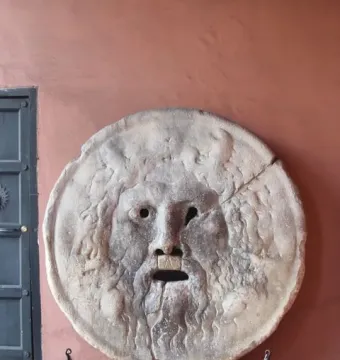
September 2020 © Fallaner · CC BY-SA 4.0
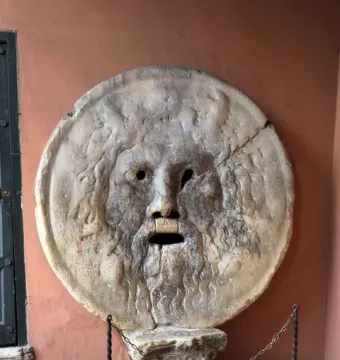
October 2025 © Falk2 · CC BY-SA 4.0
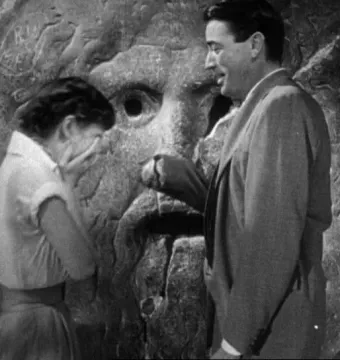
1953 © https://web.archive.org/web/20080321033709/http://www.sabucat.com/?pg=copyright · Public domain
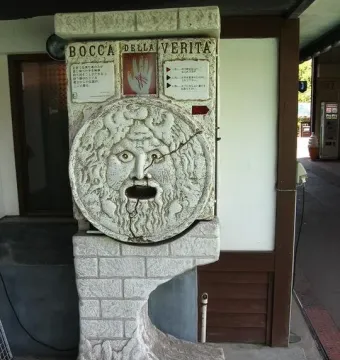
© キッコーマソ · CC BY 3.0
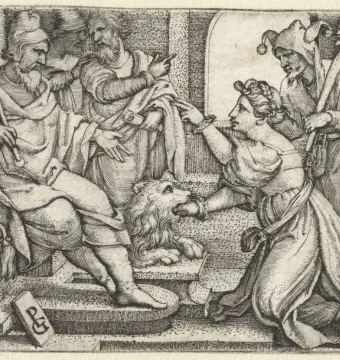
© Rijksmuseum · CC0
Identification | |
| Title | Bocca della Verità |
| Names | The Mouth of Truth; La Boca de la verdad; A Boca da Verdade; Вуста правди |
| Type | Ancient Roman marble mask relief (mascherone) |
Historical context | |
| Date | Unknown; some sources leave the date incomplete, while one fragment dates it to the 4th century BC |
Creator | |
| Attribution | Unknown |
Materials | |
| Material | Pavonazzetto marble (also called Phrygian marble; marble from Dokimeion in Phrygia, now the Phrygian Valley near İscehisar) |
Physical characteristics | |
| Form | Round stone disc / mask-like medallion |
| Size | About 1.75 m in diameter; 19 cm thick |
| Weight | About 1,200–1,300 kg |
| Condition | Very worn and heavily eroded |
| Features | Bearded male face with drilled, hollow eyes, nostrils, and mouth; five holes through the disc, including two for the eyes, one for the mouth, two for the nostrils, and two mounting holes at the sides |
| Decorative detail | Two crab claws are present among the hair |
Iconography and meaning | |
| Depicted figure | Uncertain; proposed identifications include Oceanus, Triton, Pontus, Neptune, Jupiter Ammon, a faun, or a deity associated with the sea |
| Interpretation | The crab claws among the hair have been taken as evidence that the figure is a sea god |
Discovery and provenance | |
| Removal and relocation | Probably removed from the temple in the 13th century and later moved to Santa Maria in Cosmedin; in 1631–1632 it was placed inside the church portico by order of Pope Urban VIII Barberini |
| Ancient context | The temple had an oculus like the Pantheon, so rain could enter inside |
| Temple context | Associated with the nearby Temple of Hercules Victor / Temple of Hercules in the Forum Boarium |
| Original function | Uncertain; proposed uses include a fountain face, part of a fountain, an impluvium or compluvium outlet, a drain cover, a sewer manhole cover, or a cover for a water drain at the nearby Temple of Hercules Victor |
| Alternative use | One theory says cattle merchants used it to drain the blood of cattle sacrificed to Hercules |
Location and ownership | |
| Current location | Against the left wall of the portico / pronaos of the Church of Santa Maria in Cosmedin, Rome, Italy, at Piazza della Bocca della Verità on the Forum Boarium site |
| Current placement | Set vertically into the wall |
History and restoration | |
| Church context | Santa Maria in Cosmedin was built over an ancient temple of Hercules in Rome |
| Church wall setting date | 1632 |
Significance | |
| Popular use | It continues to attract many visitors who insert their hands into the mouth |
| Literary references | José Marzo's historical novel La boca de la verdad; Robert Silverberg's novella Nightwings; a work by Rindert Kromhout; Lucas van Leyden's Power of Women woodcut series; a related drawing by Albrecht Altdorfer and Renaissance paintings by Lucas Cranach the Elder |
| Film association | Roman Holiday made the sculpture internationally famous; the scene with Audrey Hepburn and Gregory Peck uses the legend as a test of fidelity |
| Film appearances | Roman Holiday (1953); Only You (1994); Sleeping Bride (2000) |
| Legend | Since the Middle Ages it has been believed to bite off the hand of a liar who places a hand in its mouth, or anyone who lies with their hand inside it; it was also used in stories about unfaithful wives and husbands |
| Later fame | From 1485 on, it was frequently mentioned among the curiosities of Rome and reproduced in drawings, prints, postcards, and sculptures |
| Name history | The name 'Bocca della Verità' appears in 1485 |
| Literary and legendary associations | A 12th-century German text links it to Julian the Apostate, with the devil posing as Mercury; later medieval legends also attributed its making to Virgil Maro Grammaticus |
| Medieval mention | Presumed to be the object mentioned in the 11th-century Mirabilia Urbis Romae, where it was said to pronounce oracles |
| Reputation | An ancient and legendary curiosity of Rome |
Other | |
| Related objects and reproductions | There are replicas and derivative works, including a full-size reproduction at Alta Vista Gardens in California, a sculpture by Jules Blanchard in Paris's Luxembourg Garden, and coin-operated fortune teller machines inspired by the Mouth of Truth, including one in the Musée Mécanique in San Francisco |