
Parabiago Plate
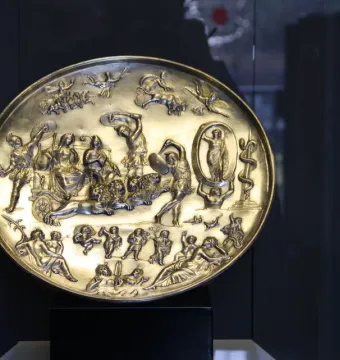
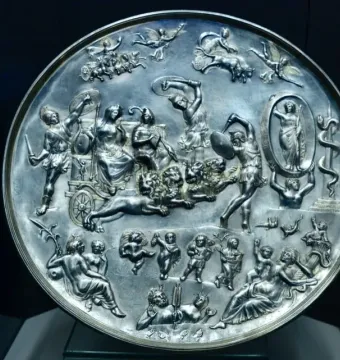
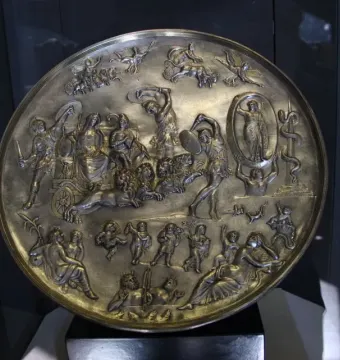
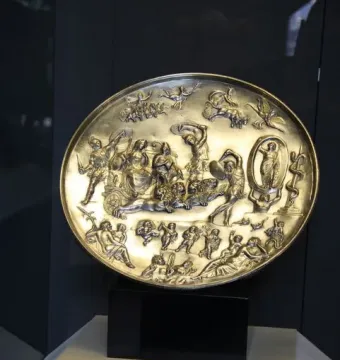
The Parabiago plate, also known as the Parabiago patera, is an ancient Roman circular silver plate depicting mythological figures. It was found in an ancient Roman cemetery at Parabiago, near Milan, in 1907, and is now in the Archaeological Museum of Milan. The plate shows Cybele with her consort Attis in a vast cosmic setting with the sun, moon, earth, sea, time, and the seasons. At the time of its discovery, it was thought to have been used as a lid for a funerary amphora. Its date remains uncertain: earlier scholars favored the 2nd century CE, while technical analyses suggest a 4th–5th century provenance.
March 2012 © Giovanni Dall'Orto · Attribution
October 2016 © ManuelaVitale · CC BY-SA 4.0
March 2012 © Giovanni Dall'Orto · Attribution
March 2012 © Giovanni Dall'Orto · Attribution
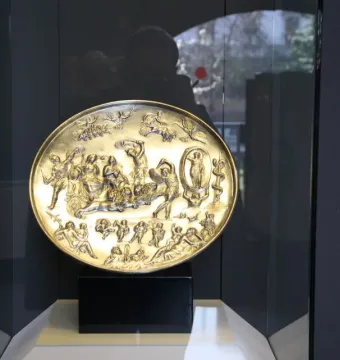
March 2012 © Giovanni Dall'Orto · Attribution
Identification | |
| Title | Parabiago plate |
| Type | Roman silver patera/plate |
| Alternative names | Parabiago patera; patera di Parabiago; Pátera de Parabiago |
Historical context | |
| Culture/period | Ancient Roman; Roman Empire |
| Date | Mid-4th century, probably the second half of the 4th century; some earlier scholarship dated it to the 2nd century CE, while technical analyses suggested the 4th–5th centuries |
| Patronage context | Probably commissioned by an educated member of the pagan aristocracy; associated with the pagan neoplatonic revival and the reign of Emperor Julian (360–363 AD) |
Creator | |
| Maker | Roman goldsmiths; possibly made within Roman craftsmanship of the period |
Discovery and provenance | |
| Discovery date | 1907 |
| Discovery place | An ancient Roman cemetery at Parabiago, Province of Milan, Lombardy, Italy, during excavation of the foundations of Villa Gajo owned by Senator Felice Gajo |
| Original find context | Found as a cover for a cremation urn, a sawn amphora containing grave goods |
| Early interpretation of use | Thought at discovery to have been used as a lid for a funerary amphora |
| Post-discovery history | Kept in the discoverer's house for several years, entered the possession of the Sovraintendenza in 1929, and was later deposited in the Civic Archaeological Museum of Milan |
Location and ownership | |
| Original/related historical context | The object later reached the Milan area; scholars have compared its context with the reign of Eugenius (392–394 AD) and with the time of Ambrose, when celebrations of Cybele are attested |
| Current location | Civic Archaeological Museum of Milan |
Physical characteristics | |
| Diameter | About 39 cm |
| Weight | About 3.5 kg |
Materials | |
| Primary material | Silver |
| Surface treatment | Partial mercury gilding; former vermeil highlights |
Technique | |
| Manufacturing technique | Lost-wax casting, chased decoration, and engraving |
Appearance | |
| Overall description | A high-value ritual plate with an allegorical, mythological and cosmological scene |
| Main scene | Cybele and Attis triumph in a chariot drawn by four lions |
| Cybele depiction | Seated on the lion-drawn chariot, wearing an embroidered tunic, mural crown, and Phrygian cap, holding a scepter and a shield, and leaning on a tympanum |
| Attis depiction | Young companion of Cybele, wearing a Phrygian cap, holding a curved shepherd's staff (pedum) and a syrinx |
| Accompanying figures | Three Corybantes dancing and striking shields decorated with stars |
| Upper register | Helios and Selene in sun and moon chariots; Phosphoros and Hesperos with torches |
| Middle register | Aion, symbol of eternal time, supported by Atlas and surrounded by the Zodiac; below are a grasshopper or cricket, a lizard, and an obelisk entwined by a serpent |
| Lower register | Four putti representing the seasons, plus a river deity with a nymph, Oceanus and Tethys emerging from the waters, and Tellus with a cornucopia, serpent, and two putti |
Iconography and meaning | |
| Meaning | The imagery refers to Cybele and Attis as guarantors of cosmic order, cyclical renewal, life, and prosperity; it has strong cosmological and religious-philosophical significance and may allude to a theatrical performance or the Hilaria festival procession |
| Religious context | Associated with the cult of Cybele and the continuation of pagan cult in late-imperial Milan; the cult is also documented in the Milan area by epigraphic evidence |
History and restoration | |
| Use traces | Traces of use survive on parts of the object, supporting a practical sacrificial or ritual function rather than merely display |
Significance | |
| Historical significance | Important for the history of late-imperial Milan; it reflects pagan worship, the wealth of suburban villas, and the quality of luxury craftsmanship in the period |