
Rape of the Sabine Women
Rape of the Sabine Women is a monumental sculptural group by Giambologna, created for the Medici court and displayed in Florence’s Loggia dei Lanzi at Piazza della Signoria. More than 410 cm high, it shows a young man lifting a young woman above his head while an older figure crouches between his legs, which is why it is also called the Three Ages of Man. The base includes a bronze plaque with a relief scene of the abduction. Designed to be viewed from multiple angles, it became part of an open-air museum together with other works such as Cellini’s Perseus. The sculpture has undergone restoration and monitoring, with further relocation from the Loggia under consideration because of environmental damage and deterioration.
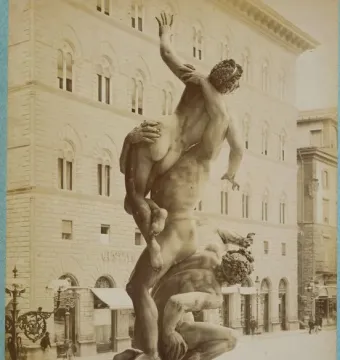
© Rijksmuseum · CC0
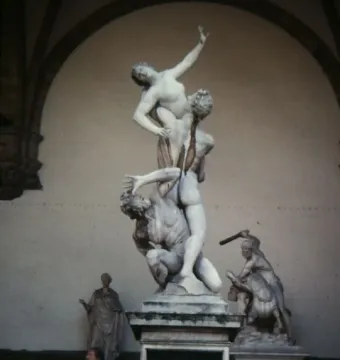
June 2000 © Gary Todd · CC0
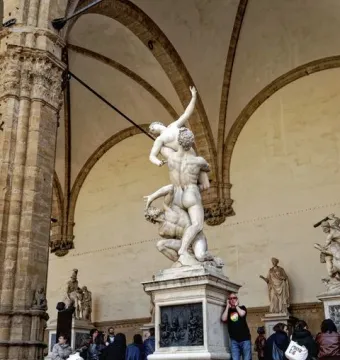
April 2010 © Txllxt TxllxT · CC BY-SA 4.0
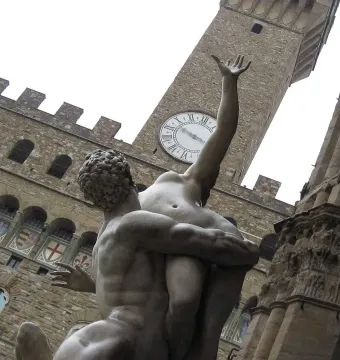
May 2009 © Muhranoff · CC BY-SA 3.0

January 2017 © Postnaif · CC BY-SA 4.0
Identification | |
| Title | Rape of the Sabine Women |
| Type | Marble sculptural group |
| Alternative titles | Porwanie Sabinek; The Three Ages of Man; The Three Ages of Human Life; The Rape of the Sabine; Abduction of a Sabine Woman; The Rape of the Sabine; The Rape of the Sabines; La Rappia delle Sabine |
| Original-language titles | Porwanie Sabinek; "Похищение сабинянки"; "Викрадення сабінянок" |
Creator | |
| Artist | Giambologna (Jean de Boulogne, Jean de Boulogne, called il Giambologna, Johannes of Boulogne) |
| Artist origin | Flemish; Florentine sculptor |
| Assistant | Pietro Francavilla |
| Movement | Mannerism |
| Artist's background | Trained in his home country with Jacques du Broeucq; traveled to and remained in Italy, where he made most of his sculptures |
| Artistic influences | Inspired by Michelangelo |
Historical context | |
| Letter date | 1579 |
| Interpretation | Can be understood as a metaphor for love and the struggle for it; also presented as a political allegory |
| Mythological subject | A scene from the Roman legend of the abduction of the Sabine women by the Romans (the Sabine War) |
| Historical basis of title | Based on the classical Roman term raptio, meaning roughly mass kidnap rather than the modern English meaning |
| Reputation | Often considered Giambologna's masterpiece; considered a classic example of Mannerist sculpture |
| Career significance | Helped establish Giambologna's career and reputation; he later produced many works for the Medici |
| Reproduction history | Later reproduced many times in small format and became sought-after by collectors |
| Contemporary naming conclusion | Contemporary scholars concluded that Rape of the Sabine Women was the most suitable title |
| Study date | 1579 |
| Suggested titles | Vincenzo Borghini suggested La Rappia delle Sabine (The Plunder of the Sabine Maidens) and The Rape of the Sabines |
| Completion and naming | It was not given a title until after it was completed; Giambologna usually named his works late in their completion |
| Original intent | Originally intended only to demonstrate the artist's ability to compose a complex sculptural group |
| Reason for creation | To demonstrate Giambologna's virtuosity and ability to compose a difficult monumental marble group |
| Patronage context | Made for Giambologna as court sculptor of the Medici family; created to impress the Medici and to silence critics who doubted his ability to carve monumental marble sculpture |
| Commissioned by | The Medici court; Francesco I de' Medici, Grand Duke of Tuscany |
| Date of creation | 1574–1580 |
| Completion date | 1582 |
Physical characteristics | |
| Pedestal | Marble pedestal with bronze reliefs |
| Emotional character | The figures appear choreographed and balanced, but lack genuine pathos or naturalness of pose |
| Iconography | Sparse iconography with no accessories or conventional symbols |
| Stylistic features | Figura serpentinata; perfect anatomy; Hellenistic references; contrasting compositional lines |
| Base inset | A bronze plaque showing the abduction scene, with repeated figure combinations at different sizes and relief depths |
| Composition | Figures twisted into a spiral within a conical volume; a multi-figure composition designed to be viewed from multiple points |
| Later version | A larger marble group with three intertwined figures |
| Figure arrangement | A young man in the centre has taken a woman from the despairing older man below him |
| Height | Over 410 cm |
| Depicted arrangement | A young man lifts a woman above his head while an old man crouches or lies below him |
| Figures depicted | A Roman man, a Sabine woman, and a Sabine man |
| Number of figures | Three human figures |
| First version | A bronze group with two figures |
Materials | |
| Bronze elements | Bronze reliefs on the pedestal |
| Significance of marble block | Believed to be the largest block ever delivered to Florence |
| Primary material | White marble |
| Block | Carved from a single solid block of white marble |
Technique | |
| Carving technique | Carved from a single marble block; Giambologna deliberately pursued a classical all-from-one-block technique |
| Technical significance | Created as a technical tour de force in competition with the belief that classical sculptors could carve large figures from single marble blocks |
| Compositional innovation | First three-figure composition in Western European sculpture designed to be viewed from multiple points of view |
| Medium precedent | Such large-scale all-round compositions had previously been made only in bronze and at a much smaller size |
| Artistic aim | To demonstrate virtuosity and be effective from all sides, not only from one viewpoint |
| Working method | The marble group was based on a bronze model |
| Model and versions | The original clay model is preserved in the Galleria dell'Accademia; two small wax models are in the Victoria and Albert Museum; the first bronze version is in the Museo Nazionale di Capodimonte, Naples; a full-size plaster cast is in the Galleria dell'Accademia, Florence |
Location and ownership | |
| Replacement of previous sculpture | Judith was moved near Palazzo Vecchio in 1583 because of its symbolic meaning, history, and smaller scale relative to the Loggia arches |
| Installed location wording | Loggia della Signoria, also known as the Loggia dei Lanzi, Florence |
| Public display purpose | Installed to turn the Loggia from a space of republican government representation into an open-air museum |
| Installation date | 1583; January 1583; August 1582 |
| Original placement | The bronze Judith by Donatello originally stood in its place |
| Part of | The grand ducal furnishing of the Loggia dei Lanzi |
| Current location | Loggia dei Lanzi, Piazza della Signoria, Florence |
History and restoration | |
| Current safety concern | Relocation would leave a serious void in the scenography of Piazza della Signoria and experts were reluctant to replace it with a copy |
| Relocation outcome | A final decision in 2008 proposed moving the work to the Galleria dell'Accademia and placing a copy in the outdoor location |
| Proposed display after relocation | It could be exhibited together with the plaster copy or in its place at the Galleria dell'Accademia |
| Proposed relocation | To the Galleria dell'Accademia or Palazzo Vecchio; a virtual museum under the arcades was also considered |
| 2008 assessment | A study cycle completed in 2008 concluded, almost unanimously, that the work should be moved to a museum setting |
| Monitoring | Its conservation conditions have been monitored since 2001 |
| Restoration | Restored in 2001 |
| Vandalism incident | In 1987 drunk people climbed it and damaged it while placing a bottle in the young woman's hand |
| Specific damage | In 2007 signs of atmospheric degradation appeared despite a protective coating |
| Conservation history | The sculpture required repeated conservation treatments because of environmental exposure, vandalism, smog, and deterioration of the marble |
Significance | |
| Assessment | Recognized masterpiece of Giambologna; classic example of Mannerist sculpture; great marble sculpture; great masterpiece |
| Reception | Viewed as an experiment in form rather than content and as a compositional exercise; admired for proportion and thoughtful design but criticized for lack of true emotional meaning and naturalness |
| Influence | Giambologna had great influence on contemporaries and later artists in Italy and Northern Europe, including Adriaen de Vries, Hubert Gerhard, Han Reichle, Pierre Puget, and Gian Lorenzo Bernini |
| Related works | Victory of Florence over Pisa; Samson and the Philistine; Equestrian Statue of Cosimo I de' Medici; Hercules and the Centaur Nessus; Donatello's Judith and Holofernes |