
Equestrian Monument of Cosimo I
The Equestrian Monument of Cosimo I is a work by Giambologna in Piazza della Signoria, Florence. Commissioned in 1587 by Ferdinando I de’ Medici, it was meant to honor Cosimo I de’ Medici, the first Grand Duke of Tuscany, who had died fifteen years earlier. The bronze horse was cast in one piece and was ready by 1591; the monument was completed in 1594 with the figure of the Grand Duke and a marble pedestal. The base includes three reliefs showing major episodes of his life, along with Latin inscriptions and the Capricorn symbol from Cosimo’s arms. The sculpture became a celebrated model for later equestrian monuments.
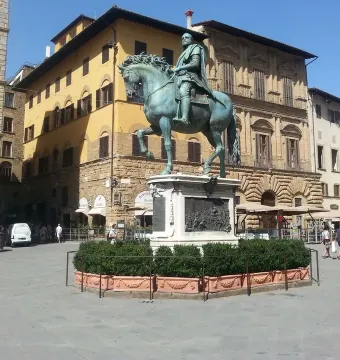
August 2013 © Avisadehh · CC BY-SA 4.0
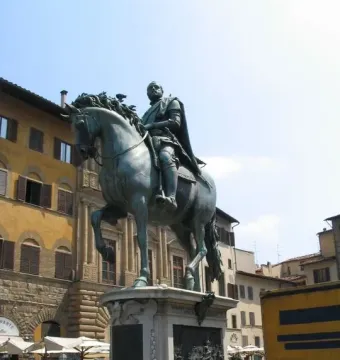
July 2004 © andrew bishop · CC BY 2.0
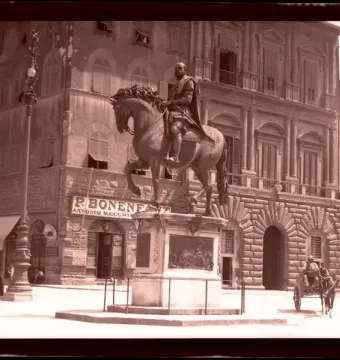
© Edmund F. Arras · Public domain
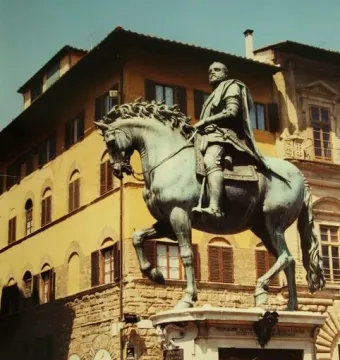
June 2000 © Gary Todd · CC0
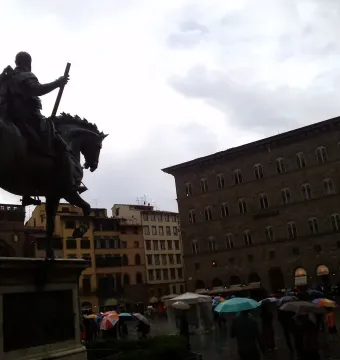
May 2017 © TeraGood · CC BY 3.0
Identification | |
| Title | Equestrian Monument of Cosimo I |
| Original-language name | Statua equestre di Cosimo I de' Medici |
| Type | Bronze equestrian statue |
| Subject | Cosimo I de' Medici |
Creator | |
| Artist | Giambologna |
Historical context | |
| Commissioned by | Ferdinand I de' Medici |
| Commission date | 1587 |
| Purpose of commission | To honor Cosimo I, first Grand Duke of Tuscany, fifteen years after his death |
| Depiction | Cosimo I as Grand Duke of Tuscany on horseback |
Location and ownership | |
| Current location | Piazza della Signoria, Florence, Italy |
| Adjacent monument | The Fountain of Neptune by Bartolomeo Ammannati, commissioned by Cosimo I |
| Placement within setting | At the north corner of the Palazzo Vecchio, the northernmost statue in the row |
Physical characteristics | |
| Pedestal decoration | Three marble reliefs with explanatory Latin cartouches |
| Completion date | 1594 |
| Horse completion | 1591 |
| Weight | The combined weight of the horse and rider was 23,000 pounds |
| Horse posture | Advancing at a trot with the right foreleg raised |
| Rider attributes | Armor, military baton, and a sheathed sword |
Materials | |
| Pedestal material | Marble |
| Main material | Bronze |
Technique | |
| Casting method | The horse was cast in a single pour; some sources say the man and horse were cast separately |
| Fabrication | A special foundry was required for the work |
Iconography and meaning | |
| Horse breed | Neapolitan horse, according to the testimony of Ludwig Anhalt-Köthen after his 1598 visit to Florence |
| Model or influence | Inspired by Donatello's Gattamelata in Padua and Andrea del Verrocchio's Bartolomeo Colleoni in Venice, with the horse's head modeled on an Etruscan horse sculpture from the Medici collections now in the National Archaeological Museum of Florence |
| Inscription | A bronze Latin inscription on the east side celebrates the Grand Duke's achievements |
| Meaning of symbols | They symbolize virility, magnificence, and leadership |
| Pedestal symbols | Capricorn emblems from Cosimo I's coat of arms |
| Relief subjects | The election as duke in 1537, the conquest of Siena in 1555, and the conferral of the title of Grand Duke in 1569 |
Significance | |
| Reception | The statue became very famous and was immediately very successful |
| Importance | Described as the first major equestrian sculpture achieved in Florence |
| Influence | Giambologna later received many similar equestrian commissions, and the work influenced later monuments including those to Henry IV of France and Philip III and Philip IV of Spain |
| Copies | Numerous reduced-size copies were made |
| Iconic status | It became an iconic image of the 'perfect monarch' in the age of absolutism |
Other | |
| Artistic tradition | Classical Roman tradition of equestrian statues as monuments to sovereign power |